
NAFTA Rewrite Could Warp Automakers' Supply Chains, Increase Prices
Trump's new United States Mexico Canada Agreement mostly maintains the NAFTA status quo, but it sets new mandates for cars made in Mexico and Canada.
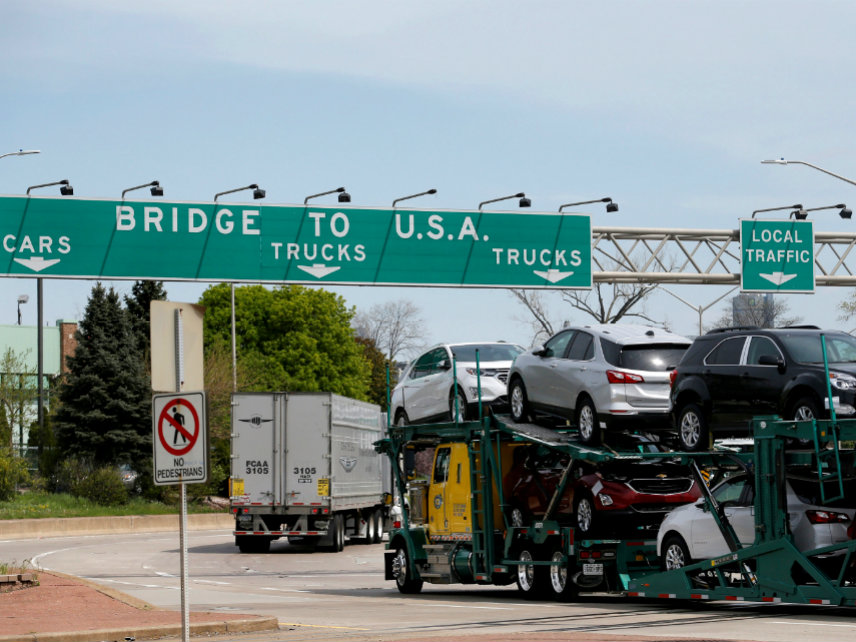
Officials from the United States, Mexico, and Canada inked a rewrite of the North American Free Trade Agreement (NAFTA) last night. President Donald Trump today touted the results as "one of the greatest deals" ever made—a sharp contrast with his years of criticism of the old NAFTA. But while the new agreement makes significant changes to how cars and trucks can pass across borders tariff-free, it otherwise amounts to a cosmetic overhual of the 24-year-old trade deal.
One of those cosmetic changes—an apparently important one for Trump, based on his Twitter feed—is a new name for the agreement. Going foward, it will be known as the United States Mexico Canada Agreement (USMCA). Congress will have 60 days to review the new agreement before holding an up-or-down vote on it.
In the new deal, the United States has the power to put tariffs on cars imported from Canada and Mexico, although the first 2.6 million automobile imports would be tariff-free. And beginning in 2020, when the USMCA is supposed to take effect, cars and trucks must have 75 percent of their component parts manufactured in North America in order to move across borders tariff-free. That's a significant increase from the 62.5 percent threshold required under NAFTA.
Another new rule requires that auto workers in all three countries must earn at least $16 per hour—about three times as much as the typical Mexico automaker now earns, according to The Washington Post's Heather Long. While that rule is meant to protect American automaking jobs from being shifted south of the border in search of cheaper labor, it also amounts to a continent-wide minimum wage that will discourage automakers from building cars in North America.
Under current World Trade Organization rates, the United States does not impose auto tariffs of more than 2.5 percent (although light trucks are subject to higher tariffs). That means it may end up being cheaper for carmakers to build overseas, ship cars into the United States, and pay the tariff rather than paying the higher wages to North American workers.
"I think this creates a weird incentive," says Clark Packard, a trade policy analyst at the R Street Institute. "Companies could instead just forgo duty-free trading under USMCA and instead pay the 2.5 percent WTO rate to ship into the United States."
The so-called "rules of origin" requirements and the new wage mandates might undercut the Mexican auto industry. The Mexican government estimates that about 30 percent of cars currently made there would not meet the new requirements.
It may also give the Trump administration reason to pursue higher tariffs against imported cars. If automakers respond to the new deal by choosing to build more cars overseas and simply pay the 2.5 percent tariff, Trump may try to raise that tariff to bully those same automakers back into the North American labor market, warns Chad Bown, an analyst from the Peterson Institute for International Economics, a trade think tank.
Either way, American consumers will likely end up paying higher prices for new cars.
"Tighter rules of origin, potentially combined with import restrictions on nonconforming autos, would mean higher consumer prices for Mexican or American-made cars," Bown wrote last month after the new rules of orgin requirement were unveiled. "Such a price increase would trigger a natural incentive for Americans to switch to relatively cheaper cars assembled outside of the region that are not subject to Trump's costly new regulations."
The deal does not remove steel and aluminum tariffs on imports from Canada and Mexico. At a press conference today, Trump said those tariffs would be part of future discussions between the three nations.
The best part of the USMCA may be the fact that it exists at all. After entering office with a promise to tear up NAFTA, Trump has seemingly been convinced of the agreement's value. Tariffs and automaking regulations aside, the new agreement will keep the economies of the U.S., Canada, and Mexico linked. That's undeniably a good thing. Since NAFTA was inked in 1994, U.S. exports have tripled and the total value of goods traded between NAFTA partners has jumped from $293 billion in 1993 to about $1.1 trillion in 2016, according to the Congressional Research Service.
There's still a ways to go before this rewrite of the three-way deal is finalized. Nothing will be finished until after the midterm elections, though reaching a deal on Sunday night does allow the USMCA to be wrapped before Mexico's government changes hands on December 1.
The bottom line? It's marginally worse than NAFTA, but it mostly retains the status quo. "We spent a lot of time and political capital," says Packard, "to essentially tinker around the edges."
