Brian Doherty | March 6, 2009
SPOILER WARNING: This article contains significant plot and denouement revelations regarding the graphic novel and movie Watchmen.
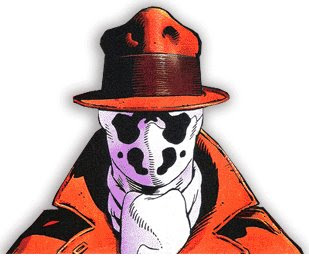
The moral center of Watchmen, both the original graphic novel by Alan Moore and Dave Gibbons and the new, much-discussed movie based on it premiering today, is a curious and prickly masked vigilante who goes by the name Rorschach.
The surface meaning of the name is visually obvious—his mask contains swirling black blots on white that remind one of the psychological testing mechanism. But applied to his character, the name is both appropriate and ironic.
It’s appropriate in that the character is obsessed with stark duality—black and white—and ironic in that the mushy “it’s whatever you see” vagueness opposes his very definite vision of what’s what in the world: There are good guys and bad guys, and the bad guys deserve to get it, good and hard. Rorschach’s mission, from which he will not diverge, is to give it to them, no matter what the demands of law, government, or social mores. He lives by his objective understanding of right and wrong.
In the original conception of the comic book Watchmen, the characters were going to be old Charlton Comics second-string superheroes that D.C. Comics had won the rights to. In that conception, the Rorschach character would have been The Question—a character created by Steve Ditko, co-creator of Spider-Man.
Ditko was a huge fan of Ayn Rand and Objectivism. After getting out from under Stan Lee’s thumb at Marvel Comics he decided to let his Rand flag fly, first with Charlton’s Question and later in his self-published “Mr. A.” That’s A as in, A is A, the essential statement of Randian Aristotelianism. Reality is what it is, Rand held, and an objective set of moral imperatives follow from that. Thus, Rorschach is Moore's vision of an Objectivist superhero.
Ditko's Mr. A is far more dispassionate than Rorschach—he’s a purer representation of a perfect Objectivist as opposed to what a real one might actually be like. (And unlike Rorschach, he doesn’t work in the slightest as an actual believable character one could care about.) When Mr. A refuses to save a kidnapper dangling above certain death, he informs the little girl (who Mr. A succeeds in rescuing, unlike the kidnapped girl central to Rorschach’s character arc, who ends up food for vicious dogs) that “I won’t help anyone who believes he has a right to hurt you!...I only care what happens to the innocent and the good people! I treat people the way they act toward human life! I grant them what their action (sic) deserve, have earned!”
Both Rorschach and Watchmen’s villain (who I’ll avoid naming, for slight spoiler protection purposes) are willing to kill in the name of what they think is a higher good. Indeed, given Rorschach’s contempt for what he sees as the moral stink of the Watchmen world, it's easy to imagine that he might have been willing to accept that each and every person killed in the movie’s central scheme might have actually deserved it (as Rand did in a smaller-scale disaster; Atlas Shrugged’s train wreck scene).
But Rorschach would deliver that as a personal, individual judgment—breaking what bones needed to be broken with his own hands—not from a world away with indiscriminate techno-gimmicks and no sense of actual individual guilt. The opposition between Rorschach and the villain is easy to read as that of individual, true justice versus the state’s collectivist version. In every single war ever waged, governments make the kind of moral judgment that Watchmen’s villain does, and the movie and comic, with Rorschach’s help, make us wonder whether those decisions that governments—and superheroes—often make really are tolerable. Rand would have been proud.
When you think of Rand’s aesthetic, it seems appropriate somehow that Rand should have invented the superhero. If the idea of the costumed vigilante, superpowered or not, hadn’t already been a pop cliché by the time she was writing Atlas Shrugged, it would fit Rand’s sense of romantic symbolic imaginative power to have, say, Ragnar commit his piracy-for-justice under a colorful masked identity; similarly, John Galt’s science-fictional invention could have turned him into a Dr. Manhattan type.
Rorschach’s sense of justice may make him hate most of humanity—he brags to himself at the beginning that if mankind begged him to save them, he’d justly say “no.” But by the end he sacrifices himself in the name of avenging the deaths of millions who he doesn’t know. He does it for another reason as well, one of particular holiness to the Objectivist: the truth, the facts of reality. Whether or not the villain’s scheme might result in some “higher good,” it did so at the cost of Faking Reality—a cost no Objectivist will bear. We don’t know if Rorschach’s attempts to set the record straight will do any good—but he’s willing to bear any burden, let the very heavens fall, to stay square with reality.
To be the kind of man whose highest value is to “have lived life free from compromise,” as Rorschach says, makes that man “unreasonable” in the colloquial sense—that is, you aren’t going to be able to talk them in or out of much. You are going to find them abrasive, aggravating, and in circumstances like those the characters in Watchmen find themselves in, mad, bad, and dangerous to know.
Moore’s conception of what an Objectivist hero would be like in “real life” (or at least in his realistically detailed fantasy) is both respectful and disrespectful to Rand’s vision in interesting ways: Rorschach seems driven to madness by his ideology; a radical Objectivism forges a character that seems obviously damaged in unpleasant ways.
Yet he’s also the only man around who stands up for everyone’s right to be judged individually on the basis of their character and actions, their right not to be a means to someone else’s higher end—no matter what one might think of that end. He knows what it means to be human—that’s why he has to condemn those he kills as having betrayed the essence of man qua man, relegating them to the status of dogs to be put down.
But always, Rorschach judges as an individual mind, and judges individual minds. Rorschach is no handsome Rand hero as she imagined them; but he’s still probably the most vivid and well-thought-out Objectivist hero that Rand didn’t create.
Senior Editor Brian Doherty is author of This is Burning Man (BenBella), Radicals for Capitalism (PublicAffairs) and Gun Control on Trial (Cato Institute).

Help Reason celebrate its next 40 years. Donate Now!
Try Reason's award-winning print edition today! Your first issue is FREE if you are not completely satisfied.
Speaking of Objectivism and Comics I remember reading a LSF catalog in the 1990s and seeing a graphic novel called "Elvis Shrugged". I didn't buy it at the time but I have never seen it elsewhere. Has anyone read it? Does anyone know where I could get a copy?
OK that's like 3 in a row now. Did I miss the big announcement? When did Reason change from a libertarian thinker's magazine into a comic book movie critic rag?
"OK that's like 3 in a row now. Did I miss the big announcement?
When did Reason change from a libertarian thinker's magazine into a
comic book movie critic rag?"
First of all Watchmen is a GRAPHIC NOVEL. One that won a Hugo Award
no less. One that is deeply philosophical. Second of all, Reason
often does stories on pop culture and their impact on society as a
whole. Alan Moore, if you are unaware, also wrote V for Vendetta
and is a self-described anarchist.
I have a copy of Elvis Shrugged somewhere. The artist emailled
me a while back. I'll look and see if I still have the purchase
info.
As for Rorscach, he fails the Objectivist test.
In the comic he clearly dismisses moral lapses and says so
explicitly. He allows moral relativism in small batches. It's a
throwaway scene, but important.
Watchmen was a 12 issue miniseries. It's chapters are
self-contained and designed as single issues. It's a comic. Graphic
Novel was a phrase invented when books like Watchmen began getting
attention.
Fitting that Rorschach is the closest one objectively comes in
"heroes" to a true psychotic.
Yeah, that's right. I brought the Ayn Rand hate.
Correlation doesn't mean causation, but why is it that so many
stupid people are discussing some comic book I've never heard of
and that those who are older than middle school probably have no
interest in?
Is Brian Doherty one of Reason's child laborers?
"Fitting that Rorschach is the closest one objectively comes in
"heroes" to a true psychotic."
I would love to have Thomas Szasz's take on Rorschach.
"Correlation doesn't mean causation, but why is it that so many
stupid people are discussing some comic book I've never heard of
and that those who are older than middle school probably have no
interest in?"
As Ayn Rand might say "check your premises". Seriously, even if, as
Jeff P says it technically fits the definition "comic book" it is
not your average comic book. It is one of the finest works of
literature of any genre. This is a work that will be remembered and
studied in 200 years. It is that classic.
There are good guys and bad guys, and the bad guys deserve
to get it, good and hard.
Funny, I've always thought that about bad girls. I'll be leaving
soon to try to put that philosophy to work.
I agree with PIRS here. Graphic novels and comics can be art
forms. Dismissing an entire medium strikes me as the foolish thing
to to (like people who dismiss TV in total, I mean they miss out on
the Sopranos, Twin Peaks, Deadwood, etc).
Also, culture influences politics and politics influences culture.
That's rather obvious. So discussing a movie or book or comic that
has great influence seems right for a political magazine.
Last, this is a libertarian site and Rosarch has widely been seen
as a libertarian figure, and you just don't see that very much in
movies and comics. So it makes sense that a libertarian magazine
would devote quite a bit of time to it.
I will say though that while Watchmen is certainly growing on me I
don't think it is the best comic ever. I think Moore's The Killing
Joke or perhaps his League of Extraordinary Gentlemen takes that
title (though some of John Byrne's Fantastic Four issues were great
stuff from a sci-fi view).
[I]t's easy to imagine that he might have been willing to
accept that each and every person killed in the movie's central
scheme might have actually deserved it (as Rand did in a
smaller-scale disaster; Atlas Shrugged's train wreck
scene).
Not exactly. For instance, the children who died in the train wreck
were certainly innocent, but:
The woman in Bedroom D was a mother who had put her two
children to sleep in the birth above her; a mother whose husband
held a government job enforcing directives, which she defended by
saying, "I don't care, it's only the rich that they hurt. After
all, I must think of my children."
The paragraphs like the one above, describing the various
passengers who perished in the wreck, are preceded by this
one:
It is said that catastrophes are a matter of pure chance, and
there were those who would have said that the passengers of the
Comet were not guilty or responsible for the thing that happened to
them.
Rand isn't saying that those passengers deserved to die in
a train wreck. She's saying that they shared a common philosophy
which, after a long chain of events, made such a disaster
inevitable. It's poetic justice in the extreme, but justice is
often cruel.
Baked
LOL!
Between you and Episarch, I almost always get a good laugh before
the week is over...
If you want to see a couple of REAL Objectivist heroes, here you go: http://is.gd/mcJW.
Oh, and in case anyone hasn't seen them, here are some reasons why Lonewhacker hates cartoons.
You're way off. Rorschach bears the same relationship to an Ayn
Rand hero as Atlanta Hope in Illuminatus! does to Ayn
Rand. Come on, Rorschach formed his opinions from a joke or lame
excuse his mother made about his father to him as a child too young
to understand such things. Moore was, if anything, lampooning
Objectivists.
And as to the dogs, there was no indication they were vicious. They
even looked friendly to me. The kidnapped girl was killed first and
fed to them in bits. Rorschach apparently killed them for
catharsis, or possibly to keep them from alerting their owner, or
so they wouldn't suffer in the fire.
Is LoneWacko serious? Or is he a parody of the "Conservative Crazy" like Steve Colbert and Ann Coulter?
Anyway, as I've written elsewhere, and have done so for years, Watchmen has already been adapted for the screen. The adaptation is called Lost, and it's much more than an adaptation of Watchmen; it reproduces the theme and style, albeit not the mood, of the graphic novel as one of the many things it accomplishes.
LOL, is Ann Coulter the best example of Poe's law in conservative commentary?
This is pretty funny if you are a Watchmen fan and grew up
watching Saturday morning super-hero cartoons...
http://www.newgrounds.com/portal/view/485797
PIRS
I don't take Ann Coulter seriously, but I guess she is serious
about what she says. You think she's just selling red meat?
"I don't take Ann Coulter seriously, but I guess she is serious
about what she says. You think she's just selling red meat?"
I'm not sure, before I read Rand & Heinlein I thought of myself
as "conservative" but even back then I would have laughed at
someone like Ann Coulter. For one think her arguments lack any sort
of substance, it is all ad hominem. Whether you agree with someone
like William F. Buckley or not at least he had logical arguments to
back his view up. Coulter lacks those. She also fills her columns
with the worst sort of straw-man arguments imaginable. And she
lumps all liberals together. She reminds me of a (much) less
intelligent and thoughtful Bill O'Reiley (and without O'Reiley's
vocabulary).
Anyway, as I've written elsewhere, and have done so for years, Watchmen has already been adapted for the screen. The adaptation is called Lost, and it's much more than an adaptation of Watchmen; it reproduces the theme and style, albeit not the mood, of the graphic novel as one of the many things it accomplishes.
It's possible I stopped watching too soon, but I think I missed the
deconstruction of superhero comics. I can't speak to the
apocalyptic elements, because I know I stopped watching
too soon for that.
Either that or you're confusing "adaptation" with "spiritual
succession."
thx, MNG - btw, Underzog is over on the Moynihan thread if you feel like arguing with that nutter.
Watchmen was a 12 issue miniseries.
I remember taking multiple copies of the first 4 issues in partial
trade on some agricultural product back in the late 80s.I quickly
skimmed them and was less than impressed.I was kinda surprised how
much I flipped 'em for at the time.
Brian Doherty notes that the Watchmen's controversial hero is as great an example of an Objectivist saint as you'll find outside the pages of an Ayn Rand novel.
Well, sure, if by "great example" you mean "a leftist Brit's
presentation of a unbalanced, obsessed right-wing paranoid." Moore
designed Rorschach as more-or-less an attack on Ditko's
Objectivism. :)
I saw the movie last night and looked through some reviews
today. I think the whole thing is like a Rorschach test. One review
thought it was anti-conservative, another the opposite. One called
the "villain" a neo-nazi, another called him a liberal stereotype.
What you read into it seems more dependent on who you are than the
characters. I think it's plausible to see Rorschach as the
Uber-mensch and the Comedian as the Lez-mensch.
I liked the movie, the violence in particular. Actually I did not
like the violence, it made me uncomfortable, I liked the use of the
violence. It was effective.
Dude, whatever else you can say about Lonewhacko, the guy is
serious...
He does crack a joke from time to time. You can always tell when it
happens, 'cause that's when he stops being funny.
Yeah, that's right. I brought the Ayn Rand hate.
How bold of you, standing out from the H&R crowd like that.
Don't forget Moore took this Randian character and infused him
with a great deal of Nietzsche. Rorschach reminded me of Allan
Bloom's/the Straussian's interpretation of Nietzsche because Bloom
insisted that Nietzsche was a right winger. Bloom also claimed Ayn
Rand exemplified Nietzschean assertiveness (admittedly, he wasn't
the first to make the Rand-Nietzsche connection).
And Rorschach certainly had Nietzschean assertiveness in a
rudderless world.
Fitting that Rorschach is the closest one objectively comes
in "heroes" to a true psychotic.
*** SPOILER WARNING ***
I think it's very much open to debate whether Veidt and the
Comedian are not closer to true psychosis. Certainly, they are less
humane characters than Rorschach.
I don't think Allan Bloom was related to Judy Bloom. And I know he wasn't related to Harold Bloom, because Harold complains about folks confusion them for the same person or otherwise thinking they were related.
"thx, MNG - btw, Underzog is over on the Moynihan thread if you
feel like arguing with that nutter."
Thanks for the update, but I'm not going there. Even I'm sick of
talking about Israel lately...
But I am looking forward to taking off work early Tuesday and
catching Watchmen.
"But I am looking forward to taking off work early Tuesday and
catching Watchmen."
Tuesday is my Saturday so I am going to go watch it on Tuesday too.
IMAX if I can. I think this the type of film that should be seen in
IMAX if possible.
I think it's very much open to debate whether Veidt and the
Comedian are not closer to true psychosis. Certainly, they are less
humane characters than Rorschach.
The Comedian I wouldn't call a hero, and Veidt's main problem is
that he is a megalomaniacally arrogant. Sociopathic psychosis is a
different thing altogether.
I would call The Comedian "amoral". And anyone who has read both "The Killing Joke" and "Watchmen" can see the similarity between "The Commedian" and "The Joker" as Moore spins the backstory.
Hey, you should also put a spoiler warning for AS in there was well. I didn't know there would be a train-wreck scene.
Watchmen was serialized, but had a well-defined arc,
even if the issues work as self-contained stories. I still say it's
a graphic novel (apparently novels were often serialized, too until
the 20th century). Please don't make me provide a link.
I can't praise Alan Moore and Dave Gibbons' work enough. And that
someone as dysfunctional as Rohrschach actually ends up being
perhaps the most humane character is fascinating to me (also that
Moore manages to make a character like the Comedian even halfway
sympathetic is quite a feat).
PIRS: check the Mile High Comics site, they should have Elvis
for sale.
Rorschach has know Comedian long enough to know he's a brute and a
thug, yet stands up for him anyway and vows to bring his killer to
justice. This is relativism pure and simple.
Point of order: There were plenty of comics that didn't fit the
stereotype before Watchmen. In fact the "mainstream" comic is a
relatively new entry in the artform. Then again, as Warren Ellis
pointed out, a mainstream comic means huge men in tights wrestling,
just about the pinnacle of anti-mainstream in every other aspect of
culture.
As for morally-centered "objectivist" characters not written by
Rand (a misnomer as all of her fiction pre-dates objectivism as a
philosophy, albeit a trademarked one) see Heinlein, Pournelle, a
good chunk of Van Vogt, the carmaker Tucker from the Coppola movie,
William Holden and Barbara Stanwyck in Executive Suite, Humphrey
Bogart at the end of Sabrina, Jose Ferrer in The Great Man, the
first three seasons of Hart to Hart, and all of Spenser for Hire,
off the top of my head.
see Heinlein, Pournelle, a good chunk of Van Vogt, the carmaker Tucker from the Coppola movie, William Holden and Barbara Stanwyck in Executive Suite, Humphrey Bogart at the end of Sabrina, Jose Ferrer in The Great Man, the first three seasons of Hart to Hart, and all of Spenser for Hire
For some reason, this also works as poetry.
Maybe Watchmen is a Rorshach test (I haven't seen the movie yet as I'm in the desert)...the comic, too. I guess you could see Rorschach as a satire of Objectivism...or just a damaged badass, or both. To me, Moore actually depicts him sympathetically.
LAWLZ @ FM. There seems to be a fair amount of 'nerds' who spend
a lot of time on Libertarian websites. Who'd've imagined?
But I guess if Evangelical Christians have Chick's Tracts,
Evangelical Objectivists have Steve Ditko comix (particularly Mr.
A). An interesting parallel I'm sure somebody else has made
somewhere else.
I really don't believe Moore actually read any of Rand's novels,
so he badly misunderstood what Ditko was trying to do with the
Question and Mr. A. He writes Rorschach as a rather standard
right-wing vigilante, and Rorschach really departs from an
Objectivist viewpoint too many times throughout the series to be
considered even close to an Objectivist.
I've soured on Watchmen over the years, especially since I've been
able to read the source material after DC put Ditko's work on
Captain Atom, Blue Beetle, and the Question back into print and
scans of some of the Mr. A stories have become available on the
internet. So many of the plot points came directly from Ditko's
stories, such as the space alien attack bringing peace to Earth
happened in a Captain Atom issue and the Mr. A story where he saves
the young girl from the kidnappers. I admire Moore's form and the
detail in each panel of Watchmen, but too much of his work
throughout his career centers on just haphazardly reinterpreting
other creators' characters and not necessarily creating much of his
own.
I had to look at The Fountainhead. I have to say I found Ayn
Rand's philosophy laughable. It was a "white supremacist dreams of
the master race," burnt in an early-20th century form. Her ideas
didn't really appeal to me, but they seemed to be the kind of ideas
that people would espouse, people who might secretly believe
themselves to be part of the elite, and not part of the excluded
majority.
Alan Moore on Ayn Rand
The more I read H&R threads on Watchmen, the less I want to see the movie. We through the theatre stage now and renting the movie on Blu-Ray now hangs in the balance.
My mother dropped me on my head when I was young, and my daddy drank too much. Rothbard is a genius. I've finally come to my senses.
Lefiti,
I am very glad you have come to your senses. If you would like to
read some of Rothbard's work online for free you can here:
http://mises.org/literature.aspx?action=author&Id=299
cool vid interview with Dave Gibbons over at wired.com
www.wired.com/video/latest-videos/latest/1815816633/how-2000-ad-influenced-watchmen/14885639001
2 hours till i go watch it!!!
That gives me an hour in the Pub first!
Laura Roslin smokes the ganja. Medicinally. Adama partakes to be
good company.
News at 11.
I really don't believe Moore actually read any of Rand's
novels, so he badly misunderstood what Ditko was trying to do with
the Question and Mr. A. He writes Rorschach as a rather standard
right-wing vigilante, and Rorschach really departs from an
Objectivist viewpoint too many times throughout the series to be
considered even close to an Objectivist.
I think this misses an important point -- and it's not just you.
Yes, the original Question and Mr. A from which Rorschach was based
were Objectivists/Randians. However, it's not at all clear that
Moore was trying to make Rorschach into a pure Objectivist or
Randian, rather just some type of right wing crack, which he
regarded Ayn Rand as.
In reading the chapter on Rorschach you see Moore cites Nietzsche,
not Rand. And that's exactly what Rorschach is: a Nietzschean hero
with the perfect sense of Nietzschean assertiveness in a rudderless
nihilistic world. Moore wasn't trying to "get" Rand. But he
perfectly "gets" Nietzsche with Rorschach.
As ol' Fred wrote:
Lo, I teach you the Superman! The Superman is the meaning of the earth. Let your will say: The Superman shall be the meaning of the earth!
So, Randian vigilantes aside, it is kinda hard to get all
intellectuloid about the long underwear crowd without bringing
Nietzsche up.
Moore's conflation of Ayn with Fred isn't particularly new. That
dates at least to Whitaker Chambers slam-job in National
Review
Kevin
Kevin,
But what of the notion that Rand was indeed greatly influenced by
Nietzsche?
But what of the notion that Rand was indeed greatly
influenced by Nietzsche?
To the extent that she misunderstood him, she was influenced by
him.
And honestly, on reading that Moore thought Rorschach was
Nietzschean, I'm pretty confident in saying he didn't get Nietzsche
either.
Elemenope,
Did you read the chapter on Rorschach in Watchmen, Chapter VI
entitled "The Abyss Gazes Also"? If you didn't, I don't think you
can make an informed judgment.
BTW: I think Moore gets Nietzsche better than most left wing
Nietzche scholars in the academy do. Moore at least understands
Nietzsche was a right winger.
If you didn't, I don't think you can make an informed
judgment.
You are right about that. It isn't an informed judgment on that
end. On the other hand, I've read *quite a bit* of Nietzsche,
Kaufmann, et al.. And I don't see much of Rorschach in there.
I think Moore gets Nietzsche better than most left wing
Nietszche scholars in the academy do.
Possibly.
Moore at least understands Nietzsche was a right
winger.
ROFL. You can't be serious.
I saw Watchmen last night, having never read the graphic
novel.
Given his complaints against "liberals and intellectuals," and his
judgmental attitude toward sex, most people are going to take him
as a right wing sociopath. That being said, he's the character
nearly everyone identifies with most.
I've soured on Watchmen over the years, especially since
I've been able to read the source material after DC put Ditko's
work on Captain Atom, Blue Beetle, and the Question back into
print
Watchmen was originally going to be a revival of the Charlton
characters DC bought a few years before.
Dr Manhattan = Captain Atom
Rorschach = The Question
Ozymandias = Peter Cannon, Thunderbolt
Comedian = Peacemaker
Nite Owl = Blue Beetle
However, DC editorial changed their minds and decided to integrate
those characters into the regular DC Universe, so Moore and Gibbons
created analog characters, and the project became Watchmen.
I happen to think Spock from Star Trek is arguably an
Objectivist hero.
The same Spock who altruistically sacrificed himself to save the
Enterprise after saying "The needs of the many outweigh the needs
of the few, or the one."?
Well I associate leftism with egalitarianism. Nietzsche was probably the most inegalitarian philosopher I can think of. His call was clearly from the "right" in that sense.
You don't think We The Living is basically
Nietzschean?
I never read We The Living (I read the Fountainhead in school and
Atlas Shrugged for "pleasure", and had about enough). So, I can't
say with any degree of authority about the "Nietzscheness" of the
book's characters. From what little I gather, Rand's affection for
Nietzsche centered around their mutual dislike of Kant and of
Christianity, and decreased steadily with time, with the dawning
realization that his philosophy did not in any way support her own.
As I understand it, she edited her earlier works in later reprints
to remove some of her flirtations with her understanding of
Nietzsche.
Allan Bloom I think accurately described Rand's approach as sub-Nietzschean assertiveness. Though he meant it as an insult. I would take away the "sub." The biggest difference between Rand and Nietzsche was that she was a rationalist and he was an anti-rationalist. That's no small difference.
And by the way, I don't get from Watchmen Ch. VI that Rorschach
like Rand was a "rationalist" who believed objective Truth could be
ascertained from Reason.
Rorschach certainly believed in his own version of black and white
Truth (hence the assertiveness). However, as to the ultimate nature
of reality Moore has him saying:
Stood in firelight, sweltering. Bloodstain on chest like map of
violent new continent. Felt cleansed. Felt dark planet turn under
my feet and knew what cats know that makes them scream like babies
in night. Looked at sky through smoke heavy with human fat and God
was not there. The cold, suffocating dark goes on forever and we
are alone. Live our lives, lacking anything better to do. Devise
reason later. Born from oblivion; bear children, hell-bound as
ourselves, go into oblivion. There is nothing else. Existence is
random. Has no pattern save what we imagine after staring at it for
too long. No meaning save what we choose to impose. This rudderless
world is not shaped by vague metaphysical forces. It is not God who
kills the children. Not fate that butchers them or destiny that
feeds them to the dogs. It's us. Only us. Streets stank of fire.
The void breathed hard on my heart, turning it's illusions to ice,
shattering them. Was reborn then, free to scrawl own design on this
morally blank world. Was Rorschach. Does that answer your
questions, Doctor?
This is Nietzsche not Rand.
Let me note I copied the above from Wikiquote and notice the grammatical error in the text -- "it's" as possessive. I double checked the original and Moore uses the possessive correctly.
[First of all Watchmen is a GRAPHIC NOVEL. One that won a Hugo
Award no less. One that is deeply philosophical.]
I read the issues of the comic book as it came out, so I have a
hard time thinking of it as a novel. More importantly, I am not
sure how calling it a comic books is somehow an insult to the
authors. It smacks of silly high-art/low-art snobbery.
Icastico,
Manga is a particular style of graphic novel. Ranma ½ is Manga but
Watchmen is not. I do love Manga and the term is fine for many
graphic novels (mostly Japanese but some Western ones as well) but
the term does not fit the style of Watchmen.
"I never read We The Living (I read the Fountainhead in school
and Atlas Shrugged for "pleasure", and had about enough)."
Dude, you should give We the Living a try. I think Atlas and
Fountainhead and Anthem to be laughable stuff, but I think We the
Living is one of the best 100 novels of this century. It's a
disgrace that it is not revered by English profs (especially ones
looking for novels with strong female characters written by, well,
strong female characters).
I think there is a pretty dramatic dpearture from We the Living to
the later stuff...
This is Nietzsche not Rand.
Sort of. I'll agree it's *definitely not* Rand. However, the values
that Rorschach eventually picks to assert are derivative, not
original. And, he enforced them (when superheroes were good
business) on behalf of the society, not himself. After superheroes
were outlawed, his clinging to that *role* (and his strong
nationalist and reactionary sympathies) makes him rather not a
Nietzschean. Also he was fueled by the emotion of vengeance, which
is about as far from the Nietzschean ideal as you can get.
Nietzsche characterizes the generation of political freedom as the
struggle to achieve liberal structures (as opposed to the
achievement of those structures, at which point they no longer
provide freedom), a struggle that Rorschach makes fun of at several
points.
Rorschach's sense of justice may make him hate most of
humanity-he brags to himself at the beginning that if mankind
begged him to save them, he'd justly say "no." But by the end he
sacrifices himself in the name of avenging the deaths of millions
who he doesn't know.
I haven't seen the movie, and after reading Doherty's description
of it, I have no intention of doing so. Rorschach isn't an
Objectivist. Objectivists don't "sacrifice" themselves for
"millions who [they] don't know". They don't go around
altruistically playing vigilante for strangers. They don't DO
altruism, at least in the careful sense in which they define
altruism, i.e., sacrificing something or someone you value highly
for something or someone you value less highly for the sake of
others. Objectivists look after their self-interest, and the
interests of people they care about and admire and love.
Doherty seems to have a shaky grasp of what Objectivist principles
are.
I got about 1/4 way through of 'we the living'. It's Gore Vidal
meets Judy Blume meets DC Fontana meets George Orwell. Which is not
a bad thing, but wasn't my thing.
Anthem's greatest asset is that it's short and gets to the point.
It's a worthwhile dystopian novella.
I don't think Rosarch "gives his life for millions of others" he
simply refuses to a lie that he is told will save millions. He dies
for his own integrity.
"It's Gore Vidal meets Judy Blume meets DC Fontana meets George
Orwell."
That line itself justifies the hour or two I've wasted on H&R
today! lol
But as to Anthem, when the character named "Equality" (get it, they
think everyone is equal!) renames himself "Prometheus" and ends the
book by writing Ego (get it, he's an "I" again, an individual) I
was howling out loud with how sophmoric it all was...It was like
some teen-age boy comics fan's Nietzschean wet dream...
Zamyatin's We is much superior dystopian novel with in some sense the same message as Anthem...
MNG-
You must not be a fan of Hawthorne
either.
anyhoo, remember the context of when Anthem was written. Everyone
was neck deep in the depression when socialism wasn't a dirty word
and for many mainstream intellectuals neither was Communism.
Unrestrained collectivism was a real threat. Maybe in retrospect
overblown, but that's only with the benefit of hindsight.
Animal Farm & 1984 would not come out until a decade later. I
think the only dystopian work that came out previously to Anthem
was Brave New World. (unless you count something like
Frankenstein)
(Post preview edit: I forgot about We, but I have never read that
one - wikipedia does cite it as the central influence for Orwell,
Rand, Le Guinn and Vonnegut)
We is pretty close to Anthem in setting, you should check it
out.
LMNOP
You know all those over the top unnatural 30 page speeches made by
the characters that make so many people here make fun of
Fountainhead and Atlas?
That's absent from We the Living.
It's a good read.
This is pretty funny if you are a Watchmen fan and grew up watching Saturday morning super-hero cartoons...
http://www.newgrounds.com/portal/view/485797
I laughed so hard I had to start over to hear it.
It's possible I stopped watching too soon, but I think I missed the deconstruction of superhero comics. I can't speak to the apocalyptic elements, because I know I stopped watching too soon for that.
Either that or you're confusing "adaptation" with "spiritual succession."
When you get to the end you'll understand what I mean. You still
might disagree, but you'll understand.
I saw the movie last night and looked through some reviews today. I think the whole thing is like a Rorschach test. One review thought it was anti-conservative, another the opposite. One called the "villain" a neo-nazi, another called him a liberal stereotype. What you read into it seems more dependent on who you are than the characters.
That's how viewers react to They Live.
MNG: Um...Zemyatin's WE blames human reason for totalitarianism. Kinda the anti-Anthem.
Just got back from the movie. Rorschach does NOT sacrifice
himself for millions. He is acting like a samurai living by a code
(whatever label you want to put on it). When faced with defeat, he
chooses to fall on his sword rather than surrender it for the
prospect of living on with the disgrace of having compromised his
principles.
I wish I could remember the exact quote, but basically as he goes
out to his execution he tells Night Owl that the difference between
them is that he would never bend even in the face of
armegeddon.
...basically as he goes out to his execution he tells Night
Owl that the difference between them is that he would never bend
even in the face of Armageddon.
Which makes exactly one of them an idiot. And it's not the guy in
the goofy looking helmet.
Not saying whether it makes him an idiot...just trying to clear
up the idea that it was some sort of self-sacrifice for the
millions.
I thought that scene was pretty well done, actually. It isn't easy
for him...the actor does a great job portraying the guy as part
crazy, part heroic...he screams for Dr. M to hurry up and get it
over with. He's been screwed by his "friends" and enemies and I
think just wants an end to it.
Not saying whether it makes him an idiot...just trying to
clear up the idea that it was some sort of self-sacrifice for the
millions.
I know. I was just throwing in my two cents on the wider issue of
how the character should be valuated.
Nite Owl should have been way fatter. That's how that character
should be evaluated.
And why do people consider dark, nihilistic despair as Nietzschean?
A lot of the stuff I've read is pretty uplifting.
And why do people consider dark, nihilistic despair as
Nietzschean? A lot of the stuff I've read is pretty
uplifting.
It's called the "abyss."
Elemenope,
Fair enough. Rorschach isn't pure Nietzsche. Nothing is pure
Nietzsche except Nietzsche. Nietzsche himself argued anything that
imitated the original would be less "authentic" than the original.
One could argue that Heidegger was the last close to "authentic"
Nietzschean or perhaps Max Weber.
But when it came to what Moore "borrowed" from Nietzsche for
Rorschach -- the abyss -- Moore absolutely nailed it.
Most of the leftists who "borrow" from Nietzsche (for instance the
French Deconstructionists) leave out the abyss, which makes
Nietzsche into a joke.
Allan Bloom argued much of "feel good" psychotherapy was really
Nietzchean German relativism without the abyss. Nietzsche to make
you "feel good about yourself" which terribly betrays Nietzsche's
authentic message.
I don't think Moore knew of Bloom, or the Straussians, or read "The
Closing of the American Mind" which coincidentally came out around
the same time as Watchmen. Further, Moore would have despised their
Nixonian "mainstream" conservative politics.
But the way he wrote book VI of Watchmen perfectly paralleled the
message Bloom posited in "Closing" about how Nietzsche's ideas had
been coopted by the egalitarian, political left, with the abyss
left out. AND how modern psychology/psychiatry exemplified this
Nietzschean nihilism sans the abyss. Bloom, I'm convinced if he
read it, would have loved that chapter where the psychotherapist
administering the Rorschach blot test was humilated.
I blogged about this in detail in 2004.
http://jonrowe.blogspot.com/2004/07/greatest-existentialist-hero-in-modern.html
That Nietzsche is misused by the left-wing (and I agree,
sometimes they sort of airbrush over the unsightly parts), it
doesn't make him of the right wing.
Nietzsche did have a profound effect on Strauss, but I would say it
is also dangerous to call Strauss right-wing.
I would say that Moore nailed the Abyss (falling unto the end of
values; nihilism) but to be fair the concern with creeping nihilism
doesn't begin with or belong exclusively to Nietzsche. What makes a
character Nietzschean must follow at least as much from the
reaction to the Abyss as the awareness of it. Rorschach's
resentment, vengeance, narrowing is symptomatic of what Nietzsche
illustrated as a crappy way to react to loss of absolute
value.
----------
On an entirely different note, I would call Denny Crane the most
authentic Nietzschean.
Heh. I guess I should start watching Boston Legal (haven't seen
an episode yet). Re Shatner himself, I love his authentic prickery.
His roast on Comedy Central was awesome. Highlight:
http://www.youtube.com/watch?v=iXlDrU7AVxA
I may be one of the few people on this site that both *likes*
Rand, fundamentally, but who also would not consider himself an
Objectivist or pretends that Rand's philosophies don't have any
problems...
The thing is though, I view the "problems" as being fundamentally
that of her not entirely understanding or recognizing the
complexity of human motivations & emotions. Real people
struggle to be perfectly consistent in their ethics most of the
time because we all have such extreme competing interests within
ourselves. I think most people on the Reason boards would agree
that people are primarily self-motivated, but Rand also believed
that it was possible to be 100% cognizant of what those motivations
are all the time.
What happens in the real world is more complex than any Rand novel
allowed it to be... and I think Alan Moore got that. Moore is a
little bit (ok... a lot) of a nut himself, but I do believe he
considers himself an Anarcho-Capitalist. Ever since I first read
Watchmen, I've always considered Rorschach an Objectivist hero the
way they really turn out.
...Yes, you can incorporate a hell of a lot of Nietzsche as well,
and no, Rorschach gave the Comedian a pass... he also should have
probably known that Veidt was trying to assert
authoritarian/collective judgment on humanity back when they'd
known each other from before, but he also viewed the Watchmen as
possibly the only group of people with whom he ever felt any
kinship and *mostly* common aims with.
Plus, maybe Rorschach simply believed that the other "heroes" were
just out to exact individual justice same as he...
Personally - I agree emphatically with Doherty. I think Rorschach
is exactly what an essentially objectivist character turns into
when they are A. real, and B. not amazingly wealthy from the
beginning.
I guess I should start watching Boston Legal (haven't seen
an episode yet).
This may sound odd, but I would recommend that you start with the
third season first, and then work your way around from there.
While we're comparing Watchmen to Rand, I've always noted
similarities between the main architect of Watchmen's central
conspiracy (avoiding spoilers, here) and John Galt.
Both are men of great intellect, ability, and charisma who
perceived a critical flaw in the world, and then went about
repairing that flaw.
You could say that in many ways, both John Galt and ****** *****
both "stopped the world."
So how would an actual Objectivist (capital O) react in Rorschach's
position? Would he be so hidebound to "the truth" that he would let
the world end, rather than live a lie? What would John Galt have
done in Rorschach's shoes?
still waiting for the film adaption of Lobo Vs the easter
bunny
clearly the best comic written
"[Lonewacko] does crack a joke from time to time. You can always
tell when it happens, 'cause that's when he stops being
funny."
Good one - have you been reading G. K.
Chesterton?
'On an entirely different note, I would call Denny Crane the
most authentic Nietzschean.'
Yeah, Denny Crane is like Nietzsche himself, except Denny Crane
scored with chicks.
Clearly the Rorschach bloke
rocked
and I reckon any normal person watchin the film would be like he
rocks
but I've been smonking teh old morocan ciggies anon the
glenmorangies so its like
its dumb to like say the cool bloke in a film is like me cus
evryone probably watches the film and finks that
and then like latex rocks
and latex does rock especially when its stuck to hot chicks
right basically if youve got a latex fetish
buy this shit for your womant
http://www.highglossdolls.com/shop/index.php?cat=c15_FRAeULEIN-EHRHARDT.html
German latex is like th ebest rock on latex
and th ewatchmen
good film
ah man latex stocking rock about as hard as anything could
do
and comics rock too
right
joint fuck it
great film
Do you really need me to spell out Rorschach for you? A boy's
mother tells him his absent father disagreed with her politically
as the reason they weren't together, clearly a lie for the boy's
sake. Over some years the boy becomes disappointed with his mother
and fantasizes a father as someone who must be a better person. The
father was said to like Truman so the boy comes to idolize that
historic figure. The atomic bombing of Japan is taken by him to
represent the epitome of a good guy's thinking -- that is, one can
do no better than to sacrifice other persons for the greater good
-- as he does when torturing people for information.
But a thought process on such a basis must be thin & unstable.
Sure he gives The Comedian a pass, just as people give a pass to
important figures in large political parties because they impute
them to be largely on the same side. The Comedian represents law,
order, and cruelty -- actually Rorschach's jokes tend to be more
cruel than The Comedian's -- so he thinks of him as an ally.
Ultimately Rorschach's hypocrisy is proven by his condemnation of
Veidt's very Truman-like action.
So WTF is supposed to be Randian about this character? Apparently
the mere fact that he's defiant and flamboyant, even stinking on
purpose.
Saw the movie. Rorschach didn't sacrifice himself for the millions lost. He sacrificed himself, the same as the comic, because he refused to be part of a great lie. He is the anti-Nazi, one who refused to be part of an evil that may or may not result in a greater good.
"Last, this is a libertarian site and Rosarch has widely been
seen as a libertarian figure, and you just don't see that very much
in movies and comics."
I'm not really seeing how Rorschach is a libertarian figure. Plus,
he wasn't really the "hero" of the original Watchmen graphic novel.
While Alan Moore deliberately referenced Objectivist ideas with
Rorschach, it was largely pejorative. In other words, he thought
Objectivists were nuts, so he imputed Objectivist ideas to the
character that was also nuts.
Rorschach is hardly an Objectivist though. For one, his thinking is hardly consistent (see Robert's comment on the contradiction between his commendation of the bombing of Hiroshima and Nagasaki versus his condemnation of Adrian Veidt's actions). He is largely a caricature. Not really my favorite part of the novel.
Rorschach is more like a cool, ass-kicking version of LoneWackOff than anything else.
"I happen to think Spock from Star Trek is arguably an
Objectivist hero."
Given that his philosophy, as stated in Star Trek, is that "the
needs of the many outweigh the needs of the few", I think you might
need to check you premises.
"MNG | March 7, 2009, 3:22pm | #
I don't think Rosarch "gives his life for millions of others" he
simply refuses to a lie that he is told will save millions. He dies
for his own integrity."
My ass is feeling petty tonight, so I wanted to point out, before
anyone says what I said upthread, that I said it first!
"Rosarch has widely been seen as a libertarian figure, and you
just don't see that very much in movies and comics."
I'm not really seeing how Rorschach is a libertarian figure"
Economist, I said "has widely been seen as a libertarian figure."
You may disagree but the fact that many see him that way is just
true, and thus this makes it a proper subject for Reason, that's
all I was trying to say ...
Rorschach's views on morality are represented by his mask. At
any given time, something is either absolute evil or absolute good
to him, but it changes constantly, hence his
self-contradiction.
Yeah, I can do literary bs with the best of 'em.
Sorry, MNG. You did say that, and I did read it, but forgot to quote it once I got to the end of the thread to comment. We're in agreement on this point.
MNG,
What I'm saying is that I don't know the reason why Rorschach is
seen as a libertarian figure. Half the novel he spends ranting
about homosexuals and fornication. And he steals, tortures, and
kills with impunity. He might be a caricature of libertarians or
conservatives, but he is most definitely not a libertarian figure
for anybody with even a cursory knowledge of libertarian ideas.
"Plus, he wasn't really the "hero" of the original Watchmen
graphic novel"
My favorite character was Veidt. But I liked him because he at
least tried (in a way) to take on Dr. Manhattan. I hated that
character. There was no seeming limit on his powers so there was no
drama around him imo. If you are going to bring in a character that
powerful, you have to give him some exploitable weakness (a la
Supes and the green stuff).
It's like a God-man cartoon.
Cop: "Hey, it's some robbers, they're getting away."
God-man: "Not so fast, I'll just use my omnipotence to stop them.
In fact, I'll use it to reverse time and have them never
born."
Cop: "Jee, thanks God-man...So much for another potentially
exciting day..."
Oh lord John-David, your politness makes me feel even more petty...It's like when you honk at someone and then realize they really just made a most honest mistake...
I actually agree with Rorschach's attempted actions at the end
of the novel, but his thought processes are all screwy. Ie, it's
okay to kill thousands of Japanese civilians with the rationale of
saving more lives, but it's an unforgivable evil to kill thousands
of New Yorkers to save millions (or billions).
Inconsistent, you see.
economist
Good points...
I did not read the article because though I've read the book I want
to see the film and am holding out that it may be a little
different and did not want to spoil it.
I'm not sure why many think Rosarch is sort of libertarian or
objectivist...Maybe it has to do with the fact that he was modelled
on Ditko's more obviously so versions?
My biggest question reading the graphic novel was:
Shit, don't any of these guys have any powers other than the blue
naked guy? WTF? I want to see somebody fly or bend steel
goddammit.
"Maybe he really, really hated JAPS?"
That was my guess. My point is that it's not a valid basis for his
reasoning.
MNG,
Does Batman have powers? Does Iron Man really have powers? There's
lots of "superheroes" sans the powers. Dr. Manhattan is just there
to have the "Got powers by being in a freak accident" element
represented. And to be the god-like figure (though ultimately not
the deus ex machina).
Agreed, but I'm betting his character thought like I
said...
But I do think he is the "hero" of the book, he's the one trying to
solve everything, he's the one who takes a stand concerning the
ending, which is obviously supposed to disturb us. Moore doesn't
like to deal in traditional hero figures, for sure (in fact I kind
of tire of his constant deconstruction of that), but we follow
Rosarch on his journey through much of the story...
Let's just say he's the "dominant narrative figure" and that you
can't help but like that figure usually (hell most people like Alex
in A Clockwork Orange just because he's the DNF and tells the
story).
Yeah, I know econ, but Batman is like the only one in the
Justice League without powers. It just seem strange to me, and also
anti-dramatic considering there was one guy who had a veritable
shit-load of powers.
It's like watching Holyfield beat on a midget for an hour...
I also like it when a guy with no powers takes on a guy with a
great deal of powers and gives him a run for his money. This may be
why I like Lex Luthor so much, he has no powers, just his brains
and cunning, and matches up with the most powerful superhero in the
DC universe.
Veidt's best blow slows Manhattan down for about 4 seconds. It
undercuts the drama...
I haven't read the Watchmen so I didn't bring any real previous
knowledge or context to the movie. That being said, I think the
movie is a pretty dry well for anyone looking for deep meaning or
universal truth...or a coherent political viewpoint for that
matter.
I liked it, but not as much as I hoped I would. V for Vendetta was
much more interesting on the intellectual level.
Half the novel he spends ranting about homosexuals and
fornication.
Which makes him a Randian hero! LOL, I'm wrong, she only disliked
the queers...and evolution. Maybe she'd like that Oklahoman
anti-Dawkins law?
/cheap shot
I'm not sure what kind of deep meaning or universal truth can be gleaned from V though.
Don't worry about it, MNG. My horn doesn't work, so I'm relying on my middle finger to get my point across. Your honking is far more polite than what I do. Plus, I did rip you off. It was what I would have posted if you hadn't said that, if it makes a difference. Just an honest mistake. I'm glad to be on a thread where we agree on shit.
BTW, my wife cried when Rorschach met his fate. She knew it was coming because she kicks ass and read the graphic novel, but it still got her. I think we both had tears when the movie showed Rorschach's childhood.
Spoiler alert - movie. Haven't read the comic yet.
Rorschach had to die to have the truth get out. He sacrificed
himself for the truth. By making that scene, he also made it more
likely that they wouldn't find his journal in time.
I don't know about the comic, but Rorschach doesn't come across
as that uptight about sex in the movie.
He seems pissed about child pornographers and the in-your-face
nature of public sex in that universe. I thought the scene with the
street-walker was crucial. She goes from sweet to total bitch in .5
seconds. No wonder he is down on sex getting harassed by women like
that.
zoltan @ 10:52pm | #
"I'm not sure what kind of deep meaning or universal truth can be
gleaned from V though."
No universal truths in V either, but it tried harder. At least V
grappled with the concept of what it means to fight and stand as an
individual or even rebel against authority in an era defined by the
War on Terror. It explored the line between freedom
fighter/vigilante/terrorist. Can't say Weatherman was as
ambitious.
All the comments on here aside, didn't Doherty explain the
character traits as to why he was a Randian hero?
1. Completely morally uncompromising, black is black, white is
white, nothing particularly intersects on an individual level
2. Detective = intrinsically rational
3.
His problem is, as discussed at length here, that his fundamental
sense of right and wrong didn't entirely come from reason, but was
born out of a terrible childhood experience.
This makes perfect sense to me, because while he is in essence a
Randian archetypal "hero", in the sense that he seems to really
have a singular motivation of dispensing what he believes to be
justice against crime. I say again, it's what Ragnar might have
been if he hadn't been goddamn amazingly rich and in the company of
wasps his entire life.
Strip the essence of guys like Francisco who would have rather
destroyed everything they owned or themselves rather than
submitting to something they believed was wrong or irrational, or a
guy like Ragnar who's life is spent exacting retribution for crimes
perpetrated against the innocent (or at least, the people who share
his world-view... a la Blake in Watchmen?)... Strip that essence
down and place it in the body of a poor street-kid, son of a whore
who was abused and in and out of prison.
What does it produce?
If you ask me, it produces Rorschach.
Rand would have hated it because she wanted all her heroes to be
perfect, flawless encapsulations of the ideal man... man qua man.
But in reality, being as uncompromising as she wanted everyone to
be makes people a little nuts when consistently applied.
Hell, I've dated the elusive "Objectivist woman" even. And let me
tell you... Of the girls I'd dated... if you'd supplanted their
middle class backgrounds with an abusive, twisted, poor background,
and given them a mission to fight crime.............. they'd have
all been Rorschach :P
I think the question is really not, "Is he a perfect Randian hero?"
but rather, "Is he how an Objectivist hero would actually turn out
in the real world?"
I think to a large degree yes. Incidentally - Rorschach, and the
view of him I've expressed just now, was why I loved the Watchmen
to begin with.
(And btw, he is kind of down on sex/drugs, but he never attacked
anyone for their use. Compared to his other means of fighting
crime, "stern condemnation" probably doesn't even count)
Oops... I forgot "3"
3. Judges individuals as individuals rather than as parts of
collective groups.
I think Rorschach is exactly what an essentially objectivist
character turns into when they are A. real, and B. not amazingly
wealthy from the beginning.
Have any of you people spinning grand theories about the psychology
of Objectivists ever actually, you know, met one? Not counting
psycho ex-girlfriends?
I've met dozens - I met the one I dated, who was the most normal
of all objectivist women I've ever met at a CLUB for objectivists,
with many members.
I met many then, plus belong to various meet up groups where I meet
more and attended several meetings of New York University's
objectivist club as well...
I might even call myself a "little o" objectivist, but don't don
the "O" title what for my various disagreements with Rand's
conception of the human psyche, which I think she gets somewhat
wrong in a few drastic ways while managing to get a few of the big
points right.
And my ex-girlfriend wasn't remotely a "psycho" either. But she was
a very serious O-ist, and as such tried to deny herself a lot of
the normal emotions that ordinary people tend to have in an extreme
effort to stay "rational".
I would say in general I know the psychology of the Objectivist
ideal pretty damned well.
Elemenope | March 7, 2009, 12:00pm | #
"But what of the notion that Rand was indeed greatly influenced by
Nietzsche?"
To the extent that she misunderstood him, she was influenced by
him.
Or, in Rand's own words:
"Nietzsche's rebellion against altruism consisted of replacing the
sacrifice of oneself to others by the sacrifice of others to
oneself. He proclaimed that the ideal man is moved, not by reason,
but by his "blood," by his innate instincts, feelings and will to
power-that he is predestined by birth to rule others and sacrifice
them to himself, while they are predestined by birth to be his
victims and slaves-that reason, logic, principles are futile and
debilitating, that morality is useless, that the "superman" is
"beyond good and evil," that he is a "beast of prey" whose ultimate
standard is nothing but his own whim."
Haven't seen the movie or read the comic books so I don't know
whether this characterization of Nietzsche is Rorschachian as well,
but Nietzsche was certainly no objectivist.
I don't know about the comic, but Rorschach doesn't come
across as that uptight about sex in the movie.
He seems pissed about child pornographers and the in-your-face
nature of public sex in that universe. I thought the scene with the
street-walker was crucial. She goes from sweet to total bitch in .5
seconds. No wonder he is down on sex getting harassed by women like
that.
Did you miss his speech toward the beginning? He calls Silk Spectre
I a whore for falling in love with the guy who tried to rape her,
and Silhouette in his opinion died *because* she was a lesbian.
Later he tells Nite Owl II that women are not to be trusted
(ostensibly because of their sexual power and tendency toward
fickleness and deceit).
The guy hates sex when it in any way diverges from what he thinks
it should be, and he hates women. That I thought was pretty clear
in the movie.
More to the point, the actor who portrays the inkblot face character, his dad's sister's roommate regularly used the same WC as Ayn Rand back in the early 60's, so I reckon that makes him objectivist to the core. To the core!
At first I was happy to be learning how to read. It seemed exciting and magical, but then I read this: Atlas Shrugged by Ayn Rand. I read every last word of this garbage, and because of this piece of shit, I am never reading again.
I don't think this movie matters enough for anyone to be talking about it. Also, I would advise any self proclaimed Objectivist to keep their distance from it, since it was so unbelievably bad. The comic may have been "groundbreaking," but that was over twenty years ago. Stick with the tried and true... Atlas Shrugged.
...Um.... Ok. I'll bite. What characters of my Dad's do you
think are particularly Objectivist?
Puzzled,
Alex Pournelle
Dr. Manhattan is just there to have the "Got powers by being in a freak accident" element represented.
Even that's not completely clear. It looks as if his experience
with watch repair and atomic physics was necessary too. Maybe that
was sufficient? That it was all know-how, and that he was just
never motivated enough before he was smithereened? That would make
him just a more extreme example of what Veidt accomplished.
It seems to me, although a lot of people say Rorschrache was the easiest to sympathize with, that Nite Owl II was a lot easier to sympathize with.
I have to say I agree with Grant, in that while Rorschach was an *interesting* character, I didn't find him even the least bit sympathetic, whereas Nite Owl II (the whole washed-up-nostalgia-for-when-I-mattered thing) was very understandable and sympathetic.
Elemenope,
I don't know if that speech says all that much. Silk Spectre I was
probably worse than a whore for falling for the guy that beat her
up. Then again, I guess it's not that exceptional...a number of
women are into the guys who beat them ('it shows they
care!').
I don't think 'whore' is all that bad a word. At least prostitutes
are honest about what they are looking for. I'm less inclined to
like the women and men who are less honest and seek to have money
spent on them. See this article for a few illustrations:
http://www.washingtonpost.com/wp-dyn/content/article/2009/02/24/AR2009022403925.html
As for the lesbian thing, I'm less sympathetic with him, but
Rorschach might have been stating a fact. According to the opening
credits, she was killed because she was a lesbian. Doesn't make it
right, but he might have been pissed she wasn't more discreet in an
era when it was frowned upon.
From what I've heard, the comic is different (it's in the mail).
Still, many people have all sorts of prejudices including ones
about sex. I don't think the few statements in the movie take all
that much away from the character.
"...a number of women are into the guys who beat them ('it shows
they care!')."
It was not that long ago that little girls who got hit by a boy on
a playground would be told "It's because he likes you." - by women
no less! I always thought that was one of the sickest things any
girl has been told in the history of Western civilization. If there
is a Hell any adult who told that to a little girl will BURN there
for eternity.
From what I've heard, the comic is different (it's in the
mail). Still, many people have all sorts of prejudices including
ones about sex. I don't think the few statements in the movie take
all that much away from the character.
Oddly I think it adds to the character, insofar as it makes him
more well-rounded as a human being. Often, characters in films (and
even books) only have the flaws that are relevant to the lot or the
overarching theme, whereas they only rarely have an unpleasant
character aspect that is there just for color. Unlike the many
people we meet in real life.
My overarching point is only that these characters really can't and
IMHO really *shouldn't* be read as Nietzschean or Randian or (God
help us) Jungian archetypes. They are meant to be be people, albeit
ones at the extremes of human experience. One of the reasons I
think that Rand was a particularly lazy writer was that her
characters were not characters at all in the well-rounded human
sense. They were caricatures of something ideological or emblematic
of a "type".
Saw the movie yesterday, so I finally read Doherty's piece
(haven't read graphic book or whatever you want to call it* so
everything below is strictly on the movie)
*heck, I never even heard of it until the trailer came out during
Batman last year.
1) A good movie, worth seeing. Not a great movie, has too many
flaws to be great - specifically the middle drags and the coda
scenes (deliberate plural) are contradictory and not in keeping
with the main storyline. Ebert I think said a great movie has three
great scenes and no bad ones. There are at least two or three great
scenes, but a least one clunker as well. On the other hand I was
really drawn in by the opening credits sequence - lots of stuff
going on the background and other assorted well crafted
touches.
2) the moral center of the movie is not Rorschach, as Doherty says;
the moral center of the movie is Night Owl II and Silk Spectre II
and their everyman bourgeois sensibilities. And lest these been
seen as a criticism of the movie, I have the same
sensibilities.
3) Dr Manhattan is clearly a more than a superman, he is a god
figure. That may make him boring, but that is rather the point of
the story. Because it works both ways; a god would be rather bored
by the antics of some mostly harmless east african plains apes
because he has transcended his gelatinous orbs and can actually
experience supernovae with his senses.
4) Despite everyone beside Dr Manhattan not having mutant powers,
they still have an element of Ubermench about them. Even out of
practice, and without their normal toys, some are still able to
accomplish tasks that indicate skills at the very upper tail of the
bell curve.
5) The morality of the tale hinges on 'perfect information'. When
the distinction between Good and Evil is clear, any excess on the
part of Good is not only justifiable, it's positively mandated. But
when it is not, like certain portions of the film and pretty much
the entirety of real life, the moral waters are significantly
muddier. Sometimes to the point of inaction. And definitely with
great doubt on the part of all involved.
6) I don't know enough about Rand's or Nietchze's philosophy to say
whether or not any of the characters in the movie are their avatars
or archetypes. All I wanted to say is that 'A is A' is the
stupidest mother frakin phrase uttered in the 1000 year history of
the english language.
7) SPOILER (or at least more specific than said above):
****
I agree with the nitpick above of the characterization that Doherty
makes of Rorschach's sacrifice is off. Rorschach is not willing to
compromise on any level. This may make him and object of much
respect, or it may make him a fool, or it makes it both, but
ultimately it's a major plot hole. Even if he was sacrificed so the
'truth' to get out - or even if he wasn't and shouted it from the
rooftops - who was going to believe him? The official story was
agreed to by all world leaders, the richest man in the world, and
everyone else that was there. Who's going believe a guy who is on
the record as being one fruit loop short of a balanced
breakfast?
****
LMNOP:
"One of the reasons I think that Rand was a particularly lazy
writer was that her characters were not characters at all in the
well-rounded human sense. They were caricatures of something
ideological or emblematic of a "type"."
That's a big part of what I was trying to say - which kinda goes to
the point that I think of Rorschach as a character that comes out
of the Randist sense of uncompromising values and motivated action
to shape the world - but which includes the flaws and honesty of a
real character. This is why I agree with Doherty fundamentally but
with the caveat that he is what her heroes would have been in real
life. No one is perfectly uncompromising and not a complete outcast
and perhaps a bit or a lot insane.
As an aside, I recently re-read Atlas Shrugged, the first time was
when I was 17 or 18, and it had a profound philosophical impact on
me (well... the Fountainhead had more... but whatever). But upon
re-reading, even though I find myself agreeing on a root level with
many of her basic points, I almost could not finish the book
because of the horrendous character-writing and dialog.
Not to turn this into a Rand-bashing thread, but jesus christ she
could not write a decent or realistic human to save her life.
To call Rorschach an "Objectivist Saint" misses the important
fact that the character is a dangerous sociopath and mentally
unstable. Alan Morre took inspiration from Steve Ditko's objetivist
hero The Question (as well another Ditko character "Mr. A" but his
depiction of Rorschach is actually designed as a critique of the
faulty "logic" of objectivisim.
oh, and dismissing ANY creative art form as a whole - be it comics,
TV, rap music or opera is intellectually lazy and the mark of true
stupidity - then again so is "objectivisim"
All I wanted to say is that 'A is A' is the stupidest mother
frakin phrase uttered in the 1000 year history of the english
language.
Speak it Brother, HALLELUJAH! One of the things that bothered me
most about Rand as a philosophy student was that her
methodology did not match her methods. For all
the exaltation of human reason that she purported, a lot of her
philosophical judgments seemed to flow out of non-rational emotive
impulses (mostly hate) directed by her at certain figures like
Kant. Remove her insistent indignation and occasional good skill at
crafting a phrase and you are left with her actual philosophical
contribution being a second-rate undergrad paper of derivative
criticism, very little of which flows logically from her own
premises.
*SPOILER ALERT* This may make him and object
of much respect, or it may make him a fool, or it makes it both,
but ultimately it's a major plot hole. Even if he was sacrificed so
the 'truth' to get out - or even if he wasn't and shouted it from
the rooftops - who was going to believe him? The official story was
agreed to by all world leaders, the richest man in the world, and
everyone else that was there. Who's going believe a guy who is on
the record as being one fruit loop short of a balanced
breakfast?
I think they were worried because Rorschach is above all a
resourceful monkey; he's like a psychotic MacGyver. Once he focused
on the task, it is possible that he would have found a way to
introduce enough doubt (it honestly wouldn't take much, especially
in the beginning when the peace is fragile and people still haven't
gotten used to trusting one another) to destroy the multilateral
peace. Once Ozymandias' tachyon thingamabob was turned off,
presumably Dr. Manhattan could see the future possibility of him
succeeding and decided it wasn't a certainty that Rorschach would
fail.
Not to bring on the Ayn Rand hate, but I've been reading Atlas
Shrugged for about five months [often quitting for a couple of
weeks only to pick it up again] and I've found it to be horrible
literature. I do agree with some of her points, but let's be
honest, the novel is horrible. I can find far better literature
that does more to make people sympathetic with libertarianism than
Atlas Shrugged.
Ironically enough a democratic socialist [George Orwell] was
probably the one who had the biggest impact on me becoming a
libertarian. The book which did it was under 100 pages long, the
plot was set on a farm, and the majority of the characters were
animals.
And my ex-girlfriend wasn't remotely a "psycho" either. But
she was a very serious O-ist, and as such tried to deny herself a
lot of the normal emotions that ordinary people tend to have in an
extreme effort to stay "rational".
This is a well-known and oft discussed problem among Objectivists,
at least among the ones less prone to the kind of emotional
repression you're talking about. I'm open to the argument that it's
a common afflication among members of the Objectivist community,
but the idea that it represents the "Objectivist ideal," given
everything Rand said the problems of emotional repression,
overstates the case.
I didn't say it's the Objectivist "ideal", I'm saying it's what
they are in reality.
The problem with Rand's ideal is ultimately that it's completely
implausible if not entirely impossible. Take any of the characters
from Atlas Shrugged:
Not a one of them had any significant interests beyond their own
career-fields, not a one was poor in any way shape or form - or if
they may have been (like I think John Galt was essentially) it
obviously didn't prevent them from reaching their full potential...
Most of them didn't get attached to any one or anything beyond what
was narrowly focused to meet their own specific goals. Hell, how
Reardon ever got married at all with the level of indifference he
obviously showed his wife was beyond me.
It just goes on and on.
Maybe, in some alternate universe, if you were mega-rich to start
out with, had only 1 significant interest, completely
single-minded, "perfect" focus on that interest, were never
distracted, never injured or sick and had virtually perfect and
unending good luck to boot, you might turn out to be Francisco or
Dagny.
Maybe...
But seriously - can you imagine being at a dinner party with a
Dagny Taggart?
You: "Hey Dagny, what did you think of the Watchmen movie that just
came out?"
Dagny: "What are movies? Do they have anything to do with
trains?"
You: *Shudder. Walk away shaking your head*
@ Alberta Libertarian:
Yes, it's bad writing... BUT... try to push through, it actually
gets pretty good towards the end, when the mystery sort of
unravels.
*Spoilers*
The movie definitely hilighted the fact that Rorschach was an
unstable sociopath (let's be honest though, none of those
characters were very heroic, they did what they did based on some
sort of neurosis). Also I think the movie pointed to HL Menken's
quote "The urge to save humanity is almost always a false front for
the urge to rule." Honestly, was Ozymandius going to give up
"control"? If anything, he was probably intent on expanding his
empire to "save the world".
I didn't really get anything Randian from it. It was almost like a
parody of what Moore would have deemed Objectivism to be, except he
forgot the point about non-coercion. Everything these heros do is
coerce humanity to their beliefs. Rorschach acts as his own judge,
jury and executioner based on his own moral premises (which may or
may not line up with any laws the "state" may have). The only thing
even remotely seen as objectivist was his walking out to reveal the
"truth" at the end. Even then, his motives for that path aren't
quite square with any objectivist. He seems quite intent on
punishing Ozymandius for his crimes than any thought about the
"right" path. He views them all at that point as "compromised",
"weak" individuals.
While I would approve of revealing the truth to humanity, because
these sorts of lies tend not to be overly effective in any case
(give it another 20 years and another few world leaders and
conditions will probably be ripe again for nuclear holocaust), the
"Watchmen" were just fucked up individuals with good fighting
skills/technology with Dr. Manhatten being the parody "God" figure
who lost all credibility with me after the Mars scene with Lori
(when I read the book, not watched the movie).
I know alot of people are going to come away missing the dark
bitter irony Moore was putting forth because things move too fast
in a movie to absorb enough of the details, but that's what made
the book so good. The redeeming features of the characters aren't
nearly as good as their flaws and to a young cynic like myself, its
the ultimate last laugh on the idealistic superhero fans, a "fuck
you" from Moore that makes "Watchmen" as good as it is.
I do find it rather interesting how many people posting here
openly admit to watching the movie without having read the book.
I've read the book, but haven't watched the movie yet. (I'm just
waiting for a convenient time for it to come up...) Here's another
oddity for you: I've never read anything by Ayn Rand, so I can't
say whether Rorschach fits her philosophy or how well.
Concerning Rorschach, "hero" is rather too simplistic a description
for him. I would definitely say that he's the main character,
whether you like his worldview or not. (I like it somewhat, though
I strongly disagree with his theology.) Alan Moore, by all
accounts, never liked Rorschach very much as a character, but it
stands as a testament to Moore's genius as a writer that I and many
others can and do see him as the protagonist, albeit not a very
pleasant one.
As for Rorschach's character and sexuality, I'm not sure how well
the movie captures this point, but the book very conclusively
indicates that he never had a single positive experience of any
kind with sex. Indeed, it's remarkable that he even entertained the
notion that there could be any such thing as good sex ("American
love") at all, since he'd had nothing but negative examples all his
life and an abundance of them. It's even more remarkable that he
stayed as loyal as he did to his fellow costumed heroes, given some
of their own sexual misbehavior.
There's also considerable evidence given in the book that Rorschach
is on the Asperger's/Autistic Spectrum and that this, in addition
to the horrendous abuse he suffered as a child, is why he has such
a hard time being friends with anyone in spite of being very smart
and athletic. His nasal tone, stilted speech, and casually impolite
behavior are all rather characteristic of people with Asperger's
Syndrome, as are his disregard for other people's requests and
tendency to miss social cues.
One might, based on his violent activities, even suppose Rorschach
is a sociopath. However, though Rorschach does torture and kill a
number of people, it's always for the sake of (respectively)
extracting vital information and punishing evil-doers, never merely
for enjoyment; he's a hot-blooded avenger, not a cold-hearted
sadist. I am also convinced that a late scene in which Rorschach
confronts his former landlady proves he still cares for some people
enough that he does what he does for them, not merely himself: it's
the one scene in the book in which he demonstrates compassion,
deciding not to press his point any further when he sees that the
way he's censuring his landlady is hurting her children. Evidently,
protecting those children was more important to him than punishing
their wayward mother for slandering him to the media.
In short, I'll concede what some contend: that the other characters
are more likable and maybe even more heroic than Rorschach.
Nonetheless, I contend that he is the moral center as well as the
main character, since it is Rorschach who opens and closes the book
and it is upon all of his actions that the final great moral
dilemma hangs: whether he ought to be allowed to succeed in his
quest to reveal the terrible truth, even though that revelation may
bring about the death of all humanity.
I, for one, am with Rorschach on this: a world as bleak and
nihilistic as the one which killed him to preserve itself has no
right to live. Adrian Veidt, a.k.a Ozymandias, is about as perfect
a template for the Beast of Revelation (commonly referred to in
popular culture as the Antichrist) as I've ever seen, suave,
seductive, and as likable as he is evil. His mad utopian
dream--bringing the USA and the USSR together the way it does at
the end--is certain to lead to the ultimate dystopia, a worldwide
totalitarian hell-on-earth worse than all previous incarnations put
together, including Hitler's Nazi Germany and Stalin's Soviet
Union. From the point of view of someone living in a world as
terrible as that, destroying the whole world might even be the
humane thing to do!
This conclusion holds true, incidentally, even if Rorschach and all
his atheistic colleagues could somehow be right about there being
no creator God (although, their world being merely a concept
contained in a comic book, that would necessarily mean they are
claiming their creators Alan Moore and Dave Gibbons do not exist, a
contention we readers know to be false). In an atheistic universe,
nihilism is the only truly logical philosophy; no one has any right
or reason to exist in the first place, and therefore no one has any
right or reason to be allowed to go on existing. It would not be
unreasonable for Rorschach to prefer the destruction of all the
world to the scratching of his finger, let alone for all the
cruelty and betrayal he endured.
I never understood the criticism of Ayn's writing. It's simply a
different style. I didn't criticize the Batman films because the
Joker was "unrealistic".
So frak off.
The Joker isn't *supposed* to be real though RWR... Kind of a
crucial difference, don't you think? Rand's people don't live in
the comic book world, they live in what she conceived of as the
real world.
@ Rorschach Admirer...
Most of your post I'm fine with... then you said:
"In an atheistic universe, nihilism is the only truly logical
philosophy; no one has any right or reason to exist in the first
place, and therefore no one has any right or reason to be allowed
to go on existing."
Speaking as an atheist... Bullshit.
"Not to turn this into a Rand-bashing thread, but jesus christ
she could not write a decent or realistic human to save her
life."
Check your premises. She was writing ideals and archetypes and
stated that.
Maybe every novel you read has to have 'realistic' humans, but I
don't mind the diversity.
Moore clearly intended Rorschach to show what he sees as the
absurdity of objectivisim (I happen to agree with him). Rorschach
is not realy a sympathetic character or someone any of us should
wish to emulate (non of these characters are very healthy
psychologically).
Just found this quote from Moore:
I have to say I found Ayn Rand's philosophy laughable. It was a
'white supremacist dreams of the master race,' burnt in an
early-20th century form. Her ideas didn't really appeal to me, but
they seemed to be the kind of ideas that people would espouse,
people who might secretly believe themselves to be part of the
elite, and not part of the excluded majority...Steve Ditko is
completely at the other end of the political spectrum from me. I
wouldn't say that I was far left in terms of Communism, but I am an
anarchist, which is 180° away from Steve Ditko's position.[1]
Brian Doherty missed the mark with this article. Many of his
premises are wrong, and his conclusion is most certainly
wrong.
Additionally:
Dagny: "What are movies? Do they have anything to do with
trains?"
Why fault someone, albeit fictional, for living in accordance with
their values?
Oh, I knew you atheists wouldn't like my contention, but it is a
conclusion I've found rather inevitable to atheism once you lose
all faith in humanity. (I never had any, so this was a rather easy
step to take for me.) Again, 'tis not unreasonable to prefer the
destruction of all the world to the scratching of my finger. To go
David Hume one better, I'll contend it's not even unreasonable
simply to prefer the destruction of the world to its not being
destroyed, never mind my experiencing or not experiencing a little
finger pain!
You can call BS on that all you like, but I have yet to see
hurricanes, wars, or any world-shattering cosmic events be turned
aside by someone's contention that he has a right to life, liberty,
pursuit of happiness, and property. Nature evidently doesn't grant
us any rights, you don't believe even in "Nature's God" a la that
pompous fool Thomas Jefferson, and humans are part of nature, so
what rights can you possibly have?
You're kidding with this nonsense, right Doherty?
The first time I come to Reason in months and I'm quickly reminded
of why I stopped coming by in the first place.
I'm sure others have said the same thing, but Rorschach is a much more complicated character than anyone Rand created. And definitely not a hero. Watchmen is about presenting different moral viewpoints and not lecturing readers on which is correct. Rand was, uh, slightly different.
To follow up on a running digression: "Watchmen" is in fact a
graphic novel. Just because it was originally serialized does not
mean that it wasn't written as an entire piece.
If you say it's not a novel, then you must also say that of most of
Dickens' work. I don't think anyone would argue that "Bleak House"
is a short-story anthology just because it wasn't published as a
single volume when first released.
Serialization is irrelevant, literary intent is key. Watchmen is a
graphic novel.
Let me first just say what's on everyone's mind - ɐuıbɐʌ ɹǝɥ dn
pǝɟɟnʇs sǝpǝdıʇuǝɔ sɐɥ puɐɹ uʎɐ. Jackie Earle Haley's Rorschach is
brilliant. And that's about it - the movie sucked blue-veined
smurf-dong / atomic sausage. And making useless ideologikal links
between a character from an anarchist's awesome graphic novel, and
the warped and soulless warblings of some dead bowl-haired bitch is
stretching the thin, strangely patterned fabric of my designer
Hollywooden reality to breaking point. Again. So don't do it.
"Ha ha only serious.."
Peace, you crazy kids
Henry
Impressive. Not only do you not understand Rand's Objectivism, but you do not understand Rorschach or the Watchmen as well.
Just because it was originally serialized does not mean that
it wasn't written as an entire piece.
The broad storyline was preconceived but, for example, book 9 was
still being written as 4 was on the shelves for sale.
That still doesn't mean it's not a coherent piece of literature,
though, and your comparison to Dickens is apt. I've done a lot of
thinking about the restrictions placed on literature, such as
serialization and commercial interests. Even Shakespeare was
writing for purposes other than pure artistic expression. Maybe the
free, untethered livelihood of artists in the modern age doesn't
really do art any favors.
The fact that Brian Doherty sees Rorschach as a "great an
example of an Objectivist saint" provides more insight into the
perfect irony of Rorschach's namesake and mask than anything else
discussed here.
I've yet to see the movie, but the 'Watchmen' graphic novel is
co-called because it has artistic qualities. You see what you get.
Naming the hero/anti-hero Rorschach is the perfect trigger pulling
it all together.
Not only does this apply externally, but within Rorschach's
character as well.
my impression came to be that rohrschach devolved out of his randian halo when he took off his mask at that final point, essentially asking to be killed because he couldn't bare that a decision was made by a non-state superhero that prevented the deaths of billions by killing only millions. on the other hand, dr manhattan is completely indifferent to the woes of humanity and is equally indifferent to the hate that will be generated for him. he is beautiful, he can live basically alone, and like the narrator in Anthem, has innovative and scientific means and builds things - for himself and others.
It's patently absurd to consider Rorschach an Objectivist. I'd
have to read the book again to explain why.
Objectivist or not, his support for that scumbag Truman is
objectively un-libertarian.
His support for gun-control, based on his interaction with Moloch,
indicates to me that he is willing to support the criminal edicts
of the criminal gang we call the state merely because said criminal
gang issues said edicts. (Why he's unwilling to also support the
un-libertarian Keene Act just shows how fickle and unprincipled he
is.)
Regards,
Alex Peak
He (Rorschach) excuses the Comedian's monstrousness because it
was "in the service of his country," which flagrantly flies in the
face of your argument re: individual vs. "collectivist" government.
Also, your "Objectivist hero" and "moral center" just happens to be
a sadistic psychopath. You might want to rethink your argument
entirely.
Most importantly, however, you fail to grasp Moore's underlying
observation, consistent throughout Watchmen: humans are morally and
emotionally complex creatures, and rarely capable of being
described in absolutist, black-and-white, Objectivist terms.
Go read it again.
Site comments/questions:
Media Inquiries and Reprint Permissions:
(310) 367-6109
Editorial & Production Offices:
3415 S. Sepulveda Blvd.
Suite 400
Los Angeles, CA 90034
(310) 391-2245