The Volokh Conspiracy
Mostly law professors | Sometimes contrarian | Often libertarian | Always independent
Supreme Court Will Hear Necessary and Proper Clause Case on Federal Law Banning Home Distilleries
The case is likely to be the most important Necessary and Proper Clause case since 2012.
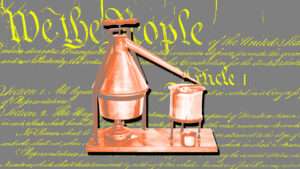
Today, the Supreme Court decided to review the case of Department of Justice v. McNutt, which challenges a federal law banning home distilleries. The key question in the case is whether the law in question is justified by the combination of the tax power and the Necessary and Proper Clause (which gives Congress the power to make laws "necessary and proper" for executing other powers granted to the federal government). This is likely to be most important Supreme Court Necessary and Proper Clause decision since at least NFIB v. Sebelius (2012), which ruled that a "proper" power permissible under the Clause is one that is "ancillary" to the implementation of an enumerated power; it cannot be a "great, substantive and independent" power. This case is likely to further clarify the meaning of "proper," perhaps by explicating in more detail what counts as a "great…and independent" power.
In the lower court decision in this case, the Fifth Circuit ruled that the law is not "proper" and even that it isn't "necessary." There is also a Sixth Circuit decision that went the other way, thereby creating a circuit split.
As explained in my earlier posts on the Fifth and Sixth Circuit decisions (linked above), I think this law is not "proper," and I hope the Supreme Court strikes it down. I summarize the reasons why in my post on the Fifth Circuit ruling:
The Fifth Circuit… concludes that the law in question exceeds Congress' authority under the Necessary and Proper Clause, which grants the power to makes laws "necessary and proper" for carrying into execution other federal powers. I think the court is right that the law in question is not "proper." The Supreme Court, in NFIB v. Sebelius(2012), ruled that a "proper" power permissible under the Clause is one that is "ancillary" to the implementation of an enumerated power. It cannot be a "great, substantive and independent" power. See my analysis in this article. The power claimed here is clearly "great and independent." As Judge [Edith] Jones notes, "[u]nder the government's logic, Congress may criminalize nearly any at-home conduct only because it has the possibility of concealing taxable activity."
I elaborated further in the post criticizing the Sixth Circuit decision:
[T]he Sixth Circuit is badly wrong to conclude that the law is "proper." As explained in my earlier post, the Supreme Court, in NFIB v. Sebelius (2012), ruled that a "proper" power permissible under the Clause is one that is "ancillary" to the implementation of an enumerated power. It cannot be a "great, substantive and independent" power. The power to ban any home-based activity that might serve a substitute for taxable activity outside the home is clearly a "great and independent power." As Judge Edith Jones explains in the Fifth Circuit ruling, "[u]nder the government's logic, Congress may criminalize nearly any at-home conduct only because it has the possibility of concealing taxable activity."
The Sixth Circuit tries to address this point by claiming alcohol is somehow special….
This distinction between alcohol and all other commodities is totally arbitrary. The same reasoning could justify banning home production of anything else that is more easily taxed if produced outside the home. And there is a long history of home production of all kinds of other commodities taxed or severely regulated by the government, ranging from cigarettes to illegal drugs, to pornographic videos.
While Judge Edith Jones (author of the Fifth Circuit decision) is one of that circuit's most conservative judges, the ruling was also joined by liberal Obama appointee Judge James Graves. On the other hand, the Sixth Circuit decision was written by prominent conservative Judge Raymond Kethledge. We shall see if the Supreme Court also divides on this issue in a way that cuts across conventional ideological and jurisprudential lines.
As noted in my post on the Fifth Circuit case, I think Judge Jones is not persuasive in arguing that the home distillery ban isn't "necessary," as well as improper. That argument is unlikely to prevail under the Supreme Court's expansive definition of "necessary, " dating back to McCulloch v. Maryland (1819), where Chief Justice John Marshall famously ruled that "necessary" includes any measures that may be "useful" or "convenient" for implementing an enumerated power.
As also noted in my posts on the two lower court rulings, I think the government has a better argument that this law is authorized by the Supreme Court's badly misguide precedent on federal power under Commerce Clause (which grants Congress power to regulate interstate commerce). But the Supreme Court is apparently not going to review that issue. The question presented submitted to the Court in McNutt is limited to the Necessary and Proper Clause.