

The Volokh Conspiracy
Mostly law professors | Sometimes contrarian | Often libertarian | Always independent
Lawsuit Against St. Louis Restaurant for Firing Manager for Post Related to Charlie Kirk Murder
Missouri law, like the law of some other states, limits even private employers from firing employees based on their political opinions.
In Mormino v. Lomb Inc., filed Aug. 31 in Missouri state court, plaintiff—General Manager for one of defendant's restaurants—posted this post on his personal Facebook page after the Charlie Kirk murder:
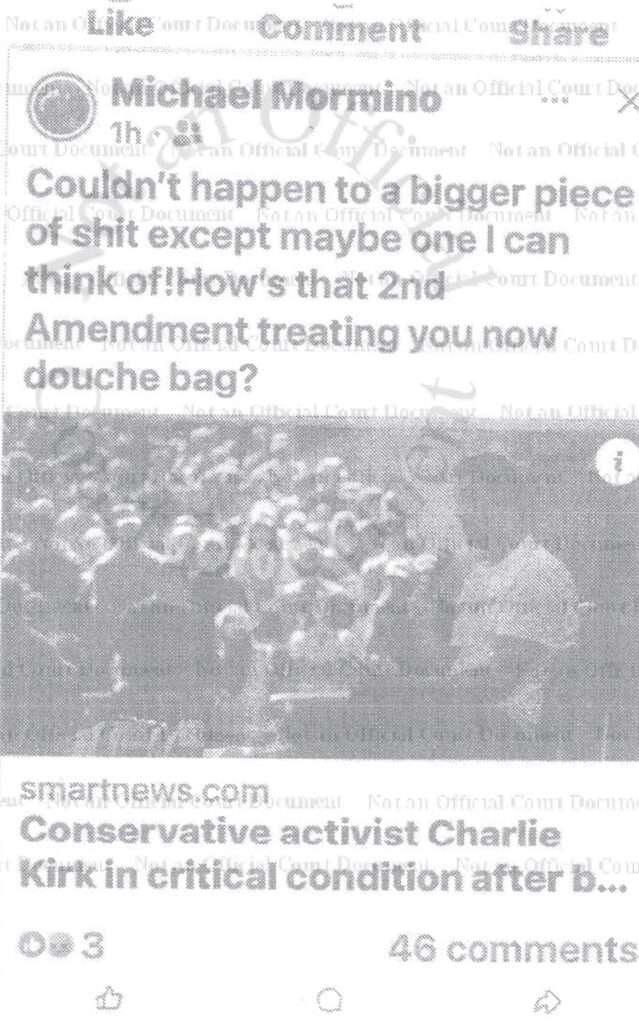
The restaurant fired him, and now plaintiff is suing. Missouri is one of a significant minority of states that forbids even private employers from firing employees based on their "political activity":
Every [entity] organized or existing by virtue of the laws of this state, or doing business in this state who shall:
- … [D]ischarge or discriminate or threaten to discriminate against any employee in this state, with respect to his or her compensation, terms, conditions or privileges of employment by reason of his political beliefs or opinions; or
- Coerce or attempt to coerce, intimidate or bribe any member or employee to vote or refrain from voting for any candidate at any election in this state; or
- Coerce or attempt to coerce, intimidate or bribe any member or employee to vote or refrain from voting for any issue at any election in this state; or
- Make any member or employee as a condition of … employment, contribute to any candidate, political committee or separate political fund; or
- Discriminate or threaten to discriminate against any … employee in this state for contributing or refusing to contribute to any candidate, political committee or separate political fund with respect to the privileges of membership or with respect to his employment and the compensation, terms, conditions or privileges related thereto shall be guilty of a class E felony….
Any person aggrieved by any act prohibited by this section shall, in addition to any other remedy provided by law, be entitled to maintain … a civil action …, and if successful, … shall be awarded civil damages of not less than one hundred dollars and not more than one thousand dollars, together with … costs, including reasonable attorney's fees….
Plaintiff's argument is that he was fired because of his "political beliefs and opinions," and he also argues that he should get compensatory damages (and not just the $100-1000 statutory damages), including emotional distress damages, under the Missouri tort of "wrongful discharge in violation of public policy." Here's a summary of the Missouri wrongful discharge tort from a 2009 case:
[There is] a public policy exception to the employment at will doctrine, which "provides that an at-will employee who has been discharged by an employer in violation of a clear mandate of public policy has a cause of action against the employer for wrongful discharge." … [T]he four general categories of public policy exception cases, which include:
(1) discharge of an employee because of his or her refusal to perform an illegal act; (2) discharge because an employee reported violations of law or public policy to superiors or public authorities; (3) discharge because an employee participated in acts that public policy would encourage, such as jury duty, seeking public office, asserting a right to collective bargaining, or joining a union; and (4) discharge because an employee filed a worker's compensation claim.
Plaintiff's argument is under category 3: The statute quoted above "reflects a clear mandate of Missouri public policy protecting employees from discharge because of their political beliefs and opinions and safeguarding their ability to engage in political expression," and "Mormino engaged in conduct protected by that public policy by expressing political beliefs and opinions on a matter of public concern in his … post."
All this still leaves various questions: One, for instance, is whether "political beliefs and opinions" refers just to electoral politics or—as in the First Amendment concept of "political speech"—to the broader sense of beliefs related to politics writ large. (See pp. 313-14 of this article.) Another might be whether in fact plaintiff was fired for his political views or instead for the vulgarity of his post (though then the restaurant would have to show it would have fired other employees for vulgar posts, which might not be easy to show).
Another might be whether a restaurant's firing an employee because of a fear that customers would dislike the employee's political beliefs or opinions counts as firing based on political beliefs or opinions. There is basically no precedent interpreting this particular Missouri statute. But perhaps this case will end up setting such precedent, or at least will further publicize the statute among Missouri citizens and lawyers.
Thanks to Prof. Lisa Hoppenjans for the pointer.




