

The Volokh Conspiracy
Mostly law professors | Sometimes contrarian | Often libertarian | Always independent
Exit, Voice, and Nikole Hannah-Jones
Nikole Hannah-Jones' controversial article about her daughter's schooling is a testament to the importance of exit rights.
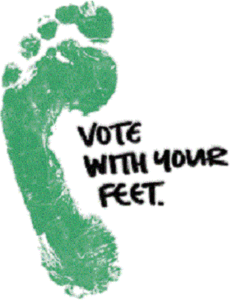
Prominent journalist, academic, and anti-racism activist Nikole Hannah-Jones recently wrote a controversial New York Times article, in which she expresses regret for her and her husband's decision to place her daughter in underperforming majority-Black public schools in New York City. Hannah-Jones hoped that putting her daughter there would help improve education for disadvantaged minority children, as her family's wealth and skills as political activists might stimulate reforms. Instead, her daughter ended up bitterly bemoaning the poor quality of the education she got, and Hannah-Jones' well-meaning efforts to improve the public schools she attended accomplished very little. Eventually, at her daughter's request, Hannah-Jones acknowledged error, and sent her daughter to a higher-quality selective high school.
Hannah-Jones' story is a testament to the value of exit rights and choice. Although she does not seem to recognize it, the best way to help students from less advantaged families than her own is to expand exit and choice opportunities for them. That is what social science shows. Her story also resonated with me because of my own experience as both a struggling student and (later) a parent. That experience also highlights the value of exit rights and choice, even if in a slightly different way.
While I think Hannah-Jones hasn't fully drawn the right lessons from her experience, I commend her for her willingness to acknowledge error. Few public intellectuals do that, and especially not on issues close to the heart of their ideological and personal commitments, as this one is for her.
Exit vs. Voice
Hannah-Jones' initial decision to send her daughter to a poorly performing public school was motivated by an argument associated with the great economist Albert Hirschman (though I don't know if that's where she got the idea). In his classic work, Exit, Voice, and Loyalty: Responses to Decline in Firms, Organizations, and States, Hirschman argued that exit rights can be harmful if they lead people to leave a flawed institution that they could instead stay and successfully reform using "voice." He specifically applied this to the issue of school choice, arguing that the most savvy and politically influential parents might take their kids out of badly-performing schools, instead of staying and successfully reforming them.
In my book Free to Move: Foot Voting, Migration, and Political Freedom, I outlined some limitations of Hirschman's argument. I summarized my key points here:
It is important to recognize that Hirschman's argument applies only in a narrow range of circumstances. In order for it to hold true, a subset of participants in a political institution must 1) be able to force through effective reforms where the others could not impose the reforms in their absence; 2) prefer to exit rather than exercise voice despite the likelihood that their use of voice will be successful; and 3) possess exit options that are not available to the others. If 1 holds true, it is hard to see why 2 would, since these individuals could instead get what they want without moving. The more foot voting opportunities become available to everyone, the more the third precondition is weakened.
Even if all three preconditions are met, foot voting by even some participants could give policymakers an incentive to enact needed reforms of their own accord in order to retain tax revenue from those who might exit. This seems to have occurred when it comes to the paradigm case that gave rise to Hirschman's theory: school vouchers that give parents funds to transfer their kids to better-performing schools…. Peer-reviewed studies of the effects of vouchers find that they actually improve the quality of public schools "left behind" by those who exit. By contrast, simply increasing funds for traditional public schools without expanding exit rights has little or no educational benefit.
Point 1 above is of special relevance to Hannah-Jones' experience. It turns out that she and others like here were not actually in a position to effectively promote beneficial reforms in the failing schools in which she enrolled her daughter. More fundamentally, the main problems besetting those schools are not lack of resources or lack of activism, but poor incentives. As economist Alex Tabarrok points out, New York City public schools spend over $40,000 per student per year (one of the highest averages in the nation), and P.S. 307 (the school where Hannah-Jones initially sent her daughter) spends over $52,000. And NYC doesn't lack for motivated political activists. The problem is that school officials and employees have little incentive to use those resources in ways that actually facilitate quality education. To put it crudely, they get paid the same, regardless of how well the kids do. If the latter perform poorly, that might even be a justification for increasing spending further. This is a large part of the cause of what Hannah-Jones calls "the callous disregard" for children's needs of the faculty and staff at her daughter's elementary school. Parental "voice" is unlikely to fix that.
By contrast, when parents can choose their schools (as Hannah-Jones eventually did), they can seek out ones that fit their kids' needs better. And schools that rely on choice for their funding have strong incentives to actually educate the kids effectively. As noted in my book, studies indicate that expanding exit rights and choice particularly benefits the poor and disadvantaged - including minorities.
Hannah-Jones rightly laments that such options are often only available to the relatively affluent (most of whom are white). But there is much we can do to expand exit options for others.
As I explain in a series of articles coauthored with Josh Braver (see here and here), one way to do so is to break down exclusionary zoning, which - among other things - keeps poor and minority parents from moving their children to areas with better schools. Exclusionary zoning also has a horrible racist history.
We can also expand choice and exit rights by instituting universal school choice, which can - at least to a large extent - break the connection between residency and schooling, thereby particularly benefiting poor and disadvantaged students. In another recent article, I explain how this (along with other measures to expand "foot voting" opportunities) can help us more fully realize the promise of Brown v. Board of Education.
By contrast, New York City has only a very limited school choice system, which does not include private schools, and has various other constraints. Even the limited available choice still creates important gains for poor Black and Hispanic students. But expanded choice and competition could make the system better.
One Student's - And Parent's - Experience
Some parts of Hannah-Jones' story reminded me of aspects of my own, as both student and parent. I was far from an ideal student, and - later - far from an ideal parent. But those shortcomings accentuated the value of exit rights and choice, without which I (and later, my daughter) would have been far worse off.
My parents brought me to the United States from the Soviet Union when I was six. Obviously, pretty much everything I have managed to accomplish since them was the result of that choice - the difference between the opportunities offered by a generally free society and those of a socialist dictatorship (which later became an only modestly less awful nationalist dictatorship).
More immediately relevant was my parents' further use of exit rights in the US. I was no great student, and did not learn to read till the age of eight - a consequence of some combination of lack of motivation and what may have been undiagnosed dyslexia. When I was 11, my parents moved to the town of Lexington, Massachusetts, largely because it had better schools than the one where we lived previously, and their strengths were particularly well-suited to my needs. Like Hannah-Jones' daughter, after she moved to a stronger high school, I initially struggled in the new environment. But, eventually, I did much better. This move did not make as big a difference as that from the Soviet Union to the US. But it was significant, nonetheless. I recounted these experiences in my 2010 immigration memoir, written for HIAS.
As a student at Lexington High School, I witnessed another benefit of school choice. The Boston area has a program called METCO, which allows inner-city students (mostly Black and Hispanic) to voluntarily apply to attend much stronger schools in the suburbs, such as LHS. Studies show that participants make major educational gains, and are more likely to attend college than they would have been otherwise.
Many METCO students initially struggle in their new environments (as I did myself after we first moved to Lexington). And there is sometimes a gap between their grades and test scores, and those of the suburban kids in their new schools. When I was a high school junior, I wrote an article about this gap for the school newspaper, thereby unexpectedly causing something of a local controversy. Nonetheless, the program creates real progress for disadvantaged kids. And, unlike mandatory school busing - which led to outbreaks of violence and racism in the Boston area in the 1970s - METCO has met with little opposition.
Many years later, my daughter Lydia, had educational issues of her own. When the Covid pandemic hit in 2020, my wife and I saw that remote education in the Arlington, Virginia public schools would be a terrible fit for Lydia, given her need for occupational therapy, and what we later learned was a fairly serious case of dyslexia (likely worse than what I had). We made the decision to send her to a private school which - among other things - kept on with in-person education throughout the pandemic. Lydia did better, as a result (including after the pandemic). Had we instead worked to use "voice" to reform the local public schools, it's unlikely we would have achieved much. Lydia would have suffered for nothing.
Nonetheless, progress was still uneven. Like me before her, Lydia still did not know how to read at the age of eight. After extensive consultation with specialists at her school and elsewhere, we finally hit upon the idea of teaching her to read by helping her memorize "sight word" flashcards. Like me, Lydia has trouble with visual learning, but is very good at learning through memorization and repetition.
For several months, Lydia and I spend 15-30 minutes every night memorizing sight words. We went from kindergarten sight words, all the way to fifth-grade ones. At the end of this not-always-fun process, Lydia could read at grade level, and the first book she read on her own was the classic science fiction novel Ender's Game, which is intended for adults. Today (at age 11), Lydia is an "academic superstar," as her school's principal put it.
In retrospect, I should have hit upon this fairly simple and cheap idea much earlier, especially given my own experiences. I am to blame for that oversight. The episode shows that even high-quality schools and teachers cannot fully substitute for parental judgment of their kids' specific needs. But the school was invaluable in maintaining a measure of progress in the meantime. And discussions with their and other specialists helped us eventually figure out the right path.
In sum, no school is perfect, and parents need to be attentive to their kids' individual situations. This reality creates difficulties for poor parents, single parents, and others less advantaged than Hannah-Jones or myself. But exit rights, choice, and competition can do much to improve the lot of poor and minority students.




