The Volokh Conspiracy
Mostly law professors | Sometimes contrarian | Often libertarian | Always independent
Supreme Court Refuses to Block Lower-Court Ruling Against Trump's Mail-in Ballot Executive Order
The decision was 7-2.

Earlier tonight, the Supreme Court, in a 7-2 ruling, refused to stay a lower-court decision blocking the Postal Service's policy implementing Donald Trump's executive order intended to curb mail-in voting. I have previously written about the First Circuit ruling in this case, and about how Trump's order is a blatant assault on federalism and separation of powers.
As is often the case with "shadow docket" decisions, the majority opinion offers almost no analysis. But they do state that "[t]he Government is unlikely to succeed on the merits of its challenge to the District Court's preliminary injunction [against the USPS policy]." That indicates they believe that Trump's policy is indeed illegal, likely for reasons similar to those outlined by the district court and the First Circuit.
In a concurring opinion, Justice Brett Kavanaugh states that he thinks "there is at least a fair prospect that the final rule falls within the Postal Service's statutory authority," but that the district court was still right to block it, under the Administrative Procedure Act "because state and local election officials do not have sufficient time to reasonably implement the rule before the elections."
In a dissent joined by Justice Thomas, Justice Samuel Alito argues that the policy is within the authority of the USPS, but bases it on statutes that nowhere mention altering mail-in ballot election rules, but only authorize USPS to make rules for the collection and delivery of the mail. Alito largely ignores the massive federalism and separation of powers issues arising from conflating the latter with the former. In addition, as the district court and the First Circuit noted, twisting this language into a sweeping power to override state mail-in ballot rules raises serious "major questions doctrine" issues.
As the District Court noted, Congress must speak clearly when delegating a "highly consequential power" to the executive, and the power to rewrite state election rules is pretty obviously highly consequential. and, to put it mildly, the statutes granting authority to the USPS come nowhere near clearly giving it such power. Indeed, they don't even mention voting rules.
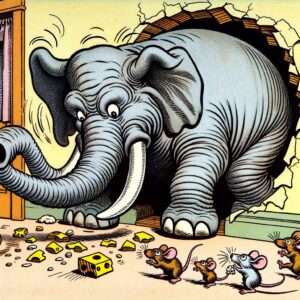
To put it a different way, inferring a power to regulate mail-in voting from a power to make rules necessary for the delivery of the mail is a classic example what Justice Antonin Scalia famously called "hid[ing] elephants in mouseholes," warning courts to avoid assuming Congress did that. The Trump administration claims there is a truly enormous elephant in a very tiny mousehole here. The Court was right to reject that position.