The Volokh Conspiracy
Mostly law professors | Sometimes contrarian | Often libertarian | Always independent
Congratulations To Kirill Muzyka, Repeat Chief Justice of FantasySCOTUS for OT 2025

The October 2025 Term of FantasySCOTUS finally came to a close. On the whole, this term was a one of the most predictable terms I can recall. In the aggregate, our crowd predicted 94.74% of the cases accurately, up from 76.36% of the cases accurately last term.
I am happy to announce that the Chief Justice is Kirill Muzyka. He is a repeat winner from last term. Players receive ten points for each correct prediction of a Justice's vote. We recorded 57 merits cases (DIGs do not count).
Here is the Top 10:
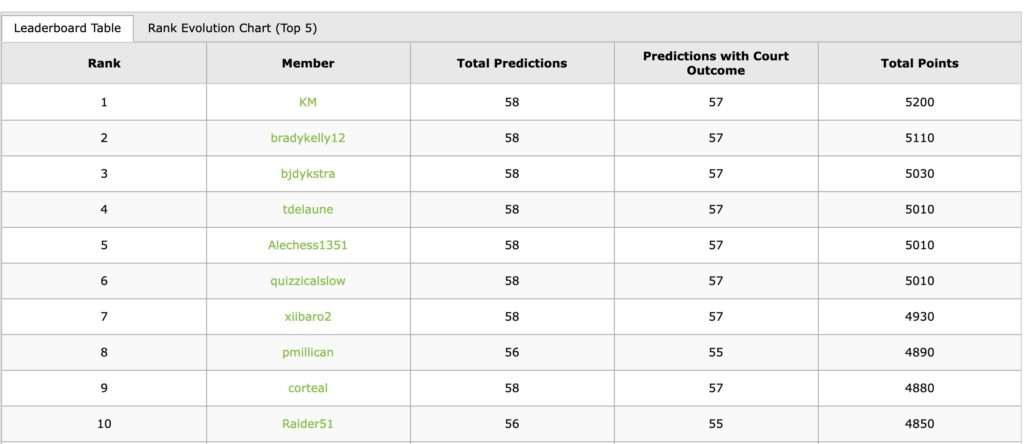
I usually ask the winner several questions to figure out their approach to predicting cases. Kirill's response was so thorough and insightful, that I reproduce it in its entirety:
As a reminder, I am Kirill Muzyka, originally from Russia and still living in London — though no longer as a student, but now trying to find a job. This term, partly because I had more free time, I spent even more of it following the Supreme Court — and occasionally wondering whether I should apply to a U.S. law school. In the meantime, I have also started a small media project in Russian, where I try to make the American political and legal systems more accessible to a Russian-speaking audience.
My approach to predictions remains broadly the same. I start with oral argument, make my first prediction based on what the Justices said there, and only then bring in background considerations such as previous votes or judicial philosophy.I prefer this mathod because many wrong predictions, I think, come from interpreting oral argument through a preexisting narrative. For example, I was puzzled by how many commentators seemed to think there was serious doubt about Justice Barrett's vote in Watson v. RNC. To me, she clearly telegraphed at argument that she was going to side with Mississippi. My guess is that the uncertainty came less from the argument itself than from background assumptions about the case and about her.
The current oral argument format makes this method more useful. Because each Justice now has extended time to ask questions, they usually have enough room to identify the concerns that actually matter to them. Some Justices are more transparent than others. Justice Jackson, for instance, often makes it possible to predict not only her vote, but almost the structure of her eventual opinion, based on her questions — or, really, her monologues. But the broader point is that the format gives close listeners a lot of information.
At the same time, this approach has real limits. Because I still do not usually read the briefs before making predictions, I sometimes miss nuances that are not fully visible from oral argument alone. The Justices may sound hostile to the broadest version of a party's theory, but still vote for that party on narrower grounds. Particular dispositions can also be hard to predict. My biggest mistake this term was Case v. Montana: based on oral argument, I thought the Court would vacate because the wrong standard had been applied, but it instead applied the correct one and affirmed. I had a similar problem in Pung v. Isabella County. It was clear the Justices would reject the petitioner's theory, as they did, but I was much less sure whether they would affirm or vacate.
There is also the familiar problem that Justices sometimes play devil's advocate. Justice Alito, for example, can be very aggressive toward a side he is usually unsympathetic to — criminal defendants, for instance — even when the case ultimately ends in a unanimous decision that he joins without writing separately. Abouammo and Ellin
gburg were two such cases this term. The Chief Justice and Justice Kagan also tend to ask hard questions of both sides, which makes them harder to read; that is how I missed their votes in Monsanto and Al Otro Lado, respectively. The Chief also speaks relatively little. I like to relisten to oral arguments after reading the opinions, to see how the argument translated into the final decision. Sometimes that makes the outcome much clearer in retrospect. But there are still missed predictions I cannot fully explain even afterward. I was almost certain Justice Kavanaugh would vote with the liberals in Saba, and after relistening to the argument I still think that was the most reasonable conclusion to draw from them. I was also very surprised by the unanimous result in Hemani: after the argument, it seemed almost certain to me that Chief Justice Roberts and Justice Alito would vote against Hemani, and quite likely that Justice Kagan would as well. Galette was another case that left me confused. After oral argument, I was certain that the Justices were divided, but the final decision was unanimous, with no separate writings. As I said last year, high-profile cases are often easier to predict, though not always. I was still very surprised by Justice Gorsuch's vote in Barbara and Justice Barrett's vote in Cook, where, based only on oral argument, they seemed inclined to vote the other way.
I am still working through all the final opinions. This year, I am trying to read not only the opinions themselves, but also some of the most relevant precedents. For example, with Slaughter, I also read Myers, Humphrey's Executor, Morrison v. Olson, and Seila Law, trying to understand the issue properly and decide what I actually think about it.
One broader conclusion I have reached from that is that the quality of judicial writing has improved enormously over time. The current Justices' opinions are much easier to read than many older ones. I also appreciate that most of them try to make their reasoning accessible, so that an educated non-specialist can understand what they are saying. As I said last year, I particularly enjoy the writing of Justices Kagan, Gorsuch, and Barrett. For that reason, I was a little sad that Justice Kagan did not write the dissent in Slaughter. With all respect to Justice Sotomayor, Kagan's dissent in Seila Law made a much stronger — and more fun to read — case against the unitary executive.
More generally, accessible judicial writing is one of the great strengths of the American legal system. Back home in Russia, judicial opinions are often close to unreadable, which makes it difficult for a bystander to follow the reasoning behind decisions (if such a reasoning exists at all). In most SCOTUS cases, by contrast, even if I have a strong view about the question or the outcome, I can usually understand why other Justices took a different path. I also greatly enjoy the Divided Argument podcast, which puts many of these debates in context and gives them useful perspective.
That said, it was disappointing to see so many cases divided along ideological lines. Those are the easiest to predict, but I generally find cases that do not split the Justices in the expected way more interesting, because they reveal more about each Justice's individual approach. When they do not simply vote with "their side," they show their own methods, instincts, and willingness to think outside the usual boxes. In many ideologically divided cases, by contrast, it can feel as though neither side is really questioning its own premises.
I hope next term brings fewer of those cases. In the meantime, I am looking forward to reading the remaining opinions over the next few weeks — and then, of course, to the start of the next term.