

The Volokh Conspiracy
Mostly law professors | Sometimes contrarian | Often libertarian | Always independent
How Bad Facts Make Good First Amendment Law
Jay Near was a hateful man whose litigation set a vital precedent for free speech.
The old legal saying, "bad facts make bad law," might be true in some cases. But that usually occurs when a court strays from its commitment to a neutral set of legal principles, often because a litigant or lawyer is particularly repulsive or persuasive. If a court sticks to those neutral principles, bad facts could make good law when the court demonstrates that the rule of law endures, even in the most difficult circumstances.
Jay Near is among the free speech anti-heroes profiled in our book. After arriving in Minneapolis from Iowa, in 1916 he started writing for Howard Guilford's Twin City Reporter, which boasted sensationalist and sometimes racist headlines, such as "White Slavery Trade: Well-Known Local Man Is Ruining Women and Living Off Their Earnings," and used terms like "yids" and "spades." The paper had a reputation for taking bribes from powerful local officials to write scandalous articles about their rivals. As journalist Fred Friendly would write in Minnesota Rag, a 1981 book about Near, Guilford and Near "practiced a brand of journalism that teetered on the edge of legality and often toppled over the limits of propriety."
Within a few years, Guilford and Near left the newspaper, and Near had moved first to California and then back to Minnesota. Their former newspaper was in the hands of a local crime syndicate that had worked out side deals with the city police, so Near convinced Guilford to start a rival newspaper, The Saturday Press, which would expose the corrupt crooks running The Twin City Reporter. Police Chief Frank Brunskill wanted to stop the distribution of this upstart paper even before the first edition came out.
Despite the threats, Guilford and Near published their first issue on September 24, 1927. The second page contained an editors' note that criticized the owner of their former newspaper:
"[He is] an unscrupulous newspaper man, a man so devoid of moral courage that he hasn't the nerve to publish the paper himself—he prefers to lease it out to others to assume the responsibility, while he engineers the numerous blackmail deals that are committed by the firm, and waxes fat from the profits of gambling houses he has been interested in for several years past, said gambling houses being permitted through the social prestige (?) of the Twin City Reporter about the City Hall."
On page 4, Near wrote that he and Guilford recently received word "that if we persisted in our expose of conditions AS THEY ARE in this city, we would be 'bumped off.' "
Their prediction proved true. Two days after publication of their paper's first edition, two men fired four shots at Guilford's car as he drove in downtown Minneapolis, critically injuring but not killing him. The next edition of the newspaper—published five days later—carried the front-page headline "Guilford's Assailants Indicted by Grand Jury" and reported that two "boys" in their early 20s had been indicted for first-degree assault. "What of the ones who HIRED THEM TO KILL?" the article asked. "Shall they escape and these boys be punished FOR THE CRIME THEIR SOULLESS EMPLOYERS ARE GUILTY OF?"
The Saturday Press continued its weekly publication, criticizing Brunskill and other local officials and focusing much of its ire on Mose Barnett, a Jewish gangster who, the paper alleged, was running much of the city's organized crime. The front page of its third edition featured the headline "A Few of the 'Unsolved' Minneapolis Mysteries " and carried the story of an assault on Sam Shapiro, a Russian dry cleaning shop owner whom Barnett had allegedly threatened. "Did the police department get busy and arrest Mose Barnett, THE GANGSTER WHO HAD THREATENED MR. SHAPIRO?" the paper asked. "It did nothing of the kind."
Until this point, the newspaper's crusade against Barnett might be seen as noble. But in the next few editions, Near then stepped up his attacks, not only on Barnett and the city officials whom he claimed Barnett controlled, but also on Jewish people in general. Near wrote that "JEW GANGSTERS" are "practically ruling Minneapolis." Near pushed back against people who warned him against criticizing Jewish people: "If the people of Jewish faith in Minneapolis wish to avoid criticism of these vermin whom I rightly call 'Jews' they can easily do so BY THEMSELVES CLEANING HOUSE." He claimed (without support) that 90 percent of crimes were perpetrated by Jews: "It was a Jew who employed JEWS to shoot down Mr. Guilford. It was a Jew who employed a JEW to intimidate Mr. Shapiro and a Jew who employed JEWS to assault that gentleman when he refused to yield to their threats."
This would be the newspaper's final edition, at least for a few years. It was clear from the paper that Brunskill had stepped up his efforts to bar the paper's distribution. Across the top of the front page were instructions to stores that sold this newspaper: "If you are molested in their sale by the police, refuse to remove them from your display stands and we will furnish the legal talent necessary for a 'show down' in the courts," the editors wrote.
That plan did not stop Brunskill and the state attorney, Floyd B. Olson, from blocking further publication of the newspaper. Two days after Near's anti-Semitic rant, Olson filed a complaint in state court, basing it on a state law that made it a criminal nuisance to publish "an obscene, lewd and lascivious newspaper, magazine, or other periodical" or "a malicious, scandalous and defamatory newspaper, magazine or other periodical." The statute allowed the county attorney to seek a court order to "perpetually enjoin the person or persons committing, conducting or maintaining any such nuisance, from further committing, conducting, or maintaining any such nuisance."
The state court ordered Near to show cause reflecting why it should not issue an order prohibiting the circulation of previous editions of The Saturday Press, "any future editions of said The Saturday Press," and "any publication, known by any other name whatsoever containing malicious, scandalous and defamatory matter of the kind alleged in plaintiff's complaint herein or otherwise." After Near moved to dismiss the complaint, the trial court asked the Minnesota Supreme Court to decide whether the state law violated the First Amendment and similar protections in the state constitution.
The Minnesota Supreme Court ruled the statute constitutional: "It was never the intention of the constitution to afford protection to a publication devoted to scandal and defamation." The state high court sent the case back to the trial court, which granted the injunction, finding that the newspaper "did engage in the business of regularly and customarily producing, publishing and circulating a malicious, scandalous and defamatory newspaper." Near again appealed to the Minnesota Supreme Court, challenging the constitutionality of the law. He focused on the impact of issuing a prior restraint that prohibits the publication of any future newspapers. In four paragraphs, the court rejected Near's argument, reasoning that the injunction would not prohibit Near and Guilford from "operating a newspaper in harmony with the public welfare to which all must yield." But the defendants, the court wrote, "have in no way indicated any desire to conduct their business in the usual and legitimate manner."
Near convinced the US Supreme Court to review the case. In his brief to the high court, Near focused on the long-standing rule that freedom of the press prevents the government from stopping publications in advance. He quoted Blackstone's famous Commentaries on the Law of England, which stated that freedom of the press "when rightly understood, consists in laying no previous restraints upon publications, and not in freedom from censure for criminal matter when published."
In a 5-4 opinion, the Supreme Court struck down the state law as unconstitutional. Writing for the majority, Chief Justice Charles Evans Hughes focused on the particularly harsh nature of prior restraints allowing government officials to stop publication of a newspaper that accuses them of wrongdoing. "This is of the essence of censorship," Hughes wrote. For the first 150 years of its history, Hughes noted, the United States followed Blackstone's model and eschewed prior restraints against publications that made accusations about government officials: "Public officers, whose character and conduct remain open to debate and free discussion in the press, find their remedies for false accusations in actions under libel laws providing for redress and punishment, and not in proceedings to restrain the publication of newspapers and periodicals."
Conservative Justice Pierce Butler, joined by three colleagues, dissented. Butler focused much of his dissent on the odious nature of the newspaper, writing that its "regular business was the publication of malicious, scandalous and defamatory articles concerning the principal public officers, leading newspapers of the city, many private persons and the Jewish race."
Had one more justice shared Butler's view, the Supreme Court would have upheld the court order shutting down The Saturday Press and, more importantly, governments across the nation would have been free to shut down publications they determined were sufficiently "scandalous." But that is not what happened. In October 1932, The Saturday Press resumed publication under Near's editorship, with the front page bearing the following slogan: "The only paper in the United States with a US Supreme Court record of being right; the only paper that dared fight for freedom of the press—fought and won."
What would the United States look like had Butler's view prevailed? Most likely some hateful publications like Near's would have been suppressed over the past century. But it would also have suppressed newspapers and other periodicals that legitimately accused government officials of wrongdoing or otherwise published information that the government would prefer to never see the light of day. Indeed, in its 1971 per curiam opinion blocking a government injunction against The New York Times and The Washington Post from publishing the Pentagon Papers, the Supreme Court cited Near v. Minnesota for the proposition that prior restraints are presumptively unconstitutional. By protecting Near's hate speech against prior restraints, the Supreme Court enabled the publication of the Pentagon Papers and so much other controversial speech. But prior restraints are only one form of penalty for speech. Governments and courts also use the threat of criminal charges to scare people from ever speaking out in the first place. And the court has set a high bar for such prosecutions, even in the face of the most deplorable speech.
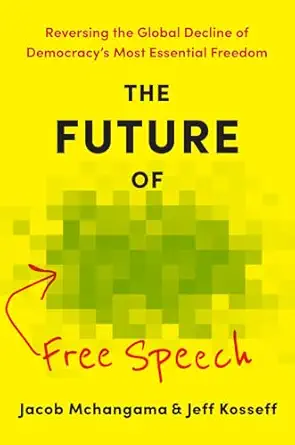
Excerpted from The Future of Free Speech: Reversing the Global Decline of Democracy's Most Essential Freedom by Jacob Mchangama and Jeff Kosseff. Copyright 2026. Published with permission of Johns Hopkins University Press.




