

The Volokh Conspiracy
Mostly law professors | Sometimes contrarian | Often libertarian | Always independent
The US News T14 Is Dead, and Has Been Replaced by the T11 (or, if You Prefer, the T10 with 11 Members)
The revamped US News law ranking methodology adopted in 2023 has killed an old grouping and created a successor.
To state the obvious, many people put a lot of weight (far too much weight, in my view) on the US News law school rankings. Good evidence of this is the prevalence of the term "T14." The label arose in the 1990s when people noticed that the same 14 law schools—and only those 14—occupied the top 14 spots in every US News overall ranking starting with the first one in 1990. (There was a 1987 ranking that was simply a survey sent to selected law school deans, but the rankings with multiple metrics began in 1990.) That is, not only were these 14 schools always in the top 14, but no other school even tied for 14th.
That pattern continued with remarkable regularity through the rankings released in 2022, with three tiny exceptions noted below. (Sidenote: after Georgetown fell out of the top 14 a couple of times, some—often Georgetown supporters—suggested that the T14 should instead be defined as the top 10 schools that had ever appeared in the US News top 10, noting that Georgetown ranked #10 once, in 1993. But by that reasoning Georgetown would forever remain a top 14 school, even if consistently ranked #30, which is pretty silly.)
Between its 2022 and 2023 law rankings, US News changed its methodology considerably, moving toward more objective metrics and away from spending per student—a metric that wasn't reported to the ABA and could easily be manipulated. We now have four years of rankings under the new regime, and a few things have become clear:
- The 1990–2022 rankings are so different from the 2023–2026 rankings that they are effectively separate regimes.
- The T14 is dead. The top 14 is the second-least coherent grouping in the 2023–2026 rankings.
- The 2023–2026 rankings show more variation (unsurprisingly, since they put more weight on things that change year to year, like employment numbers).
- Perhaps surprisingly, at least for now there is a coherent replacement for the T14 in the new regime. Say hello to the T11—or, if you prefer, a T10 with 11 members.
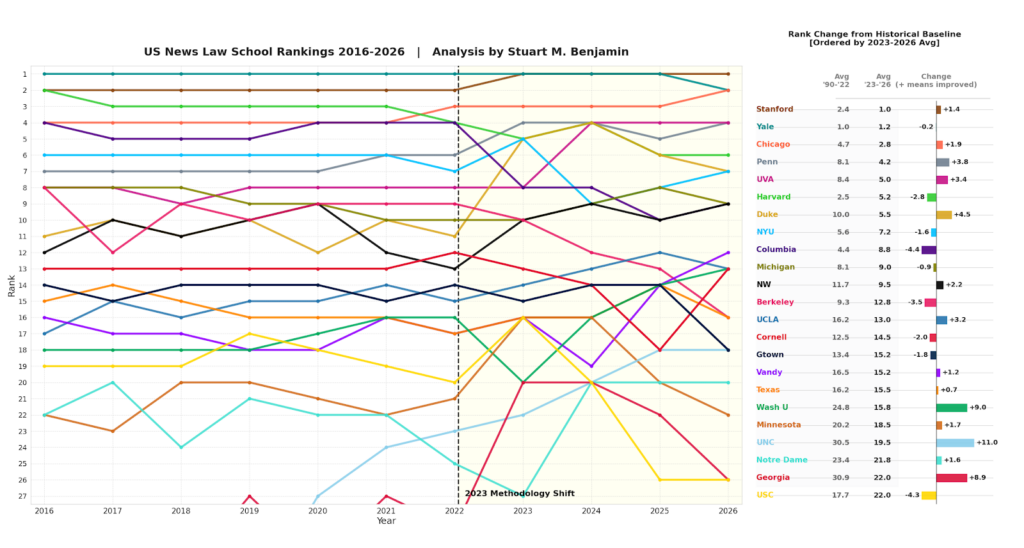
On the first claim: There are various ways to illustrate the differences between the pre-2023 and 2023–2026 regimes, but the visualization above is the one I liked best. (You can open these visualizations in a new tab to enlarge them.) The lines move dramatically after 2022. Look at the table on the right side showing how much movement occurred. Only three of the current top 23 schools (based on the 2023–2026 average rankings) moved less than one rank, and many moved much more. Indeed, I found that I couldn't include the full movement of UNC and Georgia without severely compressing the rest of the chart. And charting the top 25 schools in the current regime would have included Texas A&M, which moved up steadily before 2023 (from 60 to 53 to 46 in 2020–2022) but then had a massive leap in 2023 to 29, followed by 26 in 2024 and 22 in 2025 and 2026. Its 2023–2026 average (24.8) was thus more than 18 ranks better than its 2020–2022 average. In any event, the bottom line is that the 2023–2026 rankings differ sharply from the 1990–2022 rankings.
That still leaves the question of whether any coherent groupings exist within each period.
The cleanest way to measure deviations from a "Top X" grouping is to identify the minimum total number of changes in ordinal position necessary for the same schools—and only those schools—to constitute the top X each year. This also answers the question of which schools belong in the top X—it should be whichever combination results in the smallest minimum total number of changes. (The proxy I use to determine this is a school's average ranking over the measured time period.)
So the most coherent grouping is the one that requires the fewest moves, and thus has the lowest number in the bar charts below.
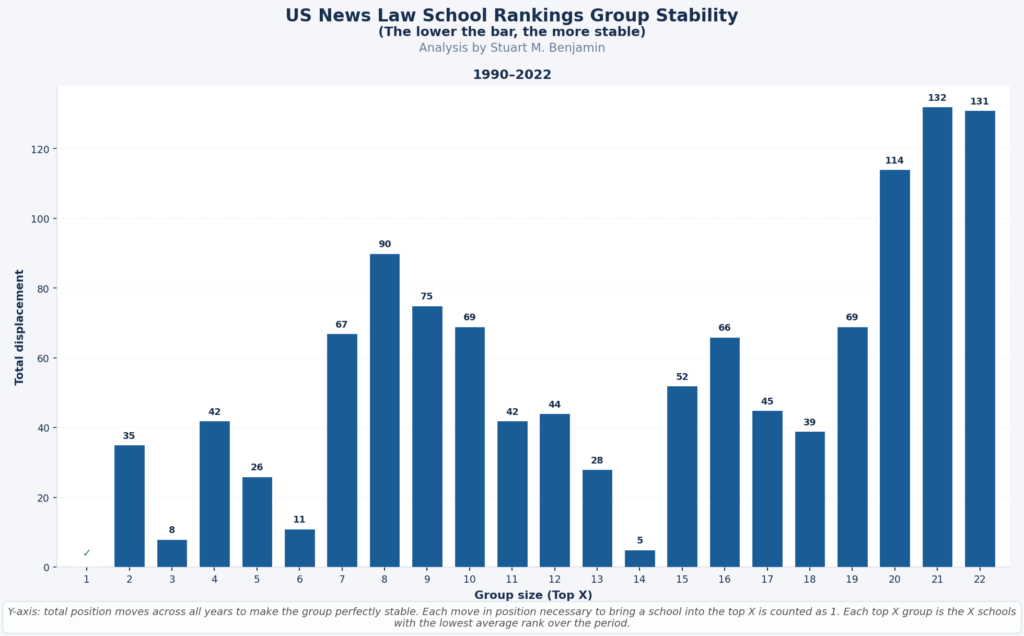
For those who aren't interested in how the counting works, feel free to skip this paragraph. There are three exceptions to the same 14 schools (Yale through Georgetown) occupying the top 14 from 1990–2022: 1) In 2011 Texas tied Georgetown for 14th. To put Georgetown alone in 14th place, Georgetown would need to move up 1 position (or Texas down 1). Either way, 1 position would need to change. 2) In 2017, Georgetown tied with UCLA for 15th, and Texas was 14th. Georgetown would need to move up 2 positions (from 15th to 13th) to avoid a tie with Texas. 3) In 2021, Georgetown was 15th and UCLA was 14th, so Georgetown would need to move up two positions, or UCLA would have to move down two positions (or each moves one) to avoid a tie, for a total of two positions moved.
As the visualization below shows, the minimum total number of positional changes needed for the T14 to remain perfectly stable from 1990–2022 is just five. That is a significantly lower number than for any other Top X grouping (except for the Top 1, which is too small to be useful). That low number of moves indicates the coherence of the T14 during those years. Meanwhile the Top 8 was quite incoherent.
The 2023–2026 regime tells a very different story. The Top 14 is tied for the second-least coherent grouping in the top 20. The T14 is no more. But an obvious replacement has emerged from the 2023–2026 rankings: the Top 11. The Top 3 is even more coherent, and there is a Top 2, but those clusters are too small to be useful replacements for the Top 14. After the Top 11, the next most coherent sizable group is the Top 7.
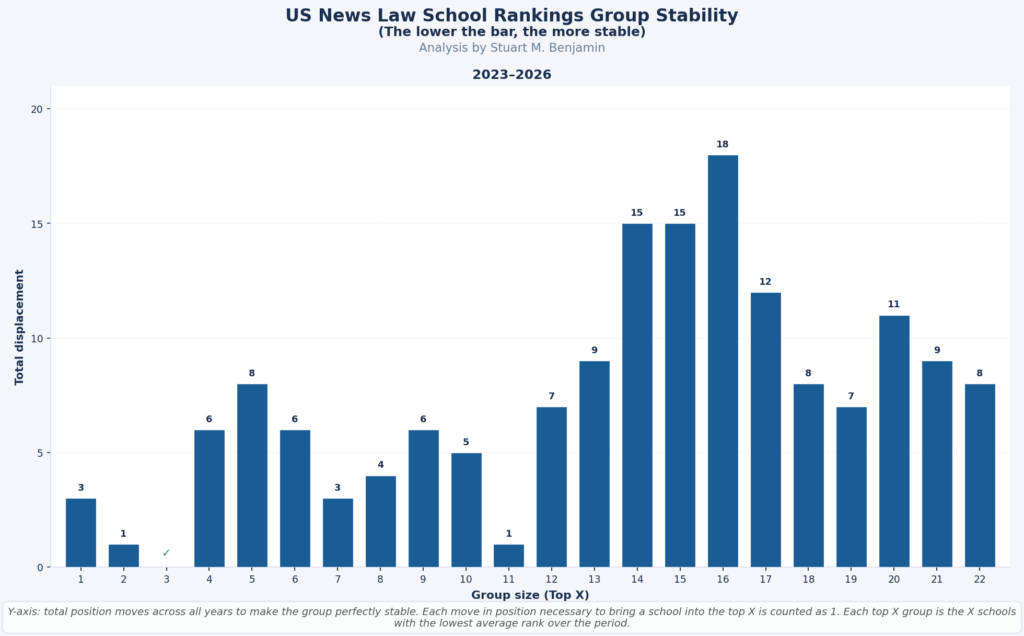
You can call the Top 11 the "Top 10" because they are the 11 schools consistently in the top 10, accounting for ties. I prefer "Top 11," but Top 10 is a more conventional number, and there's a faint absurdity (perhaps fitting for rankings that shouldn't be taken as seriously as they are) in having 11 schools in the Top 10.
None of this is to suggest that the 2023–2026 US News law rankings, or the 1990–2022 rankings, or any other rankings system is the "correct" rankings system, whatever that would even mean (and the US News 1990–2022 and 2023–2026 regimes can't both be correct, given the differences between them). Rather, my point is that insofar as you take the US News law rankings seriously, you should not invoke the T14. Invoking the T14 now is like relying on 2013–2022 college basketball polls to identify the strongest teams this season.
The larger point is about the stickiness of old paradigms—a form of status quo bias. It's easy, and lazy, to notice a pattern and assume it will persist. Sometimes it does: a 2021 ranking of universities by endowment will look very similar to one from 2026, and quite probably 2031 as well.
But often a pattern doesn't persist. From 1990–2022, the T14 was consistently the most coherent grouping in the US News law rankings. That era is over. In the post–2022 rankings, the T14 is dead, and the T11—or the T10 with 11 members—has risen from its ashes.




