

The Volokh Conspiracy
Mostly law professors | Sometimes contrarian | Often libertarian | Always independent
Zen and the Art of Persuasive Writing: Introduction
Nine mantras to persuasion.
We have an epidemic. The virus is known to travel on paper and transmit over the keyboard: it jumps from old lawyer to young lawyer, preys on the inexperienced and insecure lawyer, and thrives in the imprecise and indifferent lawyer. It spreads like wildfire in college towns and institutions of higher learning. And it mutates! Oh boy, does it mutate. Turning verbs into nouns. Adverbs flourish. Adjectives and jargon run free.
That epidemic is bad writing—especially legal and persuasive writing. Legal prose is often dull and opaque, redundant and bumpy, labored and disorganized. It sputters and coughs in the opening sentences, leaving an unnavigable and incomprehensible mess for the reader to withstand. It's hard to read, harder to understand and hardest to remember. It prefers abstractions—abstract words and abstract grammar; abstract facts and abstract arguments. And it weighs on the reader's brain.
Why is so much legal and persuasive prose so bad? I think it's because many legal writers never stop to think about their readers. The elixir for this oversight is mindfulness. A persuasive writer anticipates, meets and remembers the preferences and expectations of his readers. He cares about communication and seizes control of his literary fate—guiding the writing process from start to finish. He knows why he writes, what he writes and how he writes. He knows that persuasive prose is not a monologue, but a dialogue between writer and reader. This book introduces the path to persuasion in nine mantras.
Be aware of the audience. A persuasive writer understands the singular importance of the audience and appreciates the inherent challenges that arise when time and distance separate readers from writers, so he channels the readers to anticipate and answer their questions.
Be less categorical. Persuasive writers know that few rules are absolute. When it comes to persuasion, musty preferences are not nimble enough to track the dynamic evolution of language and communication.
Be clear and concrete. Persuasive prose conveys hard facts and ideas in plain and simple words. It favors plain nouns and vivid verbs; disfavors jargon and abstractions. It flows and sounds natural, even conversational, never driving readers to secondary sources to sharpen an image or understand a point. A persuasive writer appeals to the human senses, knowing that abstractions extract a heavy cognitive toll on the reader's brain. He knows the law has clung to abstract grammar and abstract words for hundreds of years, but he forsakes obtuse writing in the name of communication.
Be concise. A persuasive writer severs the meaningful from the meaningless. He is focused and assured. He understands the nuances of his argument—its strengths and weaknesses—and he uses that knowledge to disentangle the issues and unscramble the facts.
Be cohesive and coherent. Persuasive prose is easy on the eyes and simple to navigate, wielding the power of transitions and priming. A persuasive writer knows how his document fits together, sentence to sentence and paragraph to paragraph.
Be compelling. A persuasive writer holds the readers' attention and interest for long enough to move their hearts and minds. He knows that persuasive prose is art, both literary and logical, and uses the power of analogy and literary devices to that end.
Be credible. A persuasive writer earns his reputation with colleagues and the courts, acting honestly and urging only plausible arguments with clarity of thought. A fine reputation is not purchased or invoked by the advocate; rather, it is bestowed by the audience.
Be a reader and writer. A persuasive writer reads and reverse-engineers the language, style and approach of the stuff he likes. He knows what moves him and leverages that experience to improve his writing. He writes frequently to cultivate and refine his skills.
Be meticulous and rewrite. A persuasive writer labors to guarantee the audience will understand his point. He knows that persuasive prose is the end product of many drafts and myriad decisions. A persuasive writer sheds any stubborn, unproductive attachment to his own words and thoughts—like a rattlesnake sheds its skin. He drafts and redrafts until it flows.
When writers account for these nine mantras, persuasive prose is sublime. It leaps from the page and grabs readers by the collar, commanding their interest and attention until the very last word.
A word about my approach and teaching style. We immerse ourselves in the fundamentals of writing and explore the art of persuasion from the reader's perspective. My tools are practical, my lessons universal, presented for immediate use and instant improvement. In the words of our founding father Thomas Paine, "I offer nothing more than simple facts, plain arguments, and common sense."
My advice is anchored in science because writing is an intensely personal exercise. When someone audits our words, it causes our stomachs to squirm, our blood pressure to increase, and our brows to furrow, activating an arsenal of defense mechanisms. By adding an objective element to persuasive writing—data from studies in psychology and psycholinguistics—I hope to overcome this natural reaction. Even better, the book is peppered with research that validates what I teach.
This book is not about hard and fast rules. My hope is to deliver practical advice in an accessible and entertaining way. You may read the pages and chapters in any order, picking the advice that resonates with you.
I lean on history's best and brightest to model and confirm my methods. My guest luminaries are a motley crew of founding fathers and philosophers, authors and scientists. Each has left us his or her enduring wisdom on language and literature, which I cherish and think you will too, delivered with humor and grace.
My guest luminaries have much to teach about the art of legal and persuasive writing. From Mark Twain, a preference for concrete prose and command of modern English. From William Shakespeare, a love of concision. From Ernest Hemingway, a predatory instinct to eliminate unnecessary words and trifling points. From the Rolling Stones, a mistrust of convention. From Stephen King, a fidelity to nouns and verbs and intolerance for adverbs and adjectives. The plain and simple words of these luminaries are sprinkled throughout this book.
When it comes to legal writers, I rely on the wisdom and punchy prose of great advocates—the lions of our profession. I extract jurisprudential nectar from past and present justices and judges. You have your favorites; I have mine. From the past, I cherish Antonin Scalia, Learned Hand and Robert Jackson. From the present, I admire Richard Posner and Elena Kagan. Their helpful advice fuels lucid prose. I include some of my stuff too, spanning years of private practice, government counsel and now the bench.
Meditation: Legal writing is the common thread that binds all forms of law practice. Many law students see legal writing class as an elective, unworthy of their finite attention because it's not substantive law. That's wrong. A lawyer who cannot write well is like an opera singer with laryngitis.
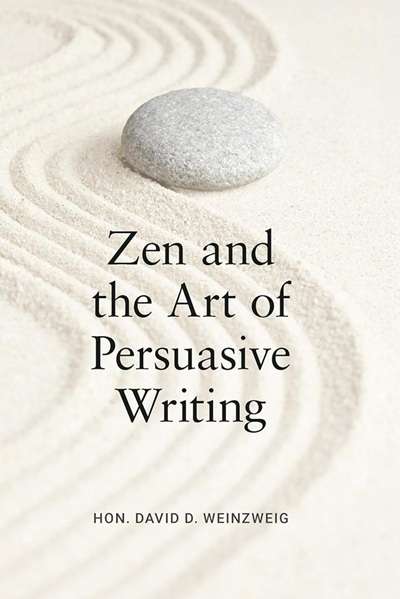
This excerpt is taken from Zen and the Art of Persuasive Writing. Purchase now where books are sold, including Amazon and Barnes & Noble.




