

The Volokh Conspiracy
Mostly law professors | Sometimes contrarian | Often libertarian | Always independent
The Prosecutor Didn't Prove I Was Over 18, Says Father of 13-Year-Old
Nope, says Kansas Court of Appeals.
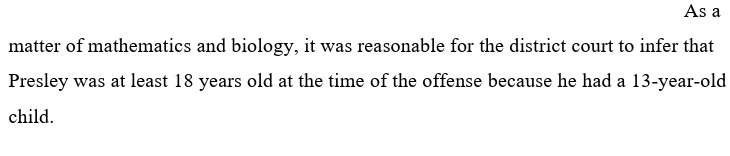
From State v. Presley, decided Dec. 26 by the Kansas Court of Appeals (opinion by District Judge Sean Hatfield, joined by Court of Appeals Judges Thomas Malone and Angela Coble):
In The Adventure of the Noble Bachelor, quoting Henry David Thoreau, Sherlock Holmes observed that "[c]ircumstantial evidence is occasionally very convincing, as when you find a trout in the milk." The days of furtively diluting milk with river water may be behind us, but that turn of phrase is still synonymous with the power of a fact proved with strongly convincing circumstantial evidence….
In March 2010, Presley was charged with three counts of aggravated indecent liberties with a child all occurring between June 1, 2009, and August 31, 2009. Each charge involved the same 13-year-old victim—referred to here under the pseudonym Jane—who was Presley's biological daughter…. [N]one of the counts alleged Presley was over the age of 18 at the time of the offenses…. {[Under the relevant statute, a]ggravated indecent liberties with a child under 14 years of age … [would lead to a presumptive sentence of 55 to 61 months] except when the offender is 18 years of age or older which statutorily makes the offense … [punishable by] life with a mandatory minimum of not less than 25 years before the possibility of parole. The fact that a defendant is 18 or older is an element of the offense ….}
Ultimately, the parties reached a plea agreement which was summarized by the trial court and confirmed by the parties. The State would seek a 25-year Jessica's Law sentence and agreed not to seek more than 25 years….
Some 13 years later, Presley filed back-to-back pro se motions to correct illegal sentence …. Presley argues that his no contest plea to one count of aggravated indecent liberties [should have led to a lower sentence] because the State omitted his age as an element from the complaint….
[T]he complaint did not explicitly include his age as an element. Yet … the district court could only accept his no contest plea if it was satisfied of the factual basis…. Any offense can be proved by circumstantial evidence if such evidence allows a fact-finder to draw a reasonable inference regarding the fact in issue….
Presley admitted to officers that he had inappropriately touched his daughter both at home and while she accompanied him on the road. Jane's statements to the investigating officers and preliminary hearing testimony corroborated this confession and established that at least one of the incidents occurred when Jane was 13 years old. As a matter of mathematics and biology, it was reasonable for the district court to infer that Presley was at least 18 years old at the time of the offense because he had a 13-year-old child.
Even further, Presley's job required him to hold a commercial driver's license. By statute, that license is not available to individuals under 18. We presume trial courts know the law. See So, it was reasonable for the district court to infer Presley's age at the time of the offense based on his employment as a truck driver during the relevant timeframe….
Kristafer R. Ailslieger, deputy solicitor general, represents the state.

Editor's Note: We invite comments and request that they be civil and on-topic. We do not moderate or assume any responsibility for comments, which are owned by the readers who post them. Comments do not represent the views of Reason.com or Reason Foundation. We reserve the right to delete any comment for any reason at any time. Comments may only be edited within 5 minutes of posting. Report abuses.
Please to post comments
A trout, a freshwater fish, would drown in any significant percentage of milk because it would mess up their gills. And what isn’t wildly known is that back? Then, in the days of hand, dug wells, people would often have a trout living in the well to eat all the flies, and such that fell into it, keeping the water clean.
That said, I’d want to see proof that it was his biological daughter, and that he actually HAD the CDL that he was supposed to have. A lot of people driving box trucks should have one, and don’t. For some reason, companies get away with this.
IMHO, the prosecutor should at least be reprimanded by the bar for shoddy work….
The proverbial trout isn't in the milk to keep it alive, fool.
Maybe the cow swallowed the trout and it was so small that it came out in the milking process.
The 'trout in the milk' is circumstantial evidence that the milk has been diluted with water. River or well water is irrelevant here, live or dead trout is irrelevant here, its the diluting of the milk while saying its not diluted that is the crime, its the fish that proves the dilution.
I had never heard the allegedly familiar trout in the milk saying.
There was a First Circuit case about diluting milk with salt water, which is federal food fraud. The guidelines offense level considers the value of all the milk that was or might have been mixed with the adulterated milk. There is no notion of being diluted to insignificance. One molecule of intentionally added salt acts homeopathically on millions of gallons of milk to render it criminal. Like when a man peed in a reservoir out West and the authorities declared all the water undrinkable.
What do people think that fish do???
I remember when North Conway NH lost a sewer lagoon into the Saco River -- I forget why, memory is flooding was involved.
Well above Saco, the Saco River is Class A (drinkable) water, and used by municipalities (including Old Orchard Beach, where I was living at the time) for drinking water. The official answer from the state DEP was that the volume of water in which the sewerage was diluted made it irrelevant.
The case brings back memories of the sentencing revolution of Apprendi and companion cases. What needs to be explicitly stated in the charging instrument even though it is undisputed?
This question comes up a lot and I have an appeal pending very, very similar to this.
The Apprendi line of cases seem to demand it. ALL facts which are necessary for the sentence imposed must be included in the indictment and proven beyond a reasonable doubt.
At first blush it seems overly technical. Since we know that this guy was over 18, why should he get a windfall because the prosecutor drafted a poor indictment? But, I would argue, once you set this precedent, how much easier is it for other more disputed elements to simply be assumed and not presented to a fact finder?
I think the downstream effects could be very pernicious and the only thing that would be required is for prosecutors to learn how to complete a charging instrument.
Except that he pleaded guilty, so there was no fact finder. I don't think you can waive a jury by pleading guilty (said waiver is supposed to be part of any plea colloquy) and then complain that a jury didn't find the relevant facts.
From my read though, the charging instrument in this case did not specify the age element. Therefore a guilty plea would admit the elements in the charging instrument but not more.
"Harmless beyond a reasonable doubt" review would save the Kansas case without creating a rule that the age element need not be charged or proved.
In my state (Texas), you have to object to defects in the indictment before trial or they're waived. As long as there's enough to identify who's being charged and invoke the jurisdiction of the court (such as charging a felony in a felony court), missing elements in the indictment don't defeat the sufficiency of the case. You'd still have to prove the elements at trial, of course, but he skipped that step by pleading guilty.
The summary of the opinion omits an essential component of what was decided. The defendant here had claimed the error involved was structural - that an indictment must allege each element of the crime including the age element or it was void ab initio and could not support a conviction regardless of the evidence.
The Kansas Court of Appeals addressed this and cited a Kansas Supreme Court case holding that age does not have to be specifically mentioned in indictments because the defendant’s age is implied in identifying the defendant. This was the basis for proceeding to the sufficiency of the evidence.
55 to 61 months if the offender is under 18? I hope there is some minimum age, because I recall certain doctor games with Jennie and Evie when we were all about 5.
In Kansas children under 14 may not be sentenced as adults. Children 14 to 17 years old may be sentenced as adults for some felonies, including statutory rape of a child under 14.
https://www.ksrevisor.gov/statutes/chapters/ch38/038_023_0047.html
There's an age of responsibility before you can get charged. In my state, it's 10. 10-16, you can be charged as a juvenile, 17+ as an adult, with 14-16 being able to be charged as adults if you meet certain extra requirements.
...


