

The Volokh Conspiracy
Mostly law professors | Sometimes contrarian | Often libertarian | Always independent
Thoughts on the Supreme Court Ruling Against Trump in the Illinois National Guard Case
The decision is a preliminary "shadow docket" ruling. But it strongly suggests the majority believes Trump's use of the Guard is illegal.
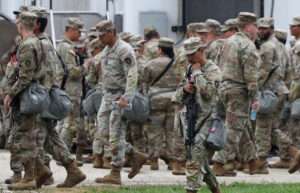
On Monday, in Trump v. Illinois, the Supreme Court ruled against Donald Trump in an important case involving his use of the National Guard for domestic law enforcement. The ruling is not a final decision on the merits; it is just a rejection of Trump's motion for a stay of the lower court ruling against him. But the Supreme Court decision strongly suggests the majority believes Trump's actions are illegal, and will rule against him when and if the Court considers the case more fully. In the meantime, Trump's use of the National Guard in Illinois remains blocked. I think the Court got this key issue right, though I might have preferred they rely on somewhat different reasoning.
The official rationale for Trump's use of the National Guard here is the supposed need to counter anti-ICE protests in the Chicago area, some of which had allegedly included elements of violence. In order to deploy the Guard, Trump invoked 10 U.S.C. Section 12406, which can only be used to federalize state National Guard forces and employ them for law enforcement in one of the following situations:
1) the United States, or any of the Commonwealths or possessions, is invaded or is in danger of invasion by a foreign nation;
(2) there is a rebellion or danger of a rebellion against the authority of the Government of the United States; or
(3) the President is unable with the regular forces to execute the laws of the United States
No one claims Illinois has been invaded, and - as the Seventh Circuit explained, there is pretty obviously no "rebellion or danger of a rebellion" in Chicago. Thus, Trump primarily relies on the argument that he is "unable with the regular forces to execute the laws of the United States." In an unsigned opinion, the Supreme Court majority rejected that claim:
The Government asked this Court to stay the District Court's order…. We directed the parties to file supplemental letter briefs on an issue that the District Court had addressed but the parties' initial briefs had not: the meaning of the term "regular forces" in §12406(3). In its supplemental brief, the Government argues that the term refers to civilian law enforcement officers, such as those employed by Immigration and Customs Enforcement or the Federal Protective Service.
Respondents, echoing the District Court, maintain that the term refers to the regular forces of the United States military. We conclude that the term "regular forces" in §12406(3) likely refers to the regular forces of the United States military. This interpretation means that to call the Guard into active federal service under §12406(3), the President must be "unable" with the regular military "to execute the laws of the United States." Because the statute requires an assessment of the military's ability to execute the laws, it likely applies only where the military could legally execute the laws. Such circumstances are exceptional: Under the Posse Comitatus Act, the military is prohibited from "execut[ing] the laws" "except in cases and under circumstances expressly authorized by the Constitution or Act of Congress." 18 U. S. C. §1385. So before the President can federalize the Guard under §12406(3), he likely must have statutory or constitutional authority to execute the laws with the regular military and must be "unable" with those forces to perform that function.
At this preliminary stage, the Government has failed to identify a source of authority that would allow the military to execute the laws in Illinois. The President has not invoked a statute that provides an exception to the Posse Comitatus Act. Instead, he relies on inherent constitutional authority that, according to the Government, allows him to use the military to protect federal personnel and property. But the Government also claims—consistent with the longstanding view of the Executive Branch—that performing such protective functions does not constitute "execut[ing] the laws" within the meaning of the Posse Comitatus Act. See Supp. Letter Reply Brief for Applicants 8; 1 Supp. Op. OLC 343, n. 1 (1971) (collecting sources). If that is correct, it is hard to see how performing those functions could constitute "execut[ing] the laws" under §12406(3).
This seems right to me. The term "regular forces" is one usually used in a military context, not one dealing with civilian law enforcement. For a more detailed defense of this position, see the excellent amicus brief by Georgetown law Prof. Marty Lederman, which may have influenced the Court.
At the same time, I think the stronger and more straightforward rationale for the Court's ruling would have been to simply endorse the district court's and the Seventh Circuit's conclusion that there was no breakdown of law and order sufficient to qualify as an "inability" to enforce the law, regardless of whether the term "regular forces" exclusively refers to the military or not. There is less ambiguity about this than about the meaning of "regular forces."
Taken literally, an "inability" to fully enforce the law always exists. In virtually every community there are people who get away with violating federal law. For example, over 50% of adult Americans admit to having used marijuana at some point in their lives; marijuana possession is a federal crime. Many have also violated other federal laws and regulations without getting caught. Moreover, if "inability" exists anytime federal law isn't fully enforced, it makes the "invasion" and "rebellion" prongs of Section 10246 redundant, since those circumstances virtually inevitably create situations where federal law cannot be fully enforced. Thus, I think Section 3 applies only when there is a general breakdown of law and order, as may happen when there is large-scale rioting or the like.
Justice Kavanaugh concurred in the result, making it a 6-3 decision. But he argues the majority's reasoning went too far. He does, however, seem to agree with the basic point that the "regular forces" referred to in Section 3 are regular military forces, and that Section 3 therefore can only be used invoked in situations where the president is authorized to use the military.
In a dissent joined by Justice Thomas, Justice Alito argues that the court violated the "party presentation" rule, which requires decisions to consider only issues raised by the parties. I am no expert on party presentation, so perhaps I am missing something here. But it seems to me that the issue of what qualifies as inability to "execute the laws" with "regular forces" clearly was raised, and that's enough for the Court to be able to consider whether "regular forces" are limited to the military or not. In addition, as the majority notes, the Supreme Court actually asked for additional briefing on this very issue. At SCOTUSblog, Dan Epps offers additional considerations that weigh against Alito's position.
Alito also argues that the disturbances caused by the anti-ICE protests were more substantial than the district court ruling indicates. I think the district court is much more persuasive on this issue. In addition, appellate courts are not allowed to overturn trial court factual findings unless the latter are "clearly erroneous," and there is no such blatant error here.
Justice Gorsuch wrote a separate dissent in which he partially agreed with Alito's analysis, such as on the party presentation question. But - much more than Alito and Thomas - he leaves open the possibility that he might ultimately decide the case in favor of Illinois, including on both statutory and constitutional grounds.
As Dan Epps points out, a footnote in Justice Kavanaugh's concurring opinion seems to backtrack on his previous endorsement of the use of racial profiling in immigration enforcement. In footnote 4, Kavanaugh states the following:
The Fourth Amendment requires that immigration stops must be based on reasonable suspicion of illegal presence, stops must be brief, arrests must be based on probable cause, and officers must not employ excessive force. Moreover, the officers must not make interior immigration stops or arrests based on race or ethnicity. Cf. Whren v. United States, 517 U. S. 806, 813 (1996) ("[T]he Constitution prohibits selective enforcement of the law based on considerations such as race").
By contrast, in his much-criticized concurrence in Noem v. Vasquez Perdomo, he said racial profiling is acceptable, so long as race isn't the only factor considered:
To be clear, apparent ethnicity alone cannot furnish reasonable suspicion [for an immigration stop]; under this Court's case law regarding immigration stops, however, it can be a "relevant factor" when considered along with other salient factors.
As Epps notes, "the two statements are reconcilable if one interprets based on' as 'based on alone,' but in my view a more natural sense of that phrase is that a decision is 'based on' a fact if that fact is a relevant (and perhaps decisive) factor in the decision." Epps speculates Kavanaugh might be trying to "walk back" position on this issue, as a result of the widespread criticism it attracted. I hope Epps is right! For reasons I outlined in my critique of the Perdomo ruling, Kavanaugh's approach in that case was badly wrong, and should be rejected by anyone committed to the constitutional principle of color-blindness in government policy.
As Jack Goldsmith notes in his analysis of the Supreme Court's rejection of the stay, this decision may not end Trump's efforts to use the military for law enforcement. He could instead resort to the Insurrection Act. Conventional wisdom suggests the president is supposed to get great, possibly preclusive deference when invoking that law, though I think that conventional wisdom is significantly overblown. For reasons I outline here, when the executive invokes sweeping emergency powers, courts should carefully scrutinize whether the type of emergency needed to trigger their use actually exists. I may have more to say about that issue later.
The legal struggle over Trump's domestic use of military forces is by no means over. But Monday's ruling is a significant victory for opponents of this egregious abuse of power. As Goldsmith also points out, the ruling is likely to impact not just the Illinois litigation but similar ongoing cases in California and Oregon. I summarized those cases in my post about the Seventh Circuit ruling in the Illinois case.




