The Volokh Conspiracy
Mostly law professors | Sometimes contrarian | Often libertarian | Always independent

Today in Supreme Court History: November 29, 2004
Editor's Note: We invite comments and request that they be civil and on-topic. We do not moderate or assume any responsibility for comments, which are owned by the readers who post them. Comments do not represent the views of Reason.com or Reason Foundation. We reserve the right to delete any comment for any reason at any time. Comments may only be edited within 5 minutes of posting. Report abuses.
Please to post comments

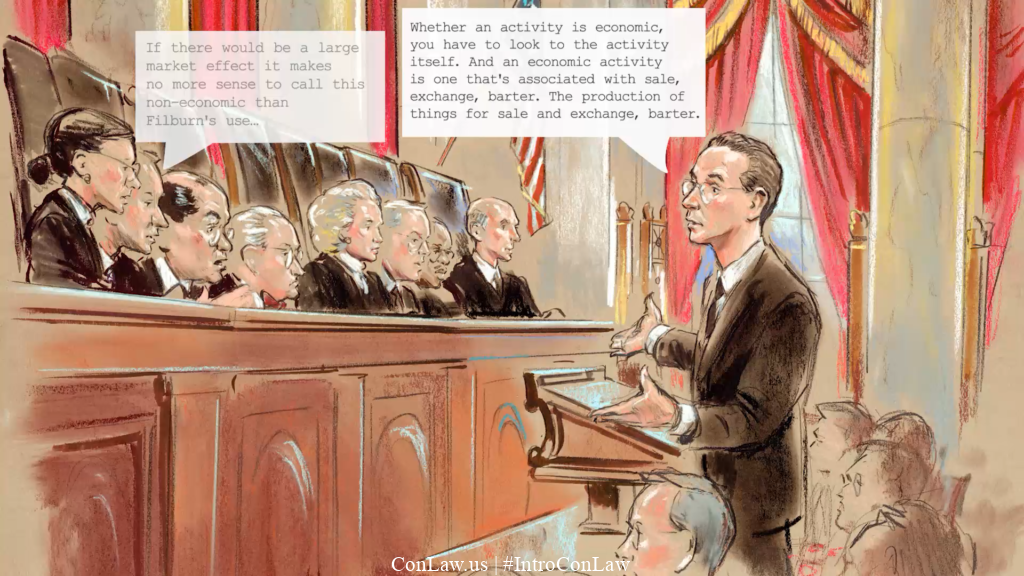
Both sides on the Court handed down opinions against their policy choices. Stevens, in an interview, noted he opposed the criminalization of medicinal marijuana. O'Connor (dissent) was more supportive. That is somewhat reassuring.
The facts make this an easier case for the majority than some possible scenarios. This is not merely about simple possession.
I think the majority is correct. The opinion provides the facts.
The issue of a medical necessity defense in certain cases (see, e.g., Stevens concurrence in United States v. Oakland Cannabis Buyers' Coop) is another matter.
I also think there is a constitutional interest in the use of marijuana for health reasons. An aspect of the right to privacy. Justice Tom Clark suggested in a 1970s article that possession overall is included. State judges have talked about that, including in reference to state constitutions (Ravin v. State).
That avenue was not open to the court of appeals, given the state of current law. It should, however, be considered when crafting federal and state policy.
I think the majority was clearly wrong. Even if Interstate Commerce is a plague that permanently infects everything it wver touches, it shouldn’t infect things that merely resemble things it might touch or that it could potentially touch in the future.
But even if it does, Congress had forbid interstate commerce in marijuana in its entirety. There was no lawful stream of interstate commerce for simple intra-state growing for personal use to become a part of. In Wickard actually was a commodity of interstate commerce. Here it WASN’T. When Congress bans interstate commerce in a commodity, there is no interstage stream to make intrastate commerce relevant.
As long as it stays within a state, what plays within a state is none of the federal government’s damned business.
Why the reference to "a plague" or "infects"?
The metaphors are suggestive of personal beliefs. What it tells about the actual constitutional text and commands is less clear.
Congress regulates "commerce with foreign nations, and among the several states, and with the Indian tribes" in a variety of ways. Including trying to destroy interstate markets in goods it deems dangerous, partially because it "infects" other interstate commerce in various ways. For instance, certain poisonous foods. Or drugs.
To use caps, there WAS "interstate commerce." It does not merely "stay in the state," and even when it does, it interferes with a federal interest Congress can regulate.
An illegal market is still a form of commerce. Which Congress is trying to suppress. As Scalia notes separately:
To effectuate its objective, Congress has prohibited almost all intrastate activities related to Schedule I substances—both economic activities (manufacture, distribution, possession with the intent to distribute) and noneconomic activities (simple possession).
Both the majority and concurrence [which included two members of the Lopez Court] explain how regulating such items is an acceptable part of congressional power over commerce and a necessary and proper regulation advancing that end.
The language is from Judge Calvert’s dissent in United States v. Bryan (11th Cir. 2025).
https://media.ca11.uscourts.gov/opinions/pub/files/202212792.pdf
And the metaphor is apt. As Judge Calvert wrote, the conviction of the defendants was held to come under interstate commerce because they briefly rode on a truck in an otherwise completely local crime, and a truck is considered an “instrumentality of commerce” such that any use of it - perhaps any touching of it - makes whatever one happens to be doing come under interstate commerce. A plague that infects everything it touches is a very accurate description of how a considerable amount of current commerce clause jurisprudence works, including the opinion finding the defendants’ conduct to fall within interstate commerce.
Now that we’re past the red herring distraction, perhaps you could address the argument. The same constitutuonal method of interprepretation could be used to reduce numerous other limits on federal power to nullities, including many parts of the bill of rights. Most have accepted exceptions. One need merely allow the exceptions at one remove, and they swallow the rule every bit as much as the commerce clause’s current interpretation swallows the rule against a general federal police power. If anything sone with an “article of commerce” is subject to the federal commerce power, why shouldn’t anything done with an “article of border crossing” be subject to the border-crossing exception to the 4th Amendment? If a crime involves an article or instrumentality of border crossing, it’s as legitimate to as part of the stream of border crossing activities subject to the border inspection exception to the 4th Amendment rule against warrantless general searches and seizures, as it is to regard it as interstate commerce subject to the Commerce Clause exception to the rule against a general federal police power.
Additional note: People who criticize judicial opinions are not basing their arguments on them. Any critique of anything looks to something outside that thing to explain why the critic believes it’s wrong. So objecting to a critique of judicial cases on grounds it isn’t based on those cases is essentially asserting that what judges do is above criticism. Do you really believe that?
I don't think we are past red herring distractions. Your whole reply comes off as one. The last paragraph is also a tad convoluted.
No, it was quite clear and to the point: The style of rationalization used to reduce the interstate commerce clause to, "To regulate;" could negate any other constitutional limit it was deployed against.
It is a plague on constitutional jurisprudence.
There’s no point arguing with a solipsist. A solipsist just isn’t capable of conceiving of, let alone considering or responding to, any other point of view than his own. If you mention anything other than what’s in his head, he’ll say he doesn’t understand, or it’s irrelevant, or it’s something you must be making up because it’s just not there. A solipsist isn’t capable of dialogue. Either you’re in tune with the monologue, or you’re distracting noise.
It seems to be that the logic for applying the border exception to the 4th Anendment at one remove is just as valid as that for applying the Commerce Clause. If the 4th Amendment doesn’t apply to border inspections, it’s an equally valid argument, as unimpeachable a judicial decision, to say it doesn’t apply to everything necessary and proper to border inspections. If place or thing to be searched contains or is constructed with or is an article that once crossed the border or is the sort of thing that might someday cross the border, the border exception to the 4th Amendment ought to apply by exactly the same logic as the interstate commerce exception to the prohibition on a general federal police power.
The argument that progress and modernity require seeing international commerce as a single continuous stream rather than an archaic fixation on physical crossing of fixed physical borders strikes me as every bit as valid and legitimate as the same argument made about interstate commerce. The notion of a sphere of personal privacy with any but the rarest of actual existance is every bit as fundamentally archaic and inimical to progress, every bit as contrary to fundamental constitutional values, as the notion of a sphere of inteastate commerce with any but the rarest and most empheral of existences.
Requiring a search warrant for failing to establish tbe jurisdictional element for the border exception ought to be as rare an event as overturning a federal prosecution for failing to establish the jurisdictional element for the imterstate commerce exception. An expansive interpretation of both is equally legitimate.
Indeed, preferring an expansive and liberal interpretation to one but a cramped, rigid, and archaic interpretation of the other is simply arbitrary happenstance. There’s no rational basis for being willing to apply the argument in one area but refusing to apply it both. If it’s a good argument, it ought to equally eviscerate ALL relevant constitutional limitations. And there are quite a few it could be applied to.
As just one more example (of many possible), the police ability to shoot dangerous suspects, ought to be applied to suspects who were once dangerous in the past, might be dangerous in the future, or who know somebody who might be dangerous, or for that matter to doing anything necessary and proper to suppressing dangerousness. Why should dangerousness be interpreted in a cramped, archaic direct manner when it’s equally susceptible to being interpreted at one remove? The logic for necessary and proper getting an expansive interpretation is not only every bit as good, there’s a very good argument it’s better. After all, we’re dealing with with DaNGEROUSNESS here. Why shouldn’t that open archaic constitutional doors and get around cramped literalist constitutional obstacles at least as much as regulating interstate commerce?
That video which those senators made about disobeying illegal orders was immoral.
- It was prefaced with the statement that American trust in the military is at risk (it is not)
- It was prefaced with the claim that this administration is pitting the military and intelligence communities against the American people (it is not)
- these claims about the Trump administration were directed expressly toward the troops, in their capacity as troops. Thus, even if the criticisms were correct, they should have been made to the general public, not specifically to the troops.
- Upon questioning by Rachel Maddow, Mark Kelly could not specify which illegal orders were recently made, only saying, "You don't want to wait for your kid to get hit by a car before you tell them to look both ways"
Really interesting look back at this moment in Supreme Court history. It’s always fascinating to see how cases from years ago still influence current legal debates and public discussion. In the middle of exploring topics like federal authority and individual rights, tools like https://isneak.pro/ highlight how modern technology is changing the way people analyze information and follow public activity online. It adds a whole new layer to how we understand transparency, privacy, and how legal issues continue to evolve over time.