
Orwell in Argentina
Dark clouds are gathering in Buenos Aires.
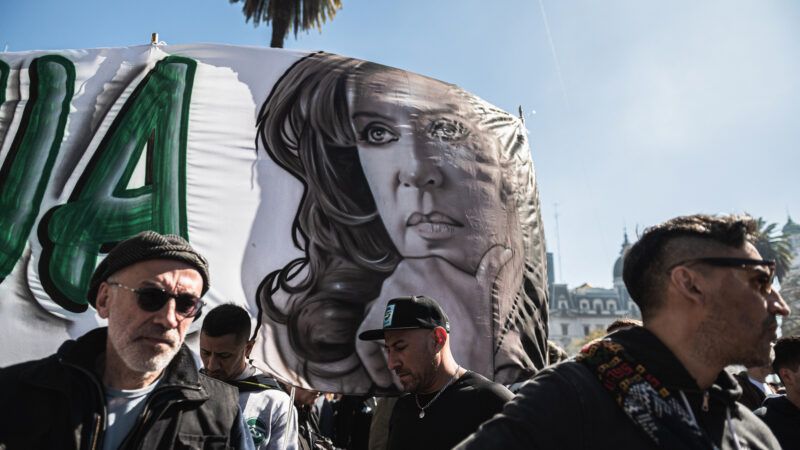
On September 1, a crowd gathered outside the Buenos Aires home of Argentina's vice president, Cristina Fernández de Kirchner (also known as CFK). They were there to signal support after a prosecutor asked for 12 years in prison for Kirchner following a corruption scandal that took place while she was president between 2007 and 2015. As CFK left her car and approached the building where she lives, a Brazilian man named Fernando André Sabag Montiel pointed a gun to her head. It misfired: Nobody was injured in the incident and crisis was averted. What came next, though, was deeply troubling.
Just as Argentines were recovering from the shocking news of the assassination attempt, the government decided to use it to go on the offensive against its political opponents. At midnight—despite the lack of any indication that the attack was politically motivated—President Alberto Fernández declared a national holiday for "reflection," contended that "hate" and "political violence" must be fought, and called for the masses to mobilize "in defense of democracy." In a message he forced all TV and radio stations in the country to broadcast, he accused the opposition, the media, and even the judiciary of being hateful. The implication was clear: Those who opposed him were at least partially responsible for the attempted assassination.
The day after the incident, Twitter users began reporting that public employees were being forced to sign declarations supporting the vice president and opposing "political violence." Supporters of the Fernández administration began harassing online influencers who do not generally comment on politics, attempting to bully them into joining the government narrative. Finally, and even more worryingly, officials began calling for the passage of a "law against hate" that would criminalize, among other things, "offensive" speech on social media.
But who is to define what hate is? And why the sudden focus on political violence allegedly perpetrated by Fernández and Kirchner's political opponents? The military today is not a player in national politics in Argentina, as it has been at times in the past; there are no politicians calling to overthrow the current government through force; and opposition-backed violent actions simply are not a part of daily life here. If anything, it is within kirchnerista circles that violent means have occasionally been praised. Only a few years ago, for example, a notorious Kirchner supporter suggested that Taser guns should be tried on the family of former president and now opposition leader Mauricio Macri before being used by the police. Some former government officials have even publicly demanded that Macri be hanged.
At this point, nobody can say why Sabag Montiel tried to shoot CFK. Though he was declared mentally fit to testify, he has refused to do so. All that is known is that Sabag Montiel, who routinely sought to be interviewed by journalists on the streets of Buenos Aires before the attack, has Nazi tattoos and appears to follow a number of occult beliefs on social media. He has shown no allegiance to any leaders or parties in the Argentine political landscape, and he has provided no indications that his actions were motivated by politics.
The sudden preoccupation with political violence comes at a convenient moment for the current administration. Recall that Kirchner stands accused of corruption; Argentina's economy is a mess; and opinion polls show that both the president and the vice president are deeply unpopular. To blame the opposition, sans evidence, for the assassination attempt against CFK reeks of a desperate attempt to change the subject. But it is also worrisome. Could the government be setting itself up for impunity? Sen. José Mayans, an ally of Fernández and Kirchner, is now demanding that corruption trials be suspended "in exchange for social peace"—an indirect threat to the judiciary.
The government's reaction to the assassination attempt is about more than distracting attention from corruption, however. The incident has provoked a resurgence for the relato—literally, a story or narrative, and the word commonly used to describe the Orwellian framing with which kirchneristas continuously seek to build an alternate reality where everything goes right or, if something does go wrong, their enemies are at fault. In 2015, that fairytale tried to convince Argentines that poverty was higher in Germany than at home. (In reality, even without taking into consideration purchasing power differences, during that time poverty was never below 27 percent in Argentina and above 15 percent in Germany). Today, the same fairytale blames businesses for the 100 percent annual inflation rate that Argentina is fast approaching. State truths, such as the one that says that opposition-driven "hateful" discourse is causing political violence, are not to be questioned: This seems to be the motto of the current regime.
In the past, Argentina has experienced authoritarian governments that made occasional turns toward totalitarianism. Juan Perón, for example, incarcerated political opponents and expropriated their assets even as he made himself out to be the "liberator" of the nation in school textbooks. Kirchneristas, who seek to vindicate Perón's legacy, are without any doubt headed in that direction. Whether they succeed or not will depend on many factors, particularly the state of a faltering economy that may cause the current administration to lose next year's presidential election. Nevertheless, dark clouds are gathering in Buenos Aires.
