
Give Nixon, McCain, and Bush Some Blame for Trump's Campaign Finance Trouble
Republicans all too often adopt themselves many of the most misguided beliefs of the left. Among these misconceptions: money is inherently corrupt.
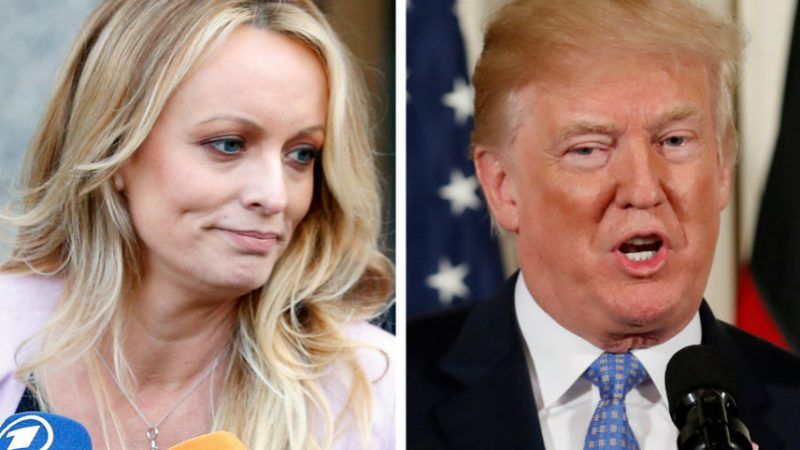
President Trump has been trying to blame the Democrats for the effort by federal prosecutors to depict payoffs to two women as campaign finance violations.
If only it were that simple.
Trump is correct to perceive campaign finance law at the heart of the matter. Actually, though, any accurate accounting of blame for it has to include three Republicans — President Nixon, Senator McCain, and President George W. Bush.
It was Nixon who, on February 7, 1972, signed into law the Federal Election Campaign Act of 1971.
In his statement, Nixon declared that the law "limits contributions by candidates and their families to their own campaigns." He added that, "By giving the American public full access to the facts of political financing, this legislation will guard against campaign abuses and will work to build public confidence in the integrity of the electoral process."
Coming from a president known for resigning amid the Watergate investigation, the language about guarding against campaign abuses and building "public confidence in the integrity of the electoral process" seems rather rich in retrospect. The whole episode is emblematic of the big long-term story of campaign finance law. It's been about the appearance of propriety, rather than about genuine integrity. And it's been a failure. Public confidence in the integrity of the electoral process has steadily declined notwithstanding the passage of the 1971 Act and subsequent similar measures.
For the subsequent measures, at the federal level, one of the main culprits was John McCain, who championed what became known as the McCain-Feingold Act, or the Bipartisan Campaign Reform Act of 2002. President George W. Bush, in signing into law a measure he acknowledged presents "serious constitutional concerns," nonetheless claimed, laughably, that "all of the American electorate will benefit from these measures to strengthen our democracy."
That these laws are now being used to attack a Republican president is a kind of poetic justice. One might be more sympathetic to Trump if he weren't a victim of laws enacted by his own party's leadership over the warnings of far-sighted and principled critics, such as Senator Mitch McConnell, who warned that they were deeply misguided.
The campaign-finance mindset encapsulates the way Republicans all too often adopt themselves many of the most misguided beliefs of the left. Among these misconceptions: money is inherently corrupt. Passing extensive and complex laws and regulations will somehow help disadvantaged people rather than further advantage those already in power. And the laws will somehow change fast enough to keep up with the technological change.
Our campaign finance laws were enacted in 1972 and 2002 to guard against rich individuals or companies writing large checks with which campaigns might buy commercials on the three major broadcast television networks. Since then, though, Barack Obama and Bernie Sanders showed how to raise recurring credit card donations from small donors using web-based and email appeals. Campaign funds are spent more efficiently on Facebook ads or YouTube videos than on broadcast television.
It takes a special sort of hubris to think that the law can stay ahead of all this.
The sentencing memo from federal prosecutors in the Southern District of New York argues that a lawyer for the Trump Organization, Michael Cohen, "sought to influence the election from the shadows…by orchestrating secret and illegal payments to silence two women who otherwise would have made public their alleged extramarital affairs….in the process, Cohen deceived the voting public by hiding alleged facts."
Whatever deception may have taken place here pales beside the prosecutorial theory that Trump was somehow elevated to the presidency by voters whose primary polling-place concern was the candidate's history of marital fidelity or lack thereof. The highest-ranking New York prosecutor whose name is at the bottom of the sentencing memo is one "acting United States attorney Robert Khuzami," who spent from 2002 to 2009 as a top in-house lawyer at Deutsche Bank. In 2008, while Mr. Khuzami worked at Deutsche Bank, Trump sued Deutsche Bank over the terms of a loan and its role in the financial crisis, complaining about what the suit called the bank's "predatory lending practices."
It's probably too much to hope that Trump would channel his annoyance at the New York charges into an effort to repeal the current campaign finance regime and replace it with a system that would make more clear that it's not a federal felony for a candidate to spend his own money to preserve his own reputation or marriage, with or without disclosing the expenditure. Whatever steps Trump does take on the campaign finance law front, it's hard to imagine he can do any worse than his Republican predecessors, Nixon, McCain, and George W. Bush.
Ira Stoll is editor of FutureOfCapitalism.com and author of JFK, Conservative.
