

Albuquerque Pays Nearly $1 Million to a Man Who Was Critically Injured When Its Police Chief Ran a Red Light
Harold Medina, who T-boned Todd Perchert's Mustang in 2024, was reprimanded for "unsafe driving practices" and failing to activate his body camera after the crash.
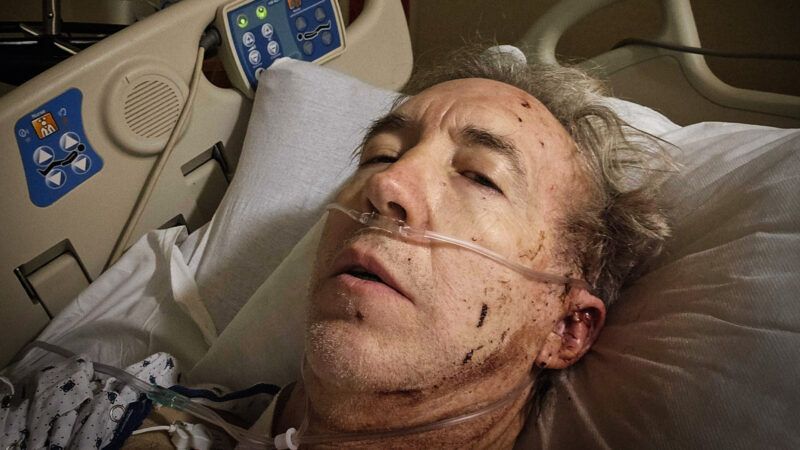
Albuquerque, New Mexico, recently paid $950,000 to settle a lawsuit by a man who was critically injured in February 2024 when Harold Medina, then the city's police chief, ran a red light and T-boned his car. Medina, who was avowedly oblivious to a pervasive, long-running police bribery scheme that became the biggest law enforcement scandal in New Mexico's history, likewise did not seem aware of Todd Perchert, then 55, who was driving his 1966 Mustang to a classic-car meetup on a Saturday morning when Medina violently interrupted his plans.
Without activating his siren or emergency lights, Medina drove his police truck through a red light at the intersection of Alvarado Drive and Central Avenue, narrowly averting a collision with westbound cars. Then he barreled across the eastbound lanes of Central Avenue, ramming into the side of Perchert's car. The cherished Mustang was totaled, and Perchert was left with eight broken ribs, a collapsed lung, a broken collarbone, a fractured shoulder blade, face gashes, and multiple lacerations. Medina's explanation: He was in a hurry to escape an altercation between two homeless men that had escalated into gunfire.
After the crash, Albuquerque Mayor Tim Keller improbably portrayed Medina's conduct as heroic. "This is above and beyond what you expect from a chief," Keller told reporters. "I'm grateful for Harold Medina." The mayor averred that Medina was "out on the front line" and "doing what he can to make our city safe" by "disrupting an altercation" and "trying to do what's right." And after colliding with Perchert, Keller added, the beneficent police chief was "trying to make sure that folks are OK."
Perchert, who underwent seven hours of surgery and was hospitalized for weeks, was definitely not OK. "Todd did nothing wrong that morning," his lawyer, James Tawney, noted. "He was an innocent motorist who had the right of way. He suffered devastating injuries because of the actions of someone entrusted with protecting the public." Tawney said Perchert's injuries continue to "affect his mobility and his everyday activity."
In a self-exculpating video that Medina recorded after the crash, he said, "I looked to my left, and the intersection was cleared." That is plainly not true, since surveillance camera footage showed that Medina drove in front of a westbound car that was entering the intersection, forcing the driver to stop suddenly in order to avoid a collision. As he was crossing the eastbound side of Central Avenue, Medina says, "I thought that…the car was going to pass before I got there, and it did not. And unfortunately, I struck the vehicle. The occupant of the other vehicle was injured, and it's just another sign of how gun violence sometimes impacts our community."
The Albuquerque Police Department's Fleet Crash Review Board (CRB), which consists of four officers and a civilian, accepted that dubious framing. Two months after the crash, the CRB unanimously accepted Medina's excuse for his reckless driving, deeming the collision "non-preventable." James Ortiz, a lieutenant with the department's Internal Affairs Division who conducted a separate investigation, disagreed.
While "the initial decision to enter the intersection is not in question," Ortiz said in a July 2024 report, "the facts and circumstances do not relieve department personnel of driving safely to ensure no additional harm is done to personnel or to citizens." Medina, Ortiz said, clearly failed to do that: "By definition, driving into a crosswalk, darting between two vehicles driving on a busy street, and crossing through an intersection with vehicles traveling eastbound were unsafe driving practices."
Ortiz not only rejected the CRB's conclusion about Medina's crash; he said the board never should have reviewed the incident to begin with, since its mission is limited to accidents "not resulting in a fatality or serious injury." Ortiz said Commander Benito Martinez, the CRB's chairman, violated department policy when he decided the board should pass judgment on Medina's accident.
Ortiz identified a third policy violation: Medina's failure to activate his body camera following the crash. "After the collision occurred, the shooting victim approached," Ortiz wrote. "The victim informed the Chief that he was okay and had not been shot. Chief Medina asked the victim to remain at the scene, but the victim refused and fled southbound on Alvarado. Another citizen approached the Chief and reported having seen individuals leaving a black truck and fleeing away from the scene. Chief clarified with the witness that no one was outstanding. It is important to note that these interactions were not recorded and are contacts that require mandatory recording."
That mandate is not just a matter of police department policy. State law requires that on-duty police officers wear body cameras and that they activate them when "responding to a call for service or at the initiation of any other law enforcement or investigative encounter between a peace officer and a member of the public." The statute adds that "peace officers who fail to comply" with such requirements "may be presumed to have acted in bad faith and may be deemed liable for the independent tort of negligent spoliation of evidence or the independent tort of intentional spoliation of evidence."
Medina offered two puzzling excuses for leaving his camera off. He "cited intermittent conversations with his wife, who was a passenger in his unmarked patrol vehicle at the time of the collision," Ortiz wrote. "He claimed there was a right to privileged communication between spouses, which specifically exempted him from mandatory recording requirements." But the relevant policy "does not provide for nonrecording based on spousal privilege."
Even more troubling, Medina said he "purposefully did not record because he was invoking his 5th Amendment right not to self-incriminate." Since "he was involved in a traffic collision," he reasoned, he was "subject to 5th Amendment protections."
Think about the implications of that argument. Body cameras are supposed to help document (and perhaps deter) police misconduct. But Medina, who was in charge of the Albuquerque Police Department (APD), suggested that cops have a constitutional right to refrain from recording their interactions with the public whenever that evidence could be used against them. By turning on their cameras in those situations, he argued, police could be incriminating themselves.
Medina received two official reprimands for the camera violation and the reckless driving that injured Perchert, a casualty of the police chief's desperation to save his own skin. In similar situations, other Albuquerque police officers have been fired.
Medina, by contrast, was rewarded with a brand-new Ford Expedition to replace the vehicle he wrecked. ABQ Raw reports that the SUV cost about $90,000 and "was outfitted with more than $20,000 in additional comfort and luxury features," including "an $18,000 snazzy looking Timberline trim package, a $1,675 power panoramic sunroof for viewing the beautiful NM skies, and nearly $4,000 for an upgraded four-wheel drive system."
Medina retired last December after serving a total of 28 years with the APD, including five as chief. According to ABQ Raw, he was honored with "a retirement video posted to APD's social media" and a "police escort from APD's Main Police Station to his home in Corrales, New Mexico."
Medina won't have to dip into his pension to cover the payment to Perchert, since the city's Risk Management Fund takes care of such settlements. "No amount of money can take away what happened to Mr. Perchert or undo the physical and emotional toll this crash has taken on him and his family," Tawney said. "While nothing can change what happened that day, we are pleased with this resolution and hope it gives Todd and his family some closure."
Gilbert Gallegos, the APD's director of communications, also tried to look on the bright side. "Fortunately," he said, "nobody lost their life as a result of the accident or the shooting that led to the crash."



