

If Democrats Win Big Again in 2028, Here's What It Might Mean for Sports
Regulating college sports might be dead in the water for now, but it could get a whole lot worse.
Hello and welcome to another edition of Free Agent! It's a great week to flip that coin.
Democrats will control Congress! We'll get into what it means at length for college sports, then touch on a few other angles after that. We'll close with some thoughts on NASCAR's new playoff format.
Don't miss sports coverage from Jason Russell and Reason.
Locker Room Links
- The College Football Playoff expansion to 24 teams is official. (Not great!)
- From Awful Announcing: "Is a sports media blue wave coming, too?"
- Blue Jays player Anthony Santander was not happy that Michigan Democrat Abdul El-Sayed won his Senate election and reposted two Instagram videos that said "America voted for Sharia" and "Islam is not peaceful." The Blue Jays distanced themselves from the statement.
- After an international court ruled that Russia must be allowed in international hockey tournaments, the Canadian government is refusing to issue visas to Russians for the upcoming World Junior Ice Hockey Championships.
- Colorado passed a higher income tax, and the state's professional athletes are getting hit with it. (Those states with no income tax must look nice!)
- The SEC might implement a luxury tax to discourage high spending on athletics. (We'll see if Democrats and the courts have anything to say about that.)
- Voters in Pickerington, Ohio, keep rejecting tax increases, so the school district cut nonvarsity sports.
- Elsewhere in Reason: "California Voters Reject 5% Billionaire Wealth Tax"
- God bless the people who do things like systematically grade field stormings in their free time:
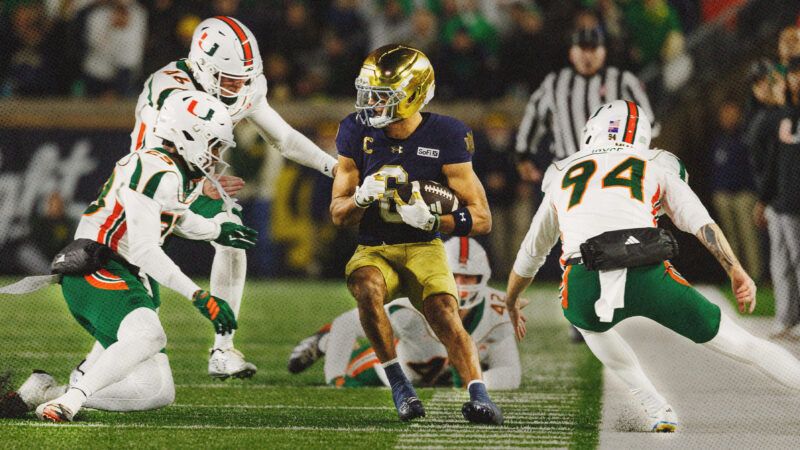
Notre Dame just stormed the field as a 7-point favorite.
Grading every field storm since 2019 on:
- the line
- who you beat
- your own program
- how close to defeatBeating No. 1 counts for a lot.
Being a home favorite counts against you.This grades as a D, 14th worst https://t.co/Jks7k9xIwP pic.twitter.com/qgzHzcfsgQ
— Stick to the Model (@StickToTheModel) November 8, 2026
The Midterms Upended the Push for College Sports Regulation
You already know Democrats won big in the 2026 midterm elections. The question is, what if it happens again in 2028? And what would it mean for federal regulation of college sports?
The Protect College Sports Act (PCSA) passed the Senate in September. Despite all the problems with it, its backers hope the House of Representatives will pass it swiftly now that they've returned from recess. (I'm old enough to remember when Sen. Ted Cruz [R–Texas] predicted the House would come back from recess early so President Donald Trump could sign the bill on College GameDay before the midterm elections.)
But last week's blue wave might be the final nail in the coffin for the Protect College Sports Act, or at least this version of it.
"If you want a quote, here it is," the aide said, "the NIL bill is dead on f****** arrival."
It's time for college sports to move on from the PCSA. https://t.co/bQrf5FEcM2
— Mit Winter (@WinterSportsLaw) November 5, 2026
Why would Democrats give Trump a win? Why wouldn't they wait out two years until, they hope and assume, a Democrat sweeps into the White House with even-larger majorities in Congress? And if that happens, what might their partisan, Democrats-only version of the bill look like? It could radically change college sports forever.
A few pieces of legislation introduced by Democrats in 2025 give us a useful preview.
The more mainstream bill introduced by Democrats last year was the Student Athlete Fairness and Enforcement (SAFE) Act. Like the PCSA, it was written in part by Sen. Maria Cantwell (D–Wash.), so the two bills have a lot in common. The PCSA and the SAFE Act both, in differing ways, give conferences and schools an antitrust exemption to pool their media rights. However, the PCSA shields the NCAA and conferences from antitrust lawsuits for enforcing the PCSA's rules, while the SAFE Act does not. The PCSA caps athletes' compensation; the SAFE Act does not alter the current cap under the legal House settlement. The PCSA codifies the NCAA's newly desired five-year eligibility rules—the SAFE Act doesn't do that, but was introduced before the new NCAA rules. The PCSA allows one free transfer; the SAFE Act allows two (both allow more with certain exceptions). The PCSA basically bans the power conferences from merging, but the SAFE Act does not.
The SAFE Act doesn't mention anything about student-athlete employment status, while the PCSA explicitly says it is neutral and does not alter that status, but a more radical Senate bill differs on that: the College Athlete Right to Organize Act, introduced by Sens. Chris Murphy (D–Conn.), Elizabeth Warren (D–Mass.), and Bernie Sanders (I–Vt.). That bill is short and narrow, but it explicitly recognizes student-athletes as employees of their colleges with rights to collectively bargain with their schools and conferences (but not the NCAA). That bill did not move through committee, and its three cosponsors all voted against the PCSA. You can bet they and several other Democrats would demand unionization rights for college athletes be included in any kind of legislation passed in the future.
Lastly, there's the College Athlete Economic Freedom Act, introduced by Murphy with no Senate cosponsors. The bill would prevent the NCAA and conferences from limiting name, image, and likeness (NIL) payments—unless the limit was reached through collective bargaining with athletes. Athletes would be free to organize and be represented by a union, agent, or lawyer. Collectives would have to register with the Federal Trade Commission and would be required to "not discriminate, on the basis of gender, race, or participating sport, in the facilitation of name, image, or likeness agreements for college athletes in the athletic program of, or prospective college athletes for, any particular institution of higher education." (Unclear if this means this spending must be equal, or just not discriminatory somehow.) It also creates a new visa category for international athletes and says NIL payments don't violate the visa terms.
Combined, the three bills show a lot of agreement with the bones of the PCSA, but with an extra push for collective bargaining rights for athletes. Maybe Democrats can get some version of that through, or maybe union rights would cause the NCAA, conferences, and schools to mobilize enough votes against it.
In the meantime, college sports will almost certainly continue to grow and thrive without the "help" of burdensome federal regulation.
If Democrats Take Control, What About Everything Else in Sports?
What else could Democrats do if they take full power of the federal government in 2028?
It's probably bad news for prediction markets and sportsbooks. If the courts don't decide the issue before 2029, a Democratic president could easily withdraw the regulations that prediction markets have been operating under, classifying them as sportsbooks that can be regulated by states. Sportsbooks might not be allowed to advertise during live sports broadcasts, and could be banned from offering prop bets on college athletes (as one bill introduced by Sen. Richard Blumenthal [D–Conn.] proposed).
The federal government might also get more involved in regulating TV broadcasts, and it could upend some of the economics that modern sports leagues are based on. Sen. Tammy Baldwin (D–Wis.) has a bill that would require major pro sports leagues to have a free live-viewing option for a team's entire home state. Local blackouts would also be banned on out-of-market streaming services offered by leagues. Some Democrats also want to strip leagues of their antitrust exemptions that allow teams to pool their media rights together for more revenue. (If TV revenues drop, where do you think leagues will turn for more money? Probably ticket prices!)
It's also possible Democrats, through legislation or executive action, might try to require pro leagues, college sports, or high school sports to allow transgender athletes in female sports. Semi-relatedly, recall that former President Joe Biden tried to require schools to spend "proportionate" NIL money on male and female athletes under Title IX—the next Democrat president might do the same, even if the order would end up in court.
I also wouldn't be surprised if Democrats decide it's time to start directly spending federal funds on Olympic sports—which sounds nice, until you consider the gross size of the national debt and all the political meddling this would involve in what's been a successful Olympic model.
At the state level, expect blue states to raise taxes, especially on the wealthy—that could widen the advantage that a few red states without income taxes have when free agents are considering where to sign.
Under Trump, Republicans have not been shy about getting the federal government more involved in sports lately (as the push for the PCSA has loudly shown). If given the same chance after the next presidential election, expect the same from Democrats—just in the other direction.
NASCAR's Great New Playoff Format Spreads Out the Drama
NASCAR has one of the few examples in recent decades of sports moving away from artificially created drama. Most leagues are moving toward more playoff teams and more Game 7–style drama. NASCAR did that for over a decade and decided to go back in the other direction.
The old playoff format involved cutting down the playoff field from 16 drivers to four, with three rounds of three races eliminating four drivers at a time, followed by one final championship race where the winner (or best finisher from the final four) was declared the season's NASCAR champion. Now the format is similar to the prior one, with 16 drivers having their points reset (with advantages for regular season finishing order) and then battling it out cumulatively over 10 races—meaning a dominant driver might clinch the title a race or two early, or several drivers might end up in the final race with a chance to finish it as champion.
As a longtime NASCAR fan (albeit with a dormant period in the 2010s), I really enjoyed the new format. It felt more like every single playoff race mattered—previously I only cared about the three elimination races and the final championship race. Winning a race gives a huge points boost, but consistently good results can still win a title too. This year's champion, Kyle Larson, won the most races in the playoffs (three out of 10), but the drivers who finished second and third in the playoff standings combined for just one playoff win.
But you can still quibble around the edges of the format. I have to say the clinching moment felt pretty lackluster—Larson's title was confirmed not when he finished a race, but when he earned points at the end of the first stage of the final race (NASCAR divides races into three stages, and finishing the first two stages in the top 10 awards points). Whatever you award points for can be the thing that someone uses to clinch a title, and winning a title in the middle of a race is pretty lame. (Formula 1 had a similar problem in 2023 when Max Verstappen clinched the championship by coming second in one of the season's sprint races, rather than at the end of a grand prix.)
Replay of the Week
College basketball is back, and people keep scoring on the wrong basket. (At least New Mexico State won anyway.)
OH. MY. GOD. 🤯 New Mexico State just put a layup into THEIR OWN BASKET in the final 20 seconds trailing by 1 Point. pic.twitter.com/oz9IFp40bz
— NCAA Buzzer Beaters & Game Winners (@NCAABuzzerBters) November 6, 2026
Today's off to an interesting start.
A college basketball player scored on the wrong basket. pic.twitter.com/N3HnAWGQR0
— Talia Goodman (@TaliaGoodmanWBB) November 6, 2026
That's all for this week. Enjoy watching the real game of the weekend: this year's Canadian Football League Grey Cup, between the Montreal Alouettes and the Edmonton Elks (Sunday, 6 p.m. Eastern, on CBS Sports Network).



