How Milei Defused Argentina's Hyperinflation Bomb
Argentina's president restored the solvency of a bankrupt Treasury and a broken central bank.
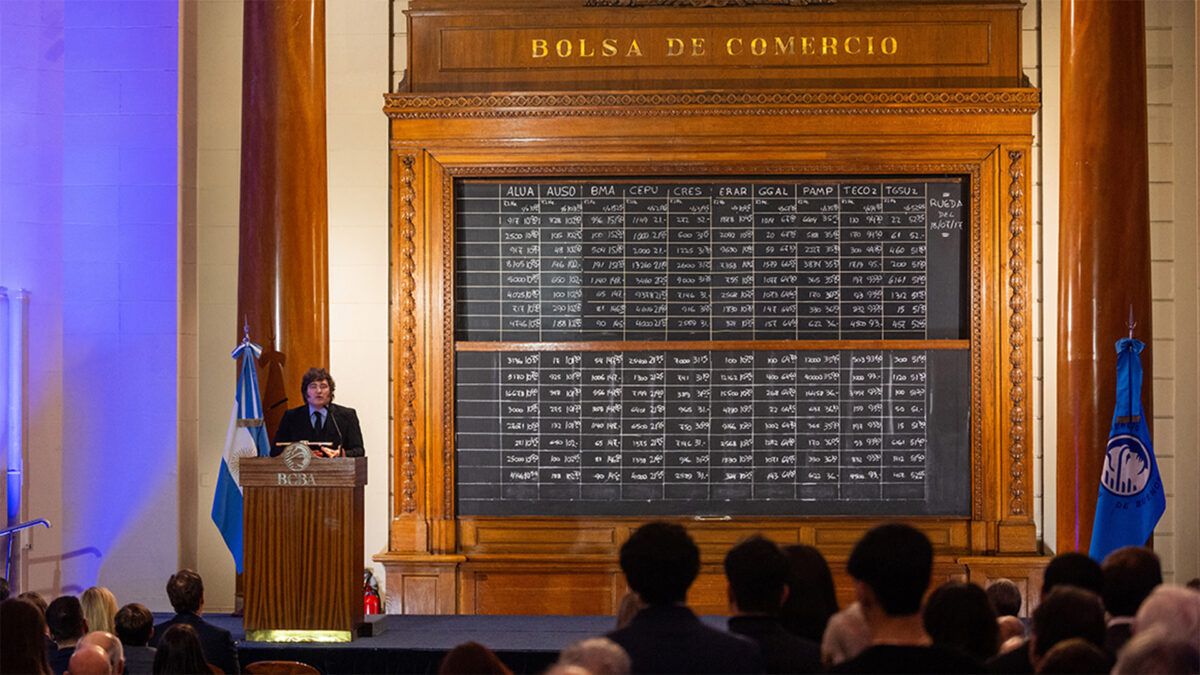
The December 2026 issue of Reason explores Argentine President Javier Milei's accomplishments and what is yet to be done.

Argentina was approaching monetary detonation. Its Treasury could not finance its deficits voluntarily, its central bank was effectively insolvent, and monthly inflation was accelerating above 12 percent.
That was just three years ago. Today, monthly inflation has fallen below 2 percent, sovereign spreads touched eight-year lows in July, and the central bank's gross reserves reached their highest level since 2019 in September. This is one of the most remarkable disinflations of the modern era to have occurred without dollarization, a currency board, or a new currency. Javier Milei did not merely slow the rate at which prices were rising; he dismantled the fiscal and monetary mechanism that was driving Argentina toward hyperinflation.
But as the events of late 2025 showed, that achievement remains vulnerable. A stabilization can be economically coherent and still be politically mortal. Argentina has restored a substantial degree of public sector solvency, but it has not yet made that solvency independent of the next election.
Deficits Without Creditors
Deficits themselves do not make Argentina unique. What distinguished Argentina was how those deficits had to be financed. In a country with functioning capital markets and a credible government, the state sells bonds to domestic and foreign savers; it obtains command over present resources, while creditors receive claims on future tax revenues. Public borrowing may be undesirable or objectionable on other grounds, but so long as the government remains solvent in the long run, it is a financial operation that can be sustained over time without debt restructurings or bouts of high inflation.
Argentina had largely exhausted that option. After repeated inflationary crises and serial debt repudiations—nine sovereign defaults, most recently in 2020—investors would lend to the Treasury only at prohibitive rates. Borrowing at those rates would itself make the debt trajectory unsustainable, so creditors expected either another restructuring of dollar-denominated bonds or an inflationary liquidation of peso-denominated liabilities. Those expectations raised borrowing costs further, making the anticipated outcome more likely. The Argentine state had trapped itself in a doom loop.
So the government relied on the one creditor that couldn't refuse it: the central bank. Fiscal deficits were financed, directly or indirectly, by issuing pesos. But that brought it up against a second constraint. The inflationary effect of money creation depends not only on the quantity of money supplied but on the quantity people are willing to hold. And after decades of monetary abuse, Argentines wanted as few pesos as possible.
Every newly issued peso became a hot potato to be exchanged for goods, dollars, or inflation-protected assets. As the demand for real peso balances contracted, the government had to print ever larger quantities to extract the same real resources, which pushed prices up faster, which further reduced the willingness to hold pesos, which required still more issuance. That's the feedback loop of an economy approaching hyperinflation.
Rather than stop the process, the government tried to repress its visible symptoms—a task for which the country has a well-worn tool kit. Its most familiar instrument is the cepo cambiario, a web of capital and exchange controls with which the state prevents its citizens from freely satisfying their demand for dollars and hides the peso's depreciation behind an artificially strong official exchange rate. President Cristina Fernández de Kirchner imposed it in 2011; Mauricio Macri lifted it on taking the presidency, only to reinstate it amid the currency run of 2019; the leaders who followed tightened it further. Under the cepo, exchange rates multiplied. Exporters were forced to surrender their dollars below market value, while politically privileged importers bought them cheaply from the central bank. That arrangement punished exports, subsidized favored imports, invited corruption, and bled reserves.
The second instrument operated through the central bank's own balance sheet: extremely high nominal interest rates paid on short-term liabilities held mainly by commercial banks. These so-called remunerated liabilities were a standing bribe to the financial system to sit on its pesos rather than convert them into dollars or goods. Since those interest payments were themselves financed by creating new money for which there was no demand, they generated what Argentines call the quasi-fiscal deficit—a deficit produced not by the Treasury's spending programs but by the central bank's mounting interest bill. Paying interest to suppress monetary expansion today merely promised greater monetary expansion tomorrow.
By the end of 2023, the numbers had become grotesque. The Treasury's fiscal deficit stood at roughly 5 percent of gross domestic product (GDP), while the central bank's quasi-fiscal deficit approached 10 percent. Sovereign spreads hovered near 2,500 basis points—meaning that when an equivalent U.S. Treasury bond yielded 5 percent a year, Argentina would have had to pay around 30 percent to borrow in dollars. Monthly inflation hit 12.8 percent in November and was accelerating. (For perspective: Americans were furious when inflation peaked at 9 percent a year under President Joe Biden.) The gap between the official exchange rate and parallel rates exceeded 100 percent and at times approached 200 percent, strangling foreign trade. And the central bank's net international reserves stood at roughly negative $11 billion, the lowest level in its recorded history.
That was the machine Milei inherited on December 10, 2023: an insolvent Treasury, a central bank buried under remunerated liabilities, a rapidly contracting demand for the national currency, and a regulatory apparatus built to disguise the consequences of all three.
Argentina was not yet in hyperinflation. But it had entered its antechamber.
Solvency First, Liberalization Second
Milei's strategy was to restore the solvency of the Treasury and the central bank so that the controls concealing their insolvency could safely be removed. The sequencing was important. If he had scrapped every exchange control while the government still ran large deficits, the central bank still printed pesos to cover them, and net reserves were deeply negative, that could have accelerated rather than stopped a speculative run.
The first front was fiscal. Milei cut government spending, and not just in inflation-adjusted terms. Some cuts were explicit: Public works were halted, discretionary transfers to provincial governments were slashed, subsidies were pared back, and government employment contracted. (Such changes struck at many of the mechanisms through which Argentina's political class distributed patronage.) Other cuts operated through inflation itself: The government declined to fully index some nominal expenditures to rising prices, shrinking the real value of public salaries and pensions. This was socially painful, particularly for pensioners, but it allowed the fiscal correction to proceed faster than Congress would otherwise have permitted.
National primary spending fell by roughly a quarter in real terms in Milei's first year—an adjustment with few peacetime precedents—which brought national spending, as a share of the economy, back toward levels last seen in 2007–08. Within weeks of taking office, the government was posting monthly primary surpluses; it closed 2024 with a fiscal surplus and has treated balanced budgets as the nonnegotiable anchor ever since. That change altered the monetary regime before any formal institutional reform. Once the Treasury stopped requiring net financing from the central bank, the primary source of fiscally driven peso creation disappeared.
Milei also devalued the official exchange rate within days of taking office, bringing it closer to the market rate. That produced an immediate price shock, with monthly inflation exceeding 25 percent in December 2023. Critics called the devaluation inflationary, and in an immediate accounting sense, it was. But much of the inflation it unleashed was already latent, repressed behind an official exchange rate that almost nobody could access and nobody believed. By recognizing the accumulated depreciation at once, the government sharply narrowed the gap between official and parallel markets, restored exporters' incentives, and began dismantling expectations of an uncontrolled adjustment. After a transitional period, most exchange restrictions were lifted in April 2025.
Skeptics will note—correctly—that the liberalization co-incided with a new $20 billion loan from the International Monetary Fund (IMF) and will be tempted to conclude that it was this that made it possible to lift the cepo: just another bailout in a long history of Argentine bailouts. That reading misses the difference between financing a flow (the deficit) and refinancing a stock (the inherited debt).
Earlier IMF programs had poured external resources into governments that were still generating new fiscal imbalances, so the money flowed in while the pile of public liabilities kept growing—most spectacularly in 2018, when the largest loan in the IMF's history stabilized nothing. This time, the Treasury was already in surplus, and the facility operated on the stock inherited from the past: Argentina's largest external creditor was rolling over its own exposure, thickening the central bank's liquidity buffers, and stretching the horizon over which the old debt would be serviced. That support undoubtedly reinforced the program's healing dynamics and probably brought the lifting of the cepo forward. But it was neither a sufficient condition for success nor, over the medium term, a necessary one. A Treasury running surpluses and a central bank no longer bleeding pesos would eventually have rebuilt reserves and regained market access on their own, though this would have happened more slowly.
Defusing the Central Bank
The second front was the central bank itself. Once the Treasury stopped demanding monetary financing, the Banco Central de la República Argentina (BCRA) could sharply cut the interest rates paid on its remunerated liabilities. With lower expectations of inflation and depreciation, it was no longer necessary to pay enormous nominal rates to keep pesos from stampeding into goods and dollars.
The relationship ran in both directions. Falling inflation allowed lower nominal rates, lower rates shrank the central bank's interest bill, a smaller interest bill reduced future money creation, and reduced expected money creation further increased the demand for pesos. A virtuous circle began to replace the old doom loop.
The government then dismantled the central bank's stock of remunerated liabilities, shifting the job of absorbing excess pesos—and its cost—onto Treasury instruments. This did not make the debt disappear, but it lengthened maturities and placed the cost where it belonged: on the Treasury's accounts, under public and legislative scrutiny, rather than hidden within the central bank's balance sheet. The distinction matters. The quasi-fiscal deficit had allowed governments to claim more fiscal discipline than actually existed by parking part of the cost of stabilization outside the formal budget. Milei's consolidation made the state's liabilities transparent and stopped the central bank from autonomously compounding them through an escalating interest bill.
As confidence returned, sovereign spreads collapsed from roughly 2,500 basis points when Milei was elected to around 400 in July 2026, their lowest in eight years. That allowed the Treasury to roll over maturing debt at ever longer terms and lower cost. Argentina has not yet fully regained ordinary access to international capital markets; the government still leans on multilateral financing and domestic issuance to meet foreign-currency maturities, and spreads widened again, to above 600 by late September, as long-term U.S. rates rose and investors began to price the 2027 presidential election. But the probability of another restructuring has receded dramatically. The improvement shows on the central bank's balance sheet too: In 2026 alone, the BCRA has bought more than $14 billion in the foreign exchange market, and in early September gross reserves topped $50 billion, their highest level since 2019. Purchases have slowed sharply since the summer, and usable net reserves remain far smaller, but the direction of travel has reversed from the deeply negative position inherited in 2023.
All of this occurred alongside a modest but real reduction in taxes. The Impuesto PAIS, a major surcharge on foreign-currency transactions, was allowed to expire at the end of 2024. Export taxes were abolished for regional economies and thousands of industrial products and were cut for major agricultural exports on a declining schedule; tariffs, internal taxes on selected goods, and the wealth tax were also reduced, pushing the national tax burden to its lowest share of GDP in almost two decades. These cuts were modest relative to Milei's ambitions, but notable because they occurred without sacrificing the surplus. Milei did not balance the budget by raising taxes; he cut spending faster than revenue fell.
The macroeconomic result is hard to dispute. Monthly inflation, 25.5 percent in December 2023, was 1.7 percent in August 2026. Year-over-year inflation has fallen to 33.5 percent from 211 percent in 2023, and it is still declining.
The Political Run of 2025
Does all of this mean that Argentina is financially saved and that Milei has completed his task? No. The months before the October 2025 midterms show why.
When the opposition began climbing in the polls, and above all after it crushed the government's candidates in September's Buenos Aires provincial election, markets started pricing a scenario in which Milei lost the political capacity to defend his own agenda. The repricing was brutal. Country risk, which had been trading around 700 basis points in mid-August, doubled to nearly 1,500 by mid-September, and the peso depreciated by more than 20 percent over the episode, even though short-term interest rates soared and the authorities burned billions of scarce dollars trying to stabilize it.
Note what had not happened. The government had not abandoned the surplus, had not returned to monetary financing, and had not rebuilt the remunerated-liability machine. Milei's program had not secretly become insolvent; what triggered the crisis was the rising probability that its enemies might regain the power to make the state insolvent again. Nor was the panic irrational. Asset values depend on expected future policy, not just current policy. Savers who believe a future government will monetize deficits, impose controls, or restructure debt will sell pesos and Argentine bonds before that government takes office, and that means the anticipation of a regime reversal can generate, in advance, the very crisis the reversal would eventually have produced.
And this was not merely a panic among foreign fund managers. Ordinary Argentines know their political class too well and have learned to protect themselves by dollarizing; the threat of a fiscally irresponsible government had them fleeing the peso en masse. The central bank's statistics tell the story. Gross retail purchases of dollars reached some $5 billion in September and almost as much in October—double their previous monthly pace, and the heaviest retail dollarization since the eve of the election in 2019—before collapsing to barely a third of that rhythm the month after the vote.
The panic revealed a real weak point, though. Milei had fixed the flows but not yet the stocks: The state's liquid assets—its international reserves—still fell short of the bills coming due, whether pesos being dumped for dollars or hard-currency bonds maturing in the months ahead. Rebuilding a state's balance sheet takes years. Reserves accumulate purchase by purchase, and maturities lengthen only as fast as creditors' trust returns. Until that slow work is done, any rise in the perceived risk of a political reversal can abruptly close the state's access to refinancing, leaving it with maturing debts it cannot yet cover and a run on the peso it cannot stabilize with its own resources.
That was the gap the U.S. Treasury stepped in to fill. In October 2025, Treasury Secretary Scott Bessent set up a $20 billion swap line with Argentina's central bank and—in an operation American taxpayers had every reason to question—bought pesos outright in the days before the vote. Bessent was bridging, for a few weeks, a gap that political panic had blown open. The intervention contained the panic just long enough for the election to remove its immediate political cause. On October 26, Milei's coalition took more than 40 percent of the vote, expanded its bloc in Congress, and locked in enough votes to sustain the president's vetoes. Within days, the peso steadied, spreads resumed their slide, and the central bank was buying dollars again. By year's end, Argentina had repaid the $2.5 billion it had actually drawn on the swap.
Still, the lesson is uncomfortable. A stabilization is consolidated only when an election can no longer plausibly revive expectations of default and monetary collapse. Argentina isn't there yet.
Time, if politics allows, will close the balance sheet gap. Reserves are being rebuilt, and maturities stretch a little further with every successful auction. But some of Milei's central libertarian promises are still, for now, only promises.
Temporary or Permanent Change?
Milei inherited a country with no voluntary creditors, almost no demand for its currency, a Treasury hooked on monetary financing, a central bank trapped by its own interest bill, deeply negative net reserves, and capital controls that strangled trade while failing to stop depreciation. In less than three years, his government produced sustained fiscal surpluses, dismantled the quasi-fiscal time bomb, cut monthly inflation from 25 percent to below 2 percent, compressed sovereign spreads to eight-year lows, liberalized the exchange market, rebuilt reserves, and reduced taxes. And it did that without confiscating deposits, without a new default, and without raising the overall tax burden.
Hyperinflation is no natural disaster. It is the political consequence of a state that loses solvency and finances itself through a currency its citizens no longer wish to hold. Milei has stopped that process. Whether he has changed Argentina's institutions enough to prevent its return is a verdict that will arrive only after he leaves office.