

When You Investigate Trump's Corruption, Don't Make Collateral Damage of the Corporate Bystanders
The incoming majority should investigate the president's alleged misbehavior, not threaten businesses simply for doing business with him.
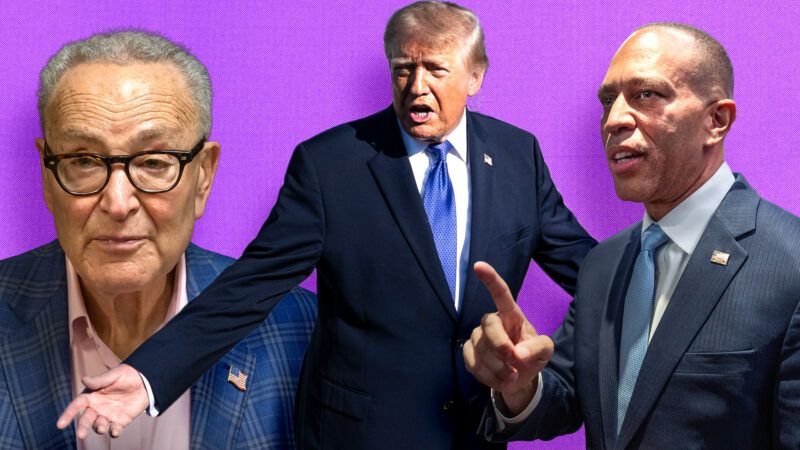
By some measures, the Trump administration is the most corrupt in American history, and, as exit polls from NBC News, CNN, and the Associated Press show, corruption heavily influenced Americans' votes on Tuesday. Now, Democrats are looking to capitalize on voters' resounding repudiation of the Trump administration's graft. Come January, the party plans to scrutinize the White House's deal making and the alleged conflicts of interest involving the president, his family, cabinet, and supporters.
"LAWYER UP" was the message from Rep. Robert Garcia (D–Calif.), who is poised to become the chairman of the House Oversight Committee. It took just one word, "Subpoenas," for Sen. Ron Wyden (D–Ore.), the likely chairman of the Senate Finance Committee, to make his point.
Yet messaging from ranking Democrats makes it clear their inquiries won't be limited to government actions; they will also extend to the actions of private companies and industries they perceive as allies of the president. In a statement released on Wednesday, Wyden promised to go after banks, insurance companies, and the CEOs of pharmaceutical companies for their "role in hurting the American people and enabling Trump's corruption." Many of his colleagues echoed the sentiment, including Sen. Ed Markey (D–Mass.), who joked that there'd be a need to "plant new forests for all of the subpoenas we'll be printing" for Big Tech executives.
Anticipating a Democratically controlled Congress, executives with even a tangential connection to the Trump administration have been taking steps to protect themselves from potential acts of lawfare. In October, Bloomberg reported that "companies with ties to President Donald Trump and his family" had begun hiring "lawyers and lobbyists" in preparation for the "possibility of congressional inquiries."
Semafor first reported the Democrats' plans to use corporate America as a back door to investigating the Trump administration in June. "After going through bruising investigative fights over testimony and documents during Trump's first term, which often resisted Hill oversight, Democrats increasingly see the private sector as a riper oversight subject because of businesses' legal obligations to respond to subpoenas," Semafor's Nicholas Wu reported at the time.
At a shadow hearing held by congressional Democrats in July, Sen. Richard Blumenthal (D–Conn.), the ranking member on the Senate Permanent Subcommittee on Investigations, said that his party would "investigate government contractors and businesses that have donated to the ballroom and other projects," according to Bloomberg Government.
Taking things a step further, the outlet reported that Rep. Melanie Stansbury (D–N.M.) named "Amazon, Apple, Coinbase, Google, HP, Lockheed, Palantir" as complicit in the "demolition of the White House," meaning it's likely that the companies' executives will be compelled to appear before Congress. This includes people like Elon Musk, a prominent ally of Trump and the Republican Party in recent years. On Wednesday, The New York Times reported that shares of Musk's companies SpaceX and Tesla "fell sharply" on expectations that he and his business dealings will face intense scrutiny from a Democrat-led Congress.
Democrats can disagree with the president's decision to renovate the White House, and how he's gone about it, without painting every company that made a political contribution to the Trump administration as corrupt. Donating to a political cause hardly makes a company or executive corrupt. In fact, the Joe Biden-Kamala Harris inaugural committee accepted donations from many of these same companies, including Google, Amazon, and Lockheed Martin, which received billions of dollars in government contracts during the Biden administration.
Democrats—through the failed and deeply unpopular investigations and impeachment trials of the first Trump administration—failed to hold the president accountable the last time they were in power, which could explain their new approach. However, going after companies simply because of their proximity to an elected official is the wrong approach, especially since there are ample reasons—including the administration's taking of equity stakes in private companies and the numerous alleged conflicts of interest involving the president and those in his inner circle—to investigate Trump directly.
Investigating the Trump administration's blatant corruption is laudable. However, using allegations of corruption as an impetus to pursue corporations is an abuse of power and the type of weaponization Americans just voted against.



