

New York Voters Say Yes to Mamdani Administration's 'COGE' Recommendations
Voters gave the green light to Mamdani's proposed efficiency initiatives.
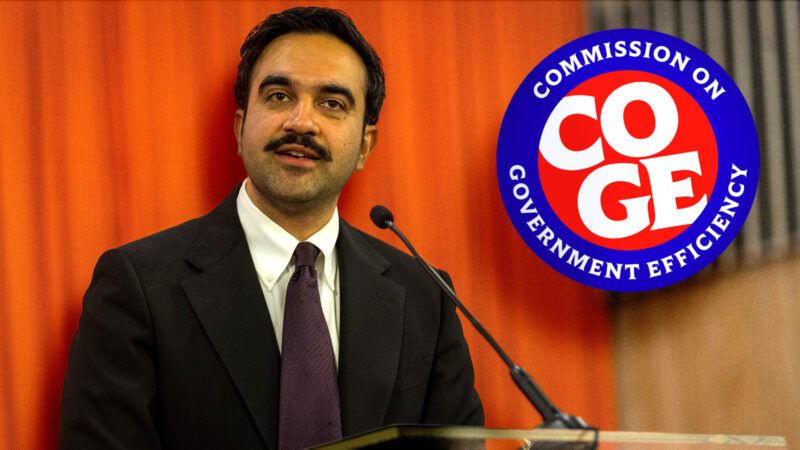
Voters in New York City have passed all five ballot measures proposed by the Commission on Government Efficiency (COGE), which Mayor Zohran Mamdani presents as an attempt to make the city's bureaucracy more efficient and effective. COGE will probably not slash bureaucratic bloat, but its proposals could make some application processes slightly less nightmarish.
After a series of government meetings—what could be more efficient or fun?—COGE proposed measures to streamline city approval processes for private use of public space (think: outdoor dining), for government contracting, for street safety projects, and for building permits. The fifth proposal would require the city to create savings targets for its rainy day fund policy.
"These might sound like bureaucratic issues, but they affect every New Yorker and can impact how fast our city runs for you," Mamdani said in a video.
As City & State New York has noted, Mamdani's videos carefully encouraged "New Yorkers to vote on faster government, rather than vote for them, since the city charter bars government advocacy for or against ballot proposals." The New York Post editorial board has accused Mamdani and his "minions" of "illegally 'weaponizing' a $1.6 million taxpayer-funded ad campaign to push ballot questions that will vastly increase his grip on Gotham."
Despite Mamdani's popularity, not everyone was on board with the initiatives. The group Common Cause New York, for example, objected to the proposal to eliminate some requirements for approving private uses of public space. While the group acknowledged that "government efficiency is important," it warned that efficiency should "not come at the expense of public participation and legislative oversight."
A Manhattan voter named Gordy, told Reason he voted no on all the measures because making approval processes shorter could "add more chaos to an already chaotic system."
Another Manhattan voter, Jean, voted against all the proposals for similar reasons. Although she approves of the Mamdani administration, she wanted to make sure communities, not city officials, had meaningful control over major projects.
"You don't know who is going to be in office in the future so you really have to think past Mamdani," she said.
New York City Council Member Frank Morano (R–Staten Island) also urged voters to reject Propositions One, Two, and Three, raising similar concerns about stifling community input.
"Cutting the public out of the process doesn't make government more efficient. It makes government less accountable," he said in a video explaining his rationale for opposing the proposition to streamline street safety processes.
Matthew Cavalletto, who was canvassing for the Working Families Party in Manhattan, told Reason he voted "yes" on all the measures so the city could complete as many projects as possible while Mamdani is in office.
"At least for now, we need to let the administration have a little elbow room and get to work," Cavalletto said.
The Citizens Budget Commission (CBC), a nonpartisan watchdog group, encouraged voters to support streamlining measures one, three, and four. (It did not comment on the second proposition, and it opposed the fifth.)
"There's always a balance to be had between sort of, you know, speed and timeliness on the one hand and, you know, meaningful community input on the other," says Sean Campion, CBC's Director of Housing and Economic Development Studies.
New York City is not turning into a Freedom City. But even supporters of big government can recognize that the city's sprawling bureaucracy could stand to be more efficient.



