

Quacks Vote To Approve Duck Bills in D.C. and Denver
Two measures passed banning the sale and production of foie gras. But the campaigns were based on shaky logic with a dash of class warfare.
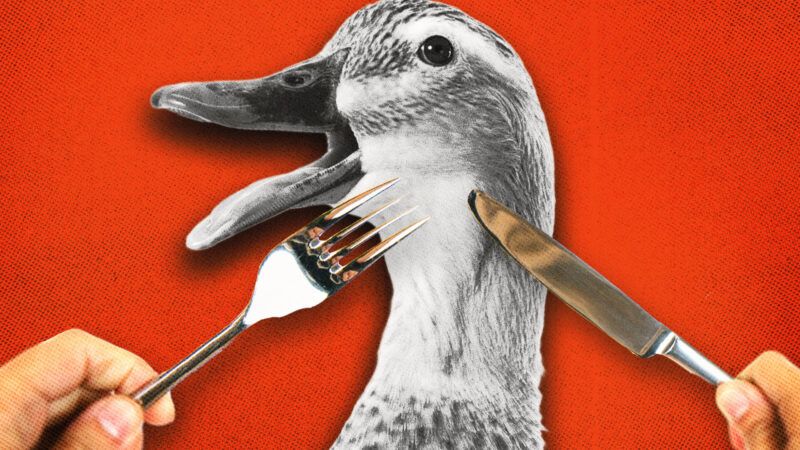
Voters in Washington, D.C., and Denver, Colorado, approved ballot initiatives on Tuesday to ban the sale and production of foie gras, a delicacy made from the enlarged livers of ducks and geese. They also bar its production, although there are no foie gras farms in D.C. or Denver. The results are a win for animal welfare activists whose campaigns, however well-intentioned, ultimately relied on leveraging widespread misconceptions about the basic science—and the occasional appeal to class resentment.
The measures, Initiative 86 in D.C. and Ordinance 311 in Denver, were backed heavily by Pro-Animal Future, an animal rights group headquartered in Portland, Oregon. In D.C., the group poured around $400,000 into the campaign; Mayor Muriel Bowser, a Democrat, suggested she would vote against it on principle.
The primary controversy over foie gras, a velvety dish that has existed since ancient Egypt, concerns its preparation, which involves overfeeding ducks and geese over the course of about 12 to 15 days. The practice has drawn the ire of activists who say the force-feeding technique—gavage—amounts to animal cruelty. They are, after all, developing fatty liver disease.
"Ducks and geese are still being force-fed until their livers become diseased, all for an expensive dish served at fancy restaurants," Pro-Animal DC, an advocacy group which launched in 2025 to help get Initiative 86 on the ballot, says on its website. "It's time to end this inhumane practice."
This omits some context. Ducks and geese are biologically programmed to gorge themselves in nature and expand their livers before long flights; that is how foie gras was discovered. "I've been on foie gras farms before in which the ducks see the tube and run towards it because they're excited," Bart Hutchins, chef and part owner of the D.C. restaurant Butterworth's, told me last week. "Because this is a natural biological process." Gavage is also quick—it takes 2-3 seconds with an automatic pump. A specimen being harvested for foie gras may undergo less than a minute of force-feeding over its entire life.
Meanwhile, their physiology is tailored to tolerate such an experience. As I summarized Sunday:
"Neural activation indicating the presence of pain signals [was] never detected in the sensory visceral brain centers of force-fed ducks," notes a review of the scientific literature by researchers affiliated with France's National Institute for Agricultural Research.
That is not surprising, they say, when accounting for the anatomy of ducks and geese. The upper esophagus is much larger than its mammalian counterpart and is unusually elastic and expandable. The opening of the trachea, meanwhile, lies farther forward than in humans—a position, they argue, that helps prevent choking during feeding. More strikingly, "degenerative events such as necrosis or cirrhosis never occur" in the liver tissue, the researchers add. "Unlike human fatty liver, foie gras does not exhibit any macroscopic lesions."
Factory-farmed chickens are often held in extreme confinement, subjected to sleep deprivation, and sometimes grow so quickly that they develop deformities and suffer broken limbs. Do we also need a government-funded chicken goon squad?
D.C.'s chief financial officer estimated the foie gras measure will cost $314,000 to enforce over the next four fiscal years and will require hiring an additional inspector. The money has not been budgeted, so it remains unclear where the city will take cash from to fund foie gras enforcement. The city of Denver does not currently estimate any fiscal impact.
Both initiatives are theoretically scheduled to take effect on July 1 of next year. That timing may be complicated, however, by potential legal challenges. New York City in 2019 passed a foie gras sales ban, which is still stuck in limbo due to unresolved litigation.
Hutchins, who notes he is "sympathetic to vegans," characterizes foie gras as part of a larger sustainability fight. "One of the broader missions of Butterworth's is to get people to eat less primary cuts," he says. "If you're going to eat animals, I think the ethical thing to do is to eat all of it. And so if you buy six pork chops, but you never learn how to eat pigs' feet or pigs' ears or whatever, eventually you're just sort of creating waste."
Though the debate has mostly been couched in animal welfare, there's another undercurrent below the surface. "Who buys it anyway?" Rebecca Ellertson, a retired teacher, told The Washington Post. "Rich, wealthy people eat it. I vote for the working class."



