Reason.com - Free Minds and Free Markets
Reason logo Reason logo
  • Latest
  • Magazine
    • Current Issue
    • Archives
    • Subscribe
    • Crossword
  • Video
    • Reason TV
    • The Reason Roundtable
    • Free Media
    • The Reason Interview
  • Podcasts
    • All Shows
    • The Reason Roundtable
    • The Reason Interview With Nick Gillespie
    • Freed Up
    • The Soho Forum Debates
  • Volokh
  • Newsletters
  • Donate
    • Donate Online
    • Ways To Give To Reason Foundation
    • Torchbearer Society
    • Planned Giving
  • Subscribe
    • Reason Plus Subscription
    • Print Subscription
    • Gift Subscriptions
    • Subscriber Support

Log In

Create new account

Second Amendment

Abdul El-Sayed Would Freeze the Bill of Rights in the 18th Century

The Second Amendment is not confined to 1780s technology.
J.D. Tuccille | 10.26.2026 7:00 AM

Share on FacebookShare on XShare on RedditShare by emailPrint friendly versionCopy page URL Add Reason to Google
Media Contact & Reprint Requests
Abdul El Sayed | Kyle Mazza - CNP/Sipa USA/Newscom
(Kyle Mazza - CNP/Sipa USA/Newscom)

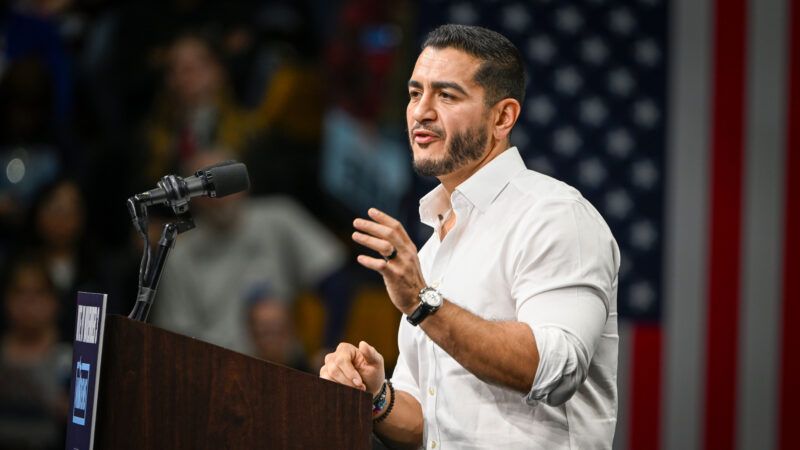
Abdul El-Sayed, Michigan's Democratic U.S. Senate candidate, is the latest politician to suggest that the Second Amendment might shield the right to bear arms, but only those that existed at the time that it was adopted: namely, flintlock muskets. It's a not-so-clever way of trimming back the Constitution's protections. The argument's flaws should be clear: the U.S. Supreme Court has already dismissed that line of reasoning, and a world in which the Bill of Rights applies only to 18th century technology would be one where freedom exists only in museum exhibits.

You are reading The Rattler from J.D. Tuccille and Reason. Get more of J.D.'s commentary on government overreach and threats to everyday liberty.

This field is for validation purposes and should be left unchanged.

"Everyone Should Have Equal Rights to a Musket"

"I'm gonna swear an oath to the Constitution. The Constitution has a Second Amendment in it, but the Second Amendment, just so we all are clear, even the most conservative folks, they hew to this idea called originalism, and originalism is the idea that you should interpret the Constitution in the context in which the Constitution was written," El-Sayed insisted at a campaign rally. "When they promised the right to bear arms, they had muskets. So, yeah, everyone should have equal rights to a musket."

So clever. The Bill of Rights passed in the 1780s, so it must only apply to 1780s things. Except that the courts have thoroughly dismissed that ridiculous line of reasoning.

"Some have made the argument, bordering on the frivolous, that only those arms in existence in the 18th century are protected by the Second Amendment," Justice Antonin Scalia wrote for the majority in District of Columbia v. Heller (2008). "We do not interpret constitutional rights that way. Just as the First Amendment protects modern forms of communications…and the Fourth Amendment applies to modern forms of search…the Second Amendment extends, prima facie, to all instruments that constitute bearable arms, even those that were not in existence at the time of the founding."


The Founders Lived in a Time of Rapid Innovation

The reason for this should be obvious. The founders were not unaware of progress. Many of them were scholars and innovators. They were certainly aware of (and enthusiastic about) continuing advancements in technology. During the then-recent revolution, American troops had faced off against a small unit of redcoats armed with Ferguson breech-loading rifles. A decade before the Bill of Rights was adopted, the 22-shot Girandoni repeating air rifle was introduced, one of which was later sent along on the Lewis and Clark expedition. And Kalthoff and Lorenzoni repeating flintlock firearms had existed for well over a century.

Not to mention, the founders made extensive use of printing presses to distribute pamphlets and official government documents, including the new Constitution, rather than having them hand-copied as they would have been a few centuries earlier. Technology marches on.

That last point illustrates the foolishness of the only-1780s-tech argument, as Scalia pointed out. What use is a First Amendment that applies only to hand-cranked printing presses and unamplified voices? That would leave the internet, television, radio, telephones, and all post-revolutionary means of communications unprotected from government censorship.

By the same token, a Fourth Amendment stuck in the 18th century might shield us from government agents kicking in the door and rifling through our papers. But it would have nothing to say about wiretaps, computer searches, surveillance cameras, thermal imaging, and the like.


The Founders Sought To Limit Government, Not Create Small Carve-Outs for People

Founders who were well aware of innovation and often contributed to it themselves (think Benjamin Franklin and Thomas Jefferson) knew that science and technology constantly advance—because they helped it do exactly that—as would the government's intrusive capabilities. And they believed they were creating protections for broad natural rights against limited government, not small carve-outs from the authority of an all-powerful state.

"Rightful liberty is unobstructed action according to our will, within the limits drawn around us by the equal rights of others," Jefferson wrote in 1819. "I do not add 'within the limits of the law'; because law is often but the tyrant's will, and always so when it violates the right of an individual."

The Bill of Rights isn't an ancient artifact to be applied only to a snapshot of life as it existed around 1789. Its amendments are intended to protect timeless individual rights, however those rights might be expressed in an always-evolving world.


El Sayed: "To Protect People From Government Tyranny"

El-Sayed went on, in his increasingly incoherent monologue, to acknowledge that the Bill of Rights was intended "to protect people from government tyranny," and "the idea was that you had the right to bear arms against your government should they become tyrannous." He floated the idea, for some reason, that "the Coast Guard, and state militias" are how this idea was implemented. I don't want to delve too deeply into whatever argument is being presented here, because I've sacrificed enough brain cells by listening to him speak.

But kudos to El Sayed for admitting the Bill of Rights is intended to protect us from government. The only way that can possibly work is if, as government's capabilities become increasingly sophisticated, the protections of the Constitution's first 10 amendments extend to safeguarding our rights from ever more advanced potential intrusions.

The Second Amendment and the rest of the Bill of Rights don't preserve a snapshot of life in the 1780s. They were written to protect eternal principles of individual liberty. And they're certainly not limited to muskets.


The Rattler is a weekly newsletter from J.D. Tuccille. If you care about government overreach and tangible threats to everyday liberty, this is for you.

This field is for validation purposes and should be left unchanged.

NEXT: America Is Spending Billions To Fight the War on Terror in Africa. The Terrorists Are Winning.

J.D. Tuccille is a contributing editor at Reason.

Second AmendmentGunsGun OwnersGun RightsBill of RightsElection 2026MidtermMichiganCampaigns/ElectionsPolitics
Share on FacebookShare on XShare on RedditShare by emailPrint friendly versionCopy page URL Add Reason to Google
Media Contact & Reprint Requests

Hide Comments (6)

Editor's Note: As of February 29, 2024, commenting privileges on reason.com posts are limited to Reason Plus subscribers. Past commenters are grandfathered in for a temporary period. Subscribe here to preserve your ability to comment. Your Reason Plus subscription also gives you an ad-free version of reason.com, along with full access to the digital edition and archives of Reason magazine. We request that comments be civil and on-topic. We do not moderate or assume any responsibility for comments, which are owned by the readers who post them. Comments do not represent the views of reason.com or Reason Foundation. We reserve the right to delete any comment and ban commenters for any reason at any time. Comments may only be edited within 5 minutes of posting. Report abuses.

  1. Stupid Government Tricks   2 hours ago

    Amen! The idiots who would restrict guns to flintlocks forget they would also restrict the press to manually powered printing presses and humans to what they can say and write with a quill pen. No fountain pens, no ball-points, no typewriters, nothing electrical or even steam powered; Watt's steam engines were restricted to mines.

    1. Mickey Rat   2 hours ago

      Already has. That the 1st Amendment does not fully apply to broadcast media because it is unfamiliar tech to the Founders is part of the rationalization for the FCC.

      1. Stupid Government Tricks   1 hour ago

        No, that is not how the Supreme Court reinterpreted the Constitution to allow censorship.

        The early days of radio had few transmitters and there were people who maintained a list and allocated frequencies. But once it got past a few dozen or hundred, something better was needed, and the courts had begun to recognize a common law property interest in the radio spectrum defined by frequency and power. That scared the new radio network executives, they leaned on the Secretary of Commerce, Herbert Hoover, and he got Congress to pass the FCC precursor in which the government gave itself permission to regulate frequencies based on the fraudulent argument that the spectrum was limited. This was ridiculous; everything is limited -- land, ores, businesses, homes, printing presses. But the Supreme Court, which you will note is part of government, gave government permission to regulate the radio spectrum. It had nothing to do with what the founders didn't know about radio, and everything to do with expanding government power at the behest of cronies.

  2. Mickey Rat   2 hours ago

    You'd think that is not a bog standard argument for gun controllers,such as it is. They have feelings and goals, a coherent argument does not necessarily fit in.

  3. John Rohan   23 minutes ago

    The Second Amendment is not confined to 1780s technology.

    Then why is the 14th Amendment (in regard to birthright citizenship) confined to the travel technology, as well as the culture and geopolitical situation of the 1860s?

    1. Rossami   16 minutes ago

      "Travel technology"? You mean like airplane and cars as opposed to sailing ships and wagons? How exactly do you think that the birthright citizenship argument is even slightly affected by that difference?

Please log in to post comments

Mute this user?

  • Mute User
  • Cancel

Ban this user?

  • Ban User
  • Cancel

Un-ban this user?

  • Un-ban User
  • Cancel

Nuke this user?

  • Nuke User
  • Cancel

Un-nuke this user?

  • Un-nuke User
  • Cancel

Flag this comment?

  • Flag Comment
  • Cancel

Un-flag this comment?

  • Un-flag Comment
  • Cancel

Latest

Abdul El-Sayed Would Freeze the Bill of Rights in the 18th Century

J.D. Tuccille | 10.26.2026 7:00 AM

America Is Spending Billions To Fight the War on Terror in Africa. The Terrorists Are Winning.

Matthew Petti | From the November 2026 issue

Brickbat: Ghost in the Machine

Charles Oliver | 10.26.2026 4:00 AM

Pamela Colloff on America's Biggest Jailhouse Snitch, Wrongful Convictions, and Criminal Justice

Billy Binion | From the November 2026 issue

Police Destroyed Their Homes and Businesses. The Supreme Court Won't Say Who Should Pay.

Billy Binion | 10.25.2026 7:00 AM

Recommended

  • About
  • Browse Topics
  • Events
  • Staff
  • Jobs
  • Donate
  • Advertise
  • Subscribe
  • Contact
  • Media
  • Amazon
Reason Facebook@reason on XReason InstagramReason TikTokReason YoutubeApple PodcastsReason on FlipboardReason RSS Add Reason to Google

© 2026 Reason Foundation | Accessibility | Privacy Policy | Terms Of Use

This site is protected by reCAPTCHA and the Google Privacy Policy and Terms of Service apply.

Reason

The All-Argentina Issue is Here

New from Reason: a look into what Javier Milei has accomplished and what it will take to make the most of Argentina’s window for real change. Out now for subscribers.

Subscribe & Start Reading Learn More
