

Reason.com - Free Minds and Free Markets
Reason logo Reason logo
  • Latest
  • Magazine
    • Current Issue
    • Archives
    • Subscribe
    • Crossword
  • Video
    • Reason TV
    • The Reason Roundtable
    • Free Media
    • The Reason Interview
  • Podcasts
    • All Shows
    • The Reason Roundtable
    • The Reason Interview With Nick Gillespie
    • Freed Up
    • The Soho Forum Debates
  • Volokh
  • Newsletters
  • Donate
    • Donate Online
    • Ways To Give To Reason Foundation
    • Torchbearer Society
    • Planned Giving
  • Subscribe
    • Reason Plus Subscription
    • Print Subscription
    • Gift Subscriptions
    • Subscriber Support

Log In

Create new account

Budget Deficit

The Federal Government Just Posted the Largest Annual Budget Deficit Since COVID

Tax revenue increased by about 3 percent last year, but spending increased twice as fast. And interest payments on the debt cost more than $1.1 trillion.
Eric Boehm | 10.9.2026 1:00 PM

Share on FacebookShare on XShare on RedditShare by emailPrint friendly versionCopy page URL Add Reason to Google
Media Contact & Reprint Requests
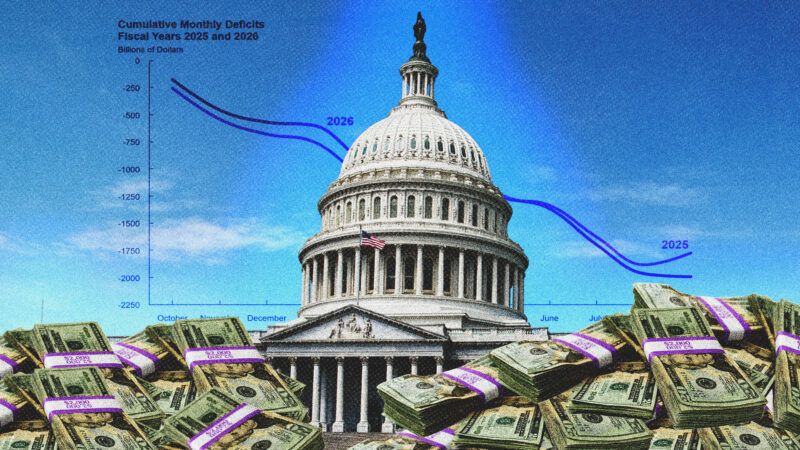
U.S. Capitol with a deficit chart in the background and piles of money | Congressional Budget Office/Robert Findlay/Splosh/Dreamstime
(Congressional Budget Office/Robert Findlay/Splosh/Dreamstime)

The federal budget deficit totaled nearly $2 trillion for the fiscal year that ended on September 30—the third-largest in American history, trailing only the two deficits recorded during the COVID-19 pandemic.

The fiscal year totals released Thursday by the Congressional Budget Office (CBO) paint another bleak picture about the state of the federal budget. That near-record deficit occurred despite tax revenue increasing by about 3 percent year over year. The federal government collected more than $5.4 trillion in taxes during the past fiscal year.

However, the government spent about $7.4 trillion, a 6 percent increase from the year before. That's why the deficit widened.

That spending increase was primarily driven by entitlement programs, the military, and interest payments on the national debt. The CBO notes that Social Security spending increased by 5 percent last year due to "increases in average benefits and in the number of beneficiaries." There was an 8 percent increase in spending on both Medicare and Medicaid, while military spending increased by 5 percent.

"The economy can't keep pace with the relentless growth of programs such as Social Security and Medicare," David Ditch, a policy analyst at the Cato Institute, told Reason. "Seniors are receiving far more in benefits than they paid in payroll taxes. America's leaders should stop pretending otherwise."

Still, the single biggest factor in rising spending and growing deficits is actually the size of the national debt itself. Interest payments on the debt rose 11 percent in fiscal year 2026 and totaled more than $1.1 trillion.

On the revenue side, the CBO's data contradicts President Donald Trump's oft-repeated claim that tariffs are bringing in "trillions" of dollars for the United States.

The CBO reports that the federal government collected $182 billion in customs duties during the fiscal year. That's actually an 11 percent decline relative to 2025, because the federal government was required to issue refunds for tariffs that were ruled unlawful by the U.S. Supreme Court earlier this year.

The CBO estimates that those refunds reduced tariff collections by about $130 billion—meaning that even if the government had been allowed to keep that money, the revenue totals would be far below Trump's outlandish claims.

The president is, unfortunately, not alone when it comes to ignoring the federal government's fiscal trajectory. Neither major political party seems to have a serious plan to address the growing deficit or the underlying factors that are causing the gap between revenue and spending to widen. There has been little talk about the budget deficit during this year's midterm election season, despite worrying signals from the bond market—yields on both short- and long-term federal debt have climbed steadily this year, a sign that investors are viewing the U.S. government as a riskier investment than in years past.

Maya MacGuineas, president of the Committee for a Responsible Federal Budget (CRFB), a nonprofit that advocates for reducing deficits, said in a statement that policymakers should aim to reduce future budget deficits to about 3 percent of the overall size of the economy—around half of the level hit in 2026.

"Clearly, we can't keep going like we have," she added. "Our fiscal path has been running backwards for far too long; it's time to start working on the path forward."

Treasury Secretary Scott Bessent has reportedly advised the Trump administration to set that same goal of cutting the budget deficit to 3 percent of the size of the economy by 2028.

However, it also seems likely that Congress will meet in the post-election lame duck session to consider Trump's plan for a massive increase in military spending. The president has also promised to send $5,000 to every American if Republicans retain control of Congress—an outright political bribe that would cost well over $1 trillion.

If you find yourself in a hole, the first step is to stop digging. However, another year of full Republican control of the federal government has produced a predictably pathetic result: more spending and a larger budget deficit.

Start your day with Reason. Get a daily brief of the most important stories and trends every weekday morning when you subscribe to Reason Roundup.

This field is for validation purposes and should be left unchanged.

NEXT: The NIH Plan To Strengthen ‘Replication and Reproducibility’ Will Not Check Anything

Eric Boehm is a reporter at Reason.

Budget DeficitGovernment SpendingBudgetTrump AdministrationCongressDeficitsDebtNational DebtFederal government
Share on FacebookShare on XShare on RedditShare by emailPrint friendly versionCopy page URL Add Reason to Google
Media Contact & Reprint Requests

Hide Comments (5)

Editor's Note: As of February 29, 2024, commenting privileges on reason.com posts are limited to Reason Plus subscribers. Past commenters are grandfathered in for a temporary period. Subscribe here to preserve your ability to comment. Your Reason Plus subscription also gives you an ad-free version of reason.com, along with full access to the digital edition and archives of Reason magazine. We request that comments be civil and on-topic. We do not moderate or assume any responsibility for comments, which are owned by the readers who post them. Comments do not represent the views of reason.com or Reason Foundation. We reserve the right to delete any comment and ban commenters for any reason at any time. Comments may only be edited within 5 minutes of posting. Report abuses.

  1. Bubba Jones   23 minutes ago

    None of this would happen if Trump were chairman of the fed. He would just set interest rates to 0. Problem solved.

  2. IceTrey   9 minutes ago

    So it's not tariffs that are causing price increases.

    1. MWAocdoc   5 minutes ago

      Yes, tariffs are causing price increases, silly! Tariffs are not the ONLY causes of price increases.

  3. MWAocdoc   6 minutes ago

    "Interest payments on the debt rose 11 percent in fiscal year 2026 and totaled more than $1.1 trillion."

    I would say that Uncle Sam is spending like a drunken sailor except that that would be unfair to drunken sailors, who stop spending money when they run out of cash.

  4. Fu Manchu   3 minutes ago

    If only there were a major political party that cared about cutting spending. Since Dubya it's been a contest to see who can spend the most.

Please log in to post comments

Mute this user?

  • Mute User
  • Cancel

Ban this user?

  • Ban User
  • Cancel

Un-ban this user?

  • Un-ban User
  • Cancel

Nuke this user?

  • Nuke User
  • Cancel

Un-nuke this user?

  • Un-nuke User
  • Cancel

Flag this comment?

  • Flag Comment
  • Cancel

Un-flag this comment?

  • Un-flag Comment
  • Cancel

Latest

The Federal Government Just Posted the Largest Annual Budget Deficit Since COVID

Eric Boehm | 10.9.2026 1:00 PM

The NIH Plan To Strengthen 'Replication and Reproducibility' Will Not Check Anything

Aaron Brown | 10.9.2026 11:15 AM

Treasury Backs Down on Biden-Era Cryptocurrency Surveillance Proposal

Matthew Petti | 10.9.2026 10:15 AM

Let Charter Schools be as Flexible as Microschools

Ian Kingsbury | 10.9.2026 10:00 AM

Livestreaming an Execution

Liz Wolfe | 10.9.2026 9:30 AM

Recommended

  • About
  • Browse Topics
  • Events
  • Staff
  • Jobs
  • Donate
  • Advertise
  • Subscribe
  • Contact
  • Media
  • Amazon
Reason Facebook@reason on XReason InstagramReason TikTokReason YoutubeApple PodcastsReason on FlipboardReason RSS Add Reason to Google

© 2026 Reason Foundation | Accessibility | Privacy Policy | Terms Of Use

This site is protected by reCAPTCHA and the Google Privacy Policy and Terms of Service apply.

Reason's July 4 Special!

For America's 250th, Get 2 Years of Reason for $17.76

Celebrate your independence with a subscription to Reason magazine, your most trusted source of honest, insightful news and analysis.

Subscribe to Reason


