Reason.com - Free Minds and Free Markets
Reason logo Reason logo
  • Latest
  • Magazine
    • Current Issue
    • Archives
    • Subscribe
    • Crossword
  • Video
    • Reason TV
    • The Reason Roundtable
    • Free Media
    • The Reason Interview
  • Podcasts
    • All Shows
    • The Reason Roundtable
    • The Reason Interview With Nick Gillespie
    • Freed Up
    • The Soho Forum Debates
  • Volokh
  • Newsletters
  • Donate
    • Donate Online
    • Ways To Give To Reason Foundation
    • Torchbearer Society
    • Planned Giving
  • Subscribe
    • Reason Plus Subscription
    • Print Subscription
    • Gift Subscriptions
    • Subscriber Support

Log In

Create new account

National Debt

America Hits a New Debt Record at $40 Trillion and Counting

President Donald Trump has surpassed Barack Obama's record for most debt amassed by a president.
Mariana Trujillo and Jordan Campbell | From the November 2026 issue

Share on FacebookShare on XShare on RedditShare by emailPrint friendly versionCopy page URL Add Reason to Google
Media Contact & Reprint Requests
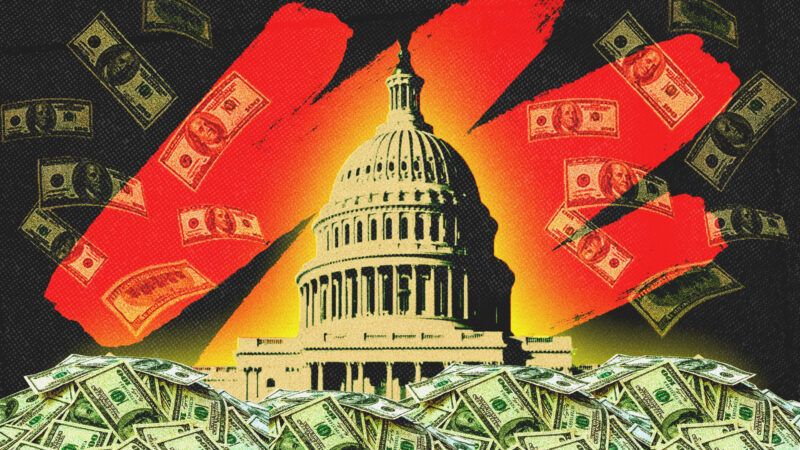
An illustration of the U.S. Capitol surrounded by $100 bills | Alexkalina/Nikolai Sorokin/Dreamstime/Midjourney
(Alexkalina/Nikolai Sorokin/Dreamstime/Midjourney)

Before the COVID-19 pandemic, in 2020, the Congressional Budget Office (CBO) did not include the $40 trillion mark in its gross national debt projections for the coming decade, forecasting a gross federal debt of $36 trillion in 2030. By 2022, the CBO expected the country to cross $40 trillion in 2030. A year later, that date had moved up to 2028, and by 2024, it had moved to 2027. The most recent report, from February 2026, projected that we would end the current fiscal year at $39.4 trillion. We have now surpassed the $40 trillion mark.

The last time the federal government had a budget surplus was in FY 2001. Since then, Congress and presidents have overseen deficit after deficit. The previous record holder for the most debt amassed was President Barack Obama, whose two terms saw a $13.2 trillion increase in the national debt, adjusted for inflation.

Eighteen months into his second term, President Donald Trump has already surpassed that. Adjusted for inflation, Trump's first term added $9.8 trillion in debt, and his second term has already added more than $3.5 trillion, bringing his total to $13.3 trillion—making him the president who oversaw the largest real increase in federal debt in history.

There's more to come. The CBO expects that by the end of 2028, the gross national debt will be $43.3 trillion, meaning that by the end of Trump's second term, he will have overseen a total of $7.1 trillion more in nominal debt. And the actual number will likely be higher: The CBO's forecast was done before Trump started his war with Iran, which is adding significant unforeseen spending.

Debt held by the public currently stands at about $32 trillion. Unlike gross national debt, that measure excludes intragovernmental debt—the debt the Treasury owes to federal trust funds and other government accounts. Setting aside those obligations, public debt is still roughly 100 percent of GDP.

Total debt amassed is not solely a presidential scorecard. Presidents don't have unilateral power and don't start from a blank slate. They must work with Congress, and they inherit entitlements, spending, and tax regimes. They also face external circumstances that may be beyond their control, such as recessions and pandemics.

It is hard to blame presidents alone for the debt when the main source of spending growth is not discretionary, but long-established entitlement programs that no president or Congress has been brave enough to tackle: Social Security, Medicare, and Medicaid, which together account for about half of the federal budget today.
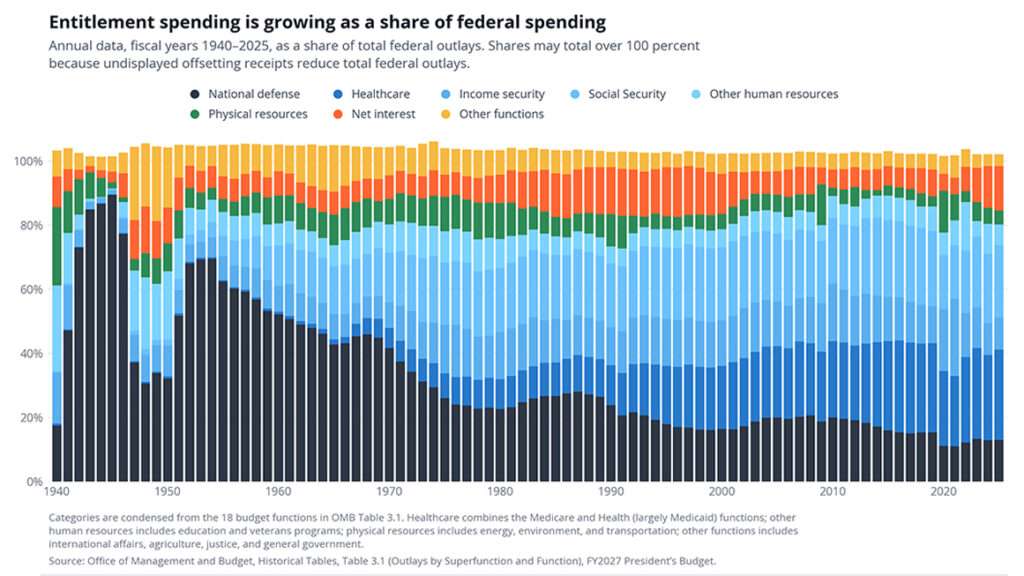
Sources: Office of Management and Budget, Historical Tables, Table 3.1 (Outlays by Superfunction and Function), FY 2027 President's Budget

Trump did not create—nor has he addressed—our entitlement programs. But many of his policies have contributed to the acceleration of the accumulation of debt. The CBO estimates that the One Big Beautiful Bill Act of 2025 increased projected deficits by $4.7 trillion over 2026–2035. Some of these deficits were expected to be eased by consumers paying Trump's tariffs, but that offset diminished after the Supreme Court struck down many of them.

Reason Foundation, the nonprofit that publishes Reason, synthesizes an array of government financial data in its annual Debtor Nation report. The largest spending category in the federal budget is Social Security, which accounted for 23 percent of net outlays in 2025. Social Security has promised more in benefits than it can finance. The middle fifth of the income distribution will receive about 50 percent more in benefits than they contributed over their lifetimes. This is becoming an impending problem as the worker-to-beneficiary ratio declines, moving from a relatively stable 3.2 to 3.4 from 1974 to 2008 to 2.6 in 2025.

Defense spending was to blame the last time the gross national debt exceeded 100 percent of GDP. America's last record was in 1946, when the country reached a debt-to-GDP ratio of 119 percent due to World War II. In 1945, the military accounted for 90 percent of all federal spending.

Despite America's constant involvement in wars abroad, defense has declined from our largest spending category to just another line item. Military spending exceeded $900 billion in 2025, but the federal budget has grown so much that it now makes up only 13 percent, with veterans' benefits adding another 5 percent.

Decades of deficits have led us to a reality in which interest expense on the debt represents a larger share of net outlays than the military. (For perspective, the Department of Defense is the single largest employer in the country.)

The national debt is unfair to future generations, leveraging the state's coercive power to force the people of the future to pay for services enjoyed by the people of the present. But beyond fairness, a more immediate concern is its costs and sustainability.

Americans have come to treat deficits and rising debt as normal. Unlike previous episodes of extraordinary borrowing, there is no plan to reverse course. Each debt milestone now arrives faster than the last.

This article originally appeared in print under the headline "A New Debt Record."

Start your day with Reason. Get a daily brief of the most important stories and trends every weekday morning when you subscribe to Reason Roundup.

This field is for validation purposes and should be left unchanged.

NEXT: The Millennial Internet Is Dead, and Politicians Killed It.

Mariana Trujillo is a managing director of government finance at Reason Foundation.

Jordan Campbell is managing director of government finance and senior quantitative analyst at Reason Foundation.

National DebtEconomicsDebtCBOTrump AdministrationGovernment SpendingGovernment Waste
Share on FacebookShare on XShare on RedditShare by emailPrint friendly versionCopy page URL Add Reason to Google
Media Contact & Reprint Requests

Hide Comments (19)

Editor's Note: As of February 29, 2024, commenting privileges on reason.com posts are limited to Reason Plus subscribers. Past commenters are grandfathered in for a temporary period. Subscribe here to preserve your ability to comment. Your Reason Plus subscription also gives you an ad-free version of reason.com, along with full access to the digital edition and archives of Reason magazine. We request that comments be civil and on-topic. We do not moderate or assume any responsibility for comments, which are owned by the readers who post them. Comments do not represent the views of reason.com or Reason Foundation. We reserve the right to delete any comment and ban commenters for any reason at any time. Comments may only be edited within 5 minutes of posting. Report abuses.

  1. Mickey Rat   2 weeks ago

    "Trump did not create—nor has he addressed—our entitlement programs."

    Because a substantial number of voters are offended if you try to address certain entitlement programs and if you even refer to hem as "entitlements", because they feel they earned the benefits.

    1. Fu Manchu   2 weeks ago

      Oh really, Trump avoids doing things that offend people? Or maybe it's because his government is spending massive amounts on military and jackbooted thugs while not meaningfully cutting anything. And yeah, Congress passed the BBB but Trump was stumping for it.

      1. Don't look at me! ( Is the war over yet?)   2 weeks ago

        Sarc ignores the chart showing the defense spending portion is shrinking.

        1. Murray Rothtard   2 weeks ago

          In my utopia the percentage we spend on defense would be higher by many multiples.

          But the total dollar amount would be lower by many multiples.

          I'm not going to celebrate that it's holding firm with everything else as it all goes to the moon.

        2. Fu Manchu   2 weeks ago

          "Defense" spending is going up. It's only going down as a %. Which is a very bad sign.

    2. SRG3   2 weeks ago

      IT's funny how "entitlements" have come to mean, "things you're not entitled to".

      AFAIC if the government takes money from me with a promise that it's for a future benefit, when the time comes for me to claim that benefit, I am legitimately entitled to it. If the government miscalculated what its promise would cost, then by all means come up with a solution but no part of that solution should be a propaganda campaign to demonise people who want what they'd paid for.

      1. Mickey Rat   2 weeks ago

        They government took that money from you when there were 3 to 4 people paying to every one person receiving. When you want the benefit, there are 2 people paying for every one receiving. No matter what the government does, it is not going to change that underlying fact.

        1. mad.casual   2 weeks ago

          See below, if I got mugged for $25, I was robbed. If I just want my $25 back, there's a pretty solid argument that I simply expect just remuneration/compensation. If want paid what the Ponzi scheme owes me before it collapses, even/especially if it doesn't have it, I'm advocating for robbery on my behalf.

      2. mad.casual   2 weeks ago

        paid for

        What an odd thing for the victim of a propaganda campaign to say.

      3. Zeb   2 weeks ago

        Government promises are worth jack shit. And it has to be that way. The legislature can vote to end any of these programs any time they choose to. What previous legislatures "promised" is irrelevant. Anyone who believes a government promise means anything is a sucker.

  2. Murray Rothtard   2 weeks ago

    This is what happens when you elect a big government Democrat.

    1. Social Justice is neither   2 weeks ago

      And when every media outlet, including Reason, eviscerates anyone that seriously attempts to address the issue with anything but MOAR TAXES.

      1. Michael Ejercito   2 weeks ago

        when did Reason object to cuts?

        1. Don't look at me! ( Is the war over yet?)   2 weeks ago

          Where you been?

  3. Nelson   2 weeks ago

    Wait, Donal Trump is the worst President for the deficit and debt, too?

    Welk, duh. Anyone either a speck of honesty and a sliver of math skills has known that since Trump first rolled out his One Big Beautiful Bill.

    MAGA still insists he’s cutting the debt and deficit.

  4. JKillion   2 weeks ago

    Civics 101: Congress is responsible for the budget, not the president.

  5. JFree   2 weeks ago

    This obsession about govt debt exclusively is a real problem. Govt debt was $10 trillion in 2008 - 43% of GDP. $30 trillion of our debt now is a consequence of a free money entitlement created by the Federal Reserve to bail out banks and homeowners. No surprise - another consequence of that bailout is unaffordable housing for those who didn't own in 2008 because those who owned in 2008 were able to refinance a permanent housing subsidy after that. No surprise either - Reason is crickets about all of that for the entire decades since

    No question that govt spending is a problem because virtually all of it is non-productive. If we incur debt this year, it does not increase production of goods and services next year (or the year after or whatever timeframe). Transferring money to old people who aren't working is pretty much the definition of anti-productive. Worse when that money transfer is going to old homeowners sitting on a ton of subsidized home equity. Nor is that transfer an actual insurance program - or a reinsurance program that backs up the states - or anything else responsible.

    Course a lot of other debt is also non-productive. But that notion of whether govt spending is productive or non-productive is what helps avoid the $30 trillion of free money entitlement. Because at some point the bill for the free lunch comes due - and having some value created is how the national debt can provide some value to future generations. Instead we act surprised when the free lunch comes due.

  6. TJJ2000   2 weeks ago

    Obama? What was that like 20-years ago? You TDS clowns are a bloody joke.

    Trumps 1st 4-years $7.37T, $1.7T of which on the Cares Act alone; so $5.7T generally.
    Biden 4-years Added to Debt = $8.52T

    How nice of you all to be completely ignorant to $2.5T more from [D]emon-sh*Ts.

  7. Brian   2 weeks ago

    The self-proclaimed "King of Debt" is justifying his title.

    He bankrupted several businesses, and now it's the USA.

Please log in to post comments

Mute this user?

  • Mute User
  • Cancel

Ban this user?

  • Ban User
  • Cancel

Un-ban this user?

  • Un-ban User
  • Cancel

Nuke this user?

  • Nuke User
  • Cancel

Un-nuke this user?

  • Un-nuke User
  • Cancel

Flag this comment?

  • Flag Comment
  • Cancel

Un-flag this comment?

  • Un-flag Comment
  • Cancel

Latest

Brickbat: Studying Hard or Hardly Studying

Charles Oliver | 10.19.2026 4:00 AM

He Campaigned for the East Cleveland Mayor's Opponent. Then Police Came for His Truck.

Billy Binion | 10.18.2026 7:00 AM

Trump's War With Iran Pushed Him To Waive a Century-Old Shipping Law. Commerce Boomed.

Eric Boehm | From the November 2026 issue

Some Progressives Tried To Abolish the Tipped Minimum Wage. Now They're Backtracking.

C. Jarrett Dieterle | 10.17.2026 7:00 AM

Ohio Court Strikes Down a Scholarship Program That Supports More Than 100,000 Families

Josh Pauzé | 10.16.2026 5:09 PM

Recommended

  • About
  • Browse Topics
  • Events
  • Staff
  • Jobs
  • Donate
  • Advertise
  • Subscribe
  • Contact
  • Media
  • Amazon
Reason Facebook@reason on XReason InstagramReason TikTokReason YoutubeApple PodcastsReason on FlipboardReason RSS Add Reason to Google

© 2026 Reason Foundation | Accessibility | Privacy Policy | Terms Of Use

This site is protected by reCAPTCHA and the Google Privacy Policy and Terms of Service apply.

Reason's July 4 Special!

For America's 250th, Get 2 Years of Reason for $17.76

Celebrate your independence with a subscription to Reason magazine, your most trusted source of honest, insightful news and analysis.

Subscribe to Reason