The Fed Can't Fight Inflation Alone. Will Congress Do Its Part?
Lawmakers have to show they'll back the national debt with future fiscal surpluses, which means reining in government spending.
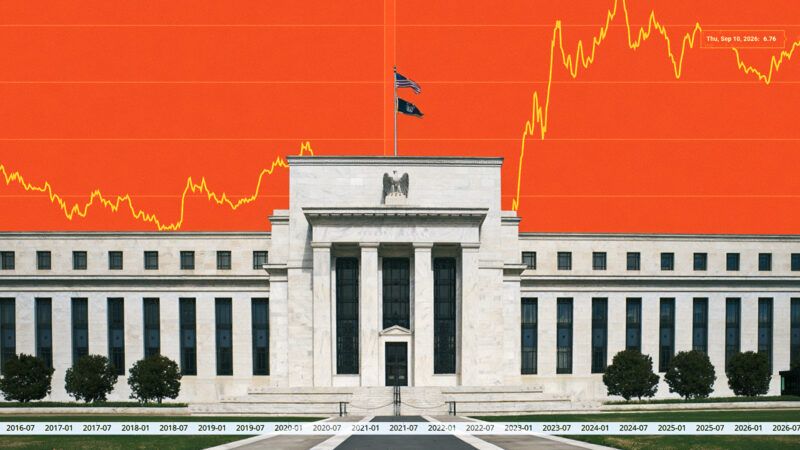
Inflation hasn't gone away—it's going up. With the midterm elections seven weeks off, that's a problem for the president and Congress. Voters hate inflation. They don't much like the cure either, and the cure has two parts. The Federal Reserve raising interest rates, like it just did, is one. The second part is overlooked and in the hands of Congress. Indeed, the Fed can't bring inflation down for good unless lawmakers show they will back the debt with future fiscal surpluses. That means becoming serious about overspending.
The Consumer Price Index shows prices rising by 0.4 percent over the past month, and by 3.4 percent over the last 12 months. The Fed's preferred measure of inflation, the Personal Consumption Expenditures Price Index, isn't especially reassuring, either.
Oil and gas prices, which have climbed due to circumstances in Iran and elsewhere, account for a substantial share of that increase. But Americans nonetheless understand the big picture: Nearly six years after our generation's "Great Inflation" began, overall prices continue to rise much faster than they should, and well above the Fed's 2 percent annual target.
A new National Bureau of Economic Research paper shows why the concern remains so personal. The authors looked at payroll records for about 16 million American workers between 2021 and 2024. As surprise inflation was plaguing the economy, peaking at 9 percent in 2022, firms were handing out their customary 3 percent cost-of-living raises. Meanwhile, 43 percent of workers who didn't change jobs (and 37 percent of all workers studied) endured reductions in real wages, most of which were quite severe. Aggregate real wages have since recovered, but the ground lost in the interim was never regained.
Considering that everyone claims to be a populist these days, you'd think the Trump administration and Congress would be making inflation a clearer priority. And by that, I certainly don't mean pressuring Kevin Warsh, the new Fed chairman, to lower interest rates.
Instead, these officials act like beating inflation is entirely the Fed's job. It's not.
In a world without fiscal austerity, when the Fed increases interest rates to slow inflation, the nation's interest payments on the debt grow too. That means more government borrowing and more claims on future tax revenue that nobody expects to be fully collected. It's a vicious cycle in which unaccounted-for money can add fuel to the inflation fire.
To win the 1980s fight against inflation, former Fed Chairman Paul Volcker was vocal with Congress and the Reagan administration about the fact that he couldn't do it on his own. What made Volcker's disinflation stick was not just a willingness to raise rates. And it wasn't that Washington ran smaller deficits, either—deficits nearly tripled in the early 1980s.
What mattered was that markets came to believe a correction was coming. Congress passed the Tax Equity and Fiscal Responsibility Act in 1982, Social Security reform in 1983, and tax reform in 1986, and eventually enabled the surpluses of the late 1990s. Unfortunately, that lesson has been forgotten.
That brings us back to today. Warsh has signaled some key shifts in Fed policy, including maintaining the 2 percent inflation target. In line with this commitment, he just raised interest rates by 0.25 percent, hiking the final figure to between 3.75 percent and 4 percent. Now, this Congress and subsequent ones must do their part. Parker Sheppard, senior fellow at the Fiscal Lab on Capitol Hill, spells out two ideas.
First, Congress should commit to a credible deficit target and restore the expectation that it will keep future debt sustainable. As Sheppard notes, "deficits are running at 6 percent today, and 3 percent is a level Congress has hit repeatedly." True, trimming deficits by half will be a serious political challenge. But considering the political challenge that inflation represents, it is worth doing.
Second, Sheppard argues that the Congressional Budget Office should include debt-service costs when it scores legislation. As things now stand, a bill can spend money in year two and offset it in year nine, and the score comes out balanced. Legislators then vote on proposals priced as if this costs us nothing. But those seven years of borrowing are not free. The Treasury pays interest on every dollar in the interim, and at current rates, it's significant money that the score never shows.
Economic growth helps too. Removing regulations that stand in the way of investment and work is valuable on its own merits, but it also helps with fiscal finances. The resulting revenue expands the government's capacity to service its obligations at the margin and lessens inflationary pressure.
All of this is worth doing, though it won't save us from the need to reform entitlement spending. Some 70 percent of the federal budget consists of mandatory spending, and the entire projected increase in the deficit comes from Social Security and Medicare. Entitlement reform is what we should be aiming for.
So yes, we should follow closely what the Fed does to fight inflation. But we should not let Congress off the hook.
COPYRIGHT 2026 CREATORS.COM