

Canada Is Moving Closer to Europe. Trump's Tariffs Help Explain Why.
As Ottawa’s trade war with the U.S. worsens, Brussels proposes closer trade, security, and technology ties, including an unprecedented "associate member” status.
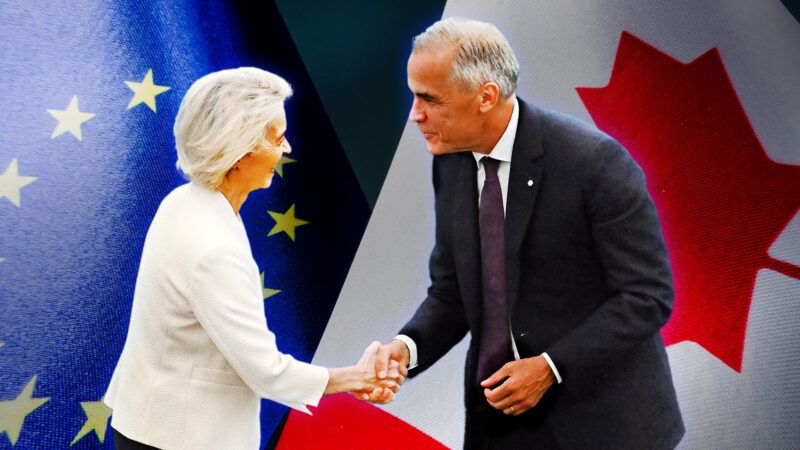
President Donald Trump's habit of ostracizing America's allies is making it a precarious time to be American, European, or Canadian.
European Commission President Ursula von der Leyen summarized this precarity at Wednesday's State of the European Union address, saying, "We must urgently reimagine our partnerships." Though the address was delivered to the European Parliament, the remarks were directed to Canadian Prime Minister Mark Carney, who was visiting the assembly and conspicuously seated to von der Leyen's left on the stage.
Von der Leyen then invited Canada to join the European Union (E.U.) as the bloc's first "associate member." The designation does not yet have a clear definition, but the two sides have said that they hope it will yield closer cooperation in energy, trade, technology, and Arctic security. In his speech to the European Parliament on Thursday, Carney said he intends to integrate the two markets further and join the E.U.'s student exchange program, Erasmus+.
Canada and the E.U. have long been partners, and the trend is accelerating. Under the 2017 Comprehensive Economic and Trade Agreement (CETA), tariff barriers on most trade between the two economies dropped. Earlier this year, Canada joined the SAFE Instrument, an E.U. program for joint defense rearmament. The country is also a cooperative participant in the European Space Agency, the E.U.'s research fund Horizon Europe, and E.U. election monitoring missions.
Details of the arrangement and how Canada will integrate into the E.U. have yet to be released. It might resemble the bloc's existing agreement with Norway, Iceland, and Liechtenstein called the European Economic Area, which integrates the three states into the E.U. common market, and allows for the free movement of goods, capital, and labor between them. Bilateral agreements with Switzerland have similarly removed trade and travel barriers, reports Bloomberg. In both cases, these "partial members" have acceded to E.U. regulations without joining E.U. institutions, in exchange for retaining autonomy to regulate the fishing and agriculture industries, and write their own trade policy. Though much space for further integration between Canada and the E.U. is possible, experts say that Canada joining the European Union Customs Union or adopting E.U. laws is unlikely.
Details aside, the political message is clear: Canada and the E.U. are seeking closer relations as they are driven away from their traditional ally, the United States. And honestly, who could blame them?
Since retaking office, Trump has wielded aggressive rhetoric and tariff policy against the E.U. and Canada.
On April 2, 2025, Trump announced his "Liberation Day" tariffs, which set a baseline 10 percent tariff rate on imports from most countries, with a 20 percent rate applied to E.U. member states. In July 2025, after months of threats and negotiations, Europe and the U.S. reached a loose trade agreement that subjected most imports from the E.U. to a 15 percent tariff, while tariffs on U.S. industrial exports were dropped. The E.U. also agreed to "invest some $600 billion in the United States and dramatically increase its purchases of U.S. energy and military equipment," reports Reuters. This agreement did not stave off the president, and over the following year, Europe saw further threats as the deal was being fully ratified and implemented. Von der Leyen's speech seems to have particularly invigorated Trump, who is now threatening to impose "serious tariffs" on the E.U. if Canada joins the bloc.
Though Canada was spared from Liberation Day's tariffs, sector-specific import taxes have steadily expanded over the past two years. After a rocky summer of U.S. reticence and threats, trade negotiations over Trump's proposed 50 percent tariff on several Canadian imports collapsed, and the tariffs went into effect last month. The conflict has since escalated into a full-scale trade war, with Canada applying retaliatory tariffs and consumers in both nations suffering the cost. Trump's jingoistic attitude toward a neighbor—frequently calling for Canada to become the "51st state," and recently ordering the renaming of Lake Ontario to Lake America—has not helped to de-escalate the situation.
The administration's tariff policy against two of America's largest trading partners has never made sense, nor has it shown much of a coherent strategy. The initial legal justification for the Liberation Day tariffs was a decades-old law that grants the president emergency powers, which plainly has nothing to do with tariffs. The Supreme Court struck down this justification in February, but swift lawyering ensured that new mechanisms for enforcement were found. The prevailing uncertainty over trade policy, coupled with the administration's contradictory rationale for these duties (Were they imposed to bring back manufacturing? Or reduce the trade deficit?) has resulted in whiplash for negotiators and businesses. It's also led U.S. allies to realize—not unfairly—that Trump's trade agenda has always been more about aggrandizement and power than sound economic policy.
Carney said as much during his speech to the E.U. Parliament on Thursday. "[Europe and Canada] do not seek power to dominate others. On the contrary, we are pursuing resilience so that no one can control our open markets, impair our sovereignty, threaten our territorial integrity, or undermine our freedoms, our democracies, our rule of law."




