

Will the Supreme Court Hear the 'Case About Swinging Dicks'?
Olympus Spa—an all-female, nude establishment in Washington state—sued after the government said it had broken the law by refusing to accept a preoperative transgender woman. But the case is more complicated than it looks.
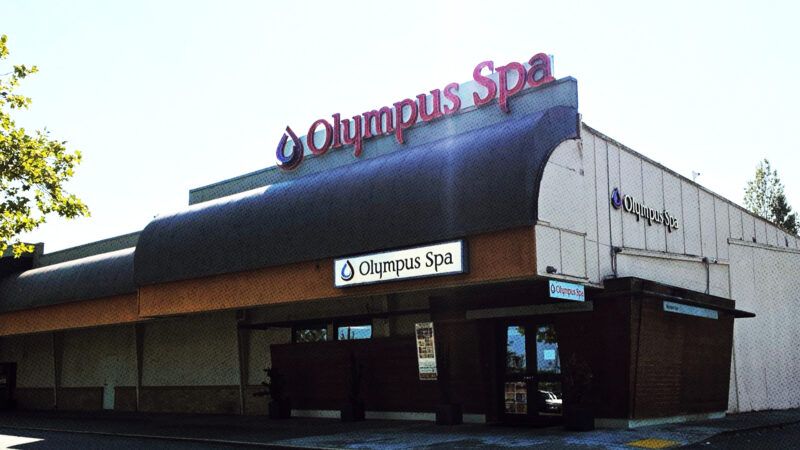
"This is a case about swinging dicks," wrote Judge Lawrence VanDyke of the U.S. Court of Appeals for the 9th Circuit in March. "You may think that swinging dicks shouldn't appear in a judicial opinion. You're not wrong. But as much as you might understandably be shocked and displeased to merely encounter that phrase in this opinion, I hope we all can agree that it is far more jarring for the unsuspecting and exposed women at Olympus Spa—some as young as thirteen—to be visually assaulted by the real thing."
VanDyke was dissenting from the 9th Circuit's decision not to revisit Olympus Spa v. Armstrong, a case that saw an all-female Korean spa sue on First Amendment grounds. The business, according to the Washington State Human Rights Commission (WSHRC), had broken the law when it declined to accept a preoperative transgender woman. This was a problem for Olympus Spa, which requires nudity in its pool area, and whose business model, relatedly, hinges on catering to a single-sex clientele.
In ruling against the business last year, the 9th Circuit acknowledged the thorniness of the case. "We are not unmindful of the concerns and beliefs raised by the Spa," wrote Judge M. Margaret McKeown. "Indeed, the Spa may have other avenues to challenge the enforcement action. But whatever recourse it may have, that relief cannot come from the First Amendment."
It is now taking its case to the Supreme Court. McKeown and VanDyke, whose vulgar approach elicited a rebuke from 27 of his colleagues, may appear irreconcilably at odds. In some sense, they are. Yet the rival sensibilities also help paint a more complete picture of a complicated case, one that naturally provokes strong reactions but for which there may be no immediately satisfying answer under the Constitution.
The ordeal traces back to 2020. Haven Wilvich, who has identified as a "nonbinary trans woman," lodged a complaint with the WSHRC after being turned away from the Olympus Spa location in Lynnwood, Washington, for having a penis. (The spa says it accepts postoperative transgender women.) The Washington State Law Against Discrimination (WLAD) bars discrimination based on many characteristics, including sexual orientation, which the state defines as encompassing "heterosexuality, homosexuality, bisexuality, and gender expression or identity."
Olympus Spa entered into a settlement with the WSHRC in October 2021 and later sued, alleging the enforcement action violated the owners' First Amendment rights.
It did not succeed. The government's "objection to [Olympus Spa's] entrance policy was not based on 'disagreement with the message it conveys,'" the 9th Circuit wrote in May 2025, "but rather with the practice it described—a practice that was unlawful under WLAD." Washington had approved "an expansive definition" of the term "sexual orientation," the court noted. "The Spa did not challenge this definition or the language of the statute," it wrote, "nor did it argue that the statute was vague or that the Spa's conduct did not fit within the statute's definition of discrimination on the basis of gender expression or identity." All in all, Olympus Spa "simply did not challenge the statute itself," the majority said, "and it is not our role to rewrite the statute."
The business's petition to the Supreme Court partially recommits to its initial approach. "The Spa is a cultural institution…founded to transmit and preserve centuries-old Korean communal bathing traditions in an intimate, sex-separated setting, consistent with its owners' cultural and religious heritage," write attorneys for Olympus Spa, which is represented by Alliance Defending Freedom and Pacific Justice Institute. "The Spa's mission of spiritual renewal and cultural expression qualifies it as an expressive association, and the forced inclusion of nude males impairs the association's mission."
That may be true in the abstract. But it is, once again, likely to be a legal loser. "Generally speaking, the [Supreme] Court has been reluctant to allow businesses to say, 'We get to associate with whomever we please,'" Eugene Volokh, a specialist in First Amendment issues and a law professor emeritus at UCLA, tells me. "That would spell, at least, if not the end of anti-discrimination law, at least very broad challenges to anti-discrimination law….As a libertarian matter, one could argue that there should be such a right, but the Supreme Court has repeatedly rejected any such claim." That comports with the 9th Circuit's ruling, in which McKeown wrote that classifying a nude spa in such a way "would stretch the freedom of association beyond all existing bounds."
More consequential, however, is that the spa expands into another area: religious exemptions. The owners are Christian, and, per the petition, "hold the religious conviction that men and women should not be unclothed together unless married to each other." The government should therefore make an exception, they say.
That is still not a surefire win, particularly when considering how unsettled and contorted the case law is on the subject. But it is for that same reason that the Supreme Court may be willing to take up the petition.
Core to the spa's argument is that WLAD carves out an exemption for exclusive private clubs, like fraternal organizations, which select members based on certain criteria. Such organizations are distinct from businesses open to the general public, and are thus not subject to public accommodations laws.
Olympus Spa does not contend that it is a private club. It is, after all, generally open to the public. So to advance this, its petition relies heavily on a 2021 Supreme Court decision, Tandon v. Newsom. In that case, the justices said California's COVID-19 restrictions on at-home gatherings were unconstitutional, because the state's haphazard approach had ultimately made it more difficult for activities like in-home Bible studies to take place than, say, shopping at retail stores. The upshot, the Court said, was that the government generally cannot make it harder to effectuate religious activity than comparable secular activity. And if it wants to do so for some reason, it must survive a high level of legal scrutiny.
That argument, too, may face an uphill battle. WLAD's exemption for "bona fide club[s]," for one, does not turn on religiosity versus secularity—what matters is public versus "distinctly private." A private club, in other words, would still be exempt under the law if it is religious, making Olympus Spa's attempt to massage its story into this framework seem a bit tortured.
Yet not entirely. If the spa "operated as a private club or as part of an Asian-interest sorority rather than as a public business," its attorneys write, "it would be free to exclude male patrons, no questions asked." Even if it doesn't win in court, it is the kind of logic that would conceivably resonate with many non-lawyers.
There is also the broader question of whether a spa's sex-exclusionary policy qualifies as religious exercise—or, more to the point, whether a biological female's objection to being nude with a biological male is exclusively a religious objection. "Let's say Olympus Spa wins," says Volokh. "There are going to be lots of other spas that say, 'Honestly, we have no religious beliefs here, but we do believe that women and men should be naked separately. We're just not religious.'"
Where would that leave those businesses? Transgender people deserve basic respect and dignity. And it can also be true that, in an ideal world, the owners of any spa—religious or otherwise—wouldn't need to petition the Supreme Court for the freedom not to expose female patrons to male genitals. That Olympus Spa has spent years fighting for that very thing, without an obviously successful pathway, is a testament to the uncomfortable chasm that sometimes exists between reality and the law.
Courts, after all, are ideally not supposed to make the latter. They are supposed to interpret it. Last year, after the 9th Circuit's decision came down, Volokh told me that lawmakers could amend WLAD to allow "places of public accommodation to segregate facilities by gender however the places define it." That could include, he said, "anatomical gender."
As we're talking a year later, I mention that lawmakers in Washington state may never be inclined to do this. What then? "Well, but here's the thing," he responds. "What you're just describing is democracy, right?"




