

A Liberal Think Tank and an Air Force Major Are Trump's Latest Targets for Speech Policing
Trump threatened the Center for American Progress with a defamation lawsuit, while Jason Watson faces a court martial for offending the president.
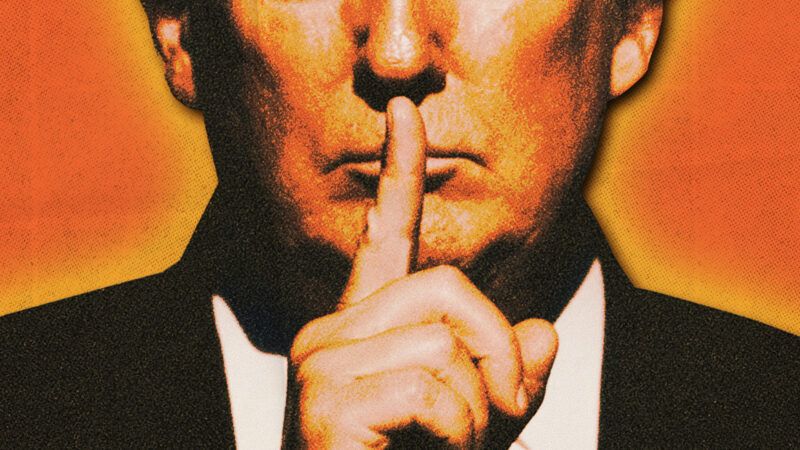
"Government censorship of speech is intolerable in a free society," according to a January 2025 executive order that President Donald Trump signed on his first day back in office. "It is the policy of the United States to…secure the right of the American people to engage in constitutionally protected speech."
That's an admirable sentiment. Of course, Trump has consistently behaved—both before and since—completely at odds with it. Just in recent days, we can add a progressive think tank and an Air Force major to the list of examples in which the president is threatening his critics with legal action simply for expressing opinions contrary to his own.
In August 2025, Trump declared a "crime emergency" in Washington, D.C., deploying U.S. National Guard troops to the nation's capital. Within 48 hours, Trump declared, "you see a big change and people are feeling safer already." But the numbers didn't bear out any major shift: An influx of nearly 2,000 federal troops netted fewer than 400 arrests, mostly for nonviolent crimes, in the first 10 days.
Trump also deployed federal officers to other cities, including Los Angeles, Charlotte, and Minneapolis, where immigration officers shot and killed two protesters in January.
Earlier this month, Reason's Autumn Billings wrote that after a year, D.C. crime is indeed down, though it's commensurate with a similar drop nationwide, raising questions "about why the $55 million-per-month show of force is necessary at all."
The Center for American Progress (CAP), a progressive think tank, reached a similar conclusion in July. "New CAP analysis reveals the Trump administration's costly National Guard deployments have failed to reduce violent crime despite its claims of success," wrote Chandler Hall. "Moreover, if these deployments are extended and continue through the end of 2026, they could cost American taxpayers more than $1.7 billion."
"The primary goal was never to stop crime," but was instead "a dangerous power grab by the Trump administration," Hall concluded.
"The report is just another Radical Left SCAM," Trump wrote on Truth Social. "This will be met with a lawsuit, which is being drawn now."
The New York Times reported that earlier this month, Trump's personal attorney, Alejandro Brito, sent a letter threatening a $5 billion defamation lawsuit if CAP did not retract the report, apologize to Trump, and provide him compensation.
According to the Times, the letter ended with the characteristically Trumpian sign-off, "PLEASE GOVERN YOURSELVES ACCORDINGLY."
"This threatened lawsuit's attack on facts and evidence is baseless," CAP President and CEO Neera Tanden said in a statement. "A fundamental protection of the First Amendment is to allow for the publication of facts and analysis that are contrary to the arguments and claims of any administration. A lawsuit is a transparent attempt to silence us. We will neither cower nor bend in the face of it."
Indeed, the details of Trump's demand suggest there's little more basis to them than just the president's hurt feelings.
For one thing, just like facts, pure expressions of opinion are not defamatory. And while it may fit into his pattern of demanding big round numbers, there's no way that a single mildly critical report harmed Trump's reputation, much less to the tune of $5 billion.
In fact, it's hard to square the claim that criticizing federal policies is defamatory to Trump personally, rather than critical of the government as a whole. "The alleged defamation…isn't about Trump's private conduct from before he was president," wrote Caitlin Vogus of the Freedom of the Press Foundation. "It's about whether his government's policies are as effective as the Trump administration claims they are."
In the 1964 case New York Times v. Sullivan, the U.S. Supreme Court determined that for public figures to prove defamation, they must show that the speaker demonstrated "actual malice" and didn't merely get facts wrong. But as Vogus points out, Sullivan "also established that the government itself cannot bring defamation suits, and it emphasized that public officials can't evade that rule simply by bringing the lawsuit in their own names."
"It is impossible to understand CAP's claim that the administration is trying to take credit for a drop in crime rates as defamatory (as everyone knows, politicians and political bodies try to take credit for things all the time)," Dan Greenberg, senior legal fellow at the Cato Institute, wrote last week. "It is impossible to understand CAP's claim about the timeline of falling crime rates as damaging to Donald Trump's reputation (it looks to be a statement about the country, not the president). And it is impossible to understand an allegation that Trump's policies are unpopular, ineffective, and costly as anything but a protected expression of opinion."
At the same time, Trump's government is also targeting a member of the armed forces for daring to criticize the president.
"A US airman who was arrested twice, once on the steps of the US Capitol while calling for the impeachment of President Donald Trump, was officially criminally charged Monday for his comments," CNN reported last week. Jason Watson, a U.S. Air Force major, faces 10 counts of violating the Uniform Code of Military Justice (UMCJ), including three counts of violating Article 88, which says "any commissioned officer who uses contemptuous words" against federal officials like the president, vice president, or Cabinet secretaries can be subject to a court-martial.
Watson first called for Trump's impeachment in July while demonstrating on the steps of the U.S. Capitol. Members of the Capitol Police arrested him for "crowding, obstructing, or incommoding…the entrance of any public or private building or enclosure," though he was later released.
Then earlier this month, in a televised interview, Watson again called for Trump's impeachment, telling CNN's Erin Burnett, "Not only is he a failure as president, he is flagrantly violating the Constitution, breaking the law, engaged in rampant corruption and is killing Americans. And that is unacceptable to me and it should be unacceptable to all of us."
That was apparently enough for the administration to arrest Watson and place him in pre-trial detention.
"If convicted on all counts, according to military law experts, the 17-year veteran will probably lose all retirement pay and benefits and could face time in a military prison," Dan Morse wrote at The Washington Post. "Three longtime military law attorneys…said he could face up to 10 years in prison, but given sentencing guidelines, if Watson receives prison time, it will probably range from 90 days to three years."
Article 88 is a particularly powerful weapon in the hands of a committed administration. "Article 88 is one of the punitive provisions of the UCMJ that create military crimes," according to a March 2026 article from Just Security. Per the Manual for Courts-Martial, "It is immaterial whether the words are used against the official in an official or private capacity."
Article 88 even applies to retired officers, who can be called back into active service just to be court-martialed if they ever criticize the president. "Under our current laws this restriction of your freedom and the threat of court martial is permanent for you until the day you die," George Acree, a retired U.S. Army colonel, wrote in 2024.
"According to Watson's attorneys, he is believed to be among the first officers of his rank in the history of the military to be charged under Article 88," CBS News reported. "The charges are the rare occurrence of the U.S. military not handling punishment behind closed doors."
Granted, it seems reasonable that Watson could expect to lose his job: Not many employers will tolerate an employee besmirching their boss on national television. In 2010, then-President Barack Obama famously sacked Gen. Stanley McChrystal, the commander of all U.S. forces in Afghanistan, after he disparaged Obama in an interview with Rolling Stone.
But it's something else entirely to threaten someone with legal or financial reprisal, including possible prison time, for expressing an opinion about the president of the United States.
Trump started his second term saying government censorship was over. He's weaponized it against his enemies ever since. The Center for American Progress and Jason Watson are just the latest targets.




