

Who's Paying for the Discounts in Mamdani's City-Run Grocery Stores?
This week, Mamdani announced his city-run grocery stores will sell core goods at a 30 percent discount.
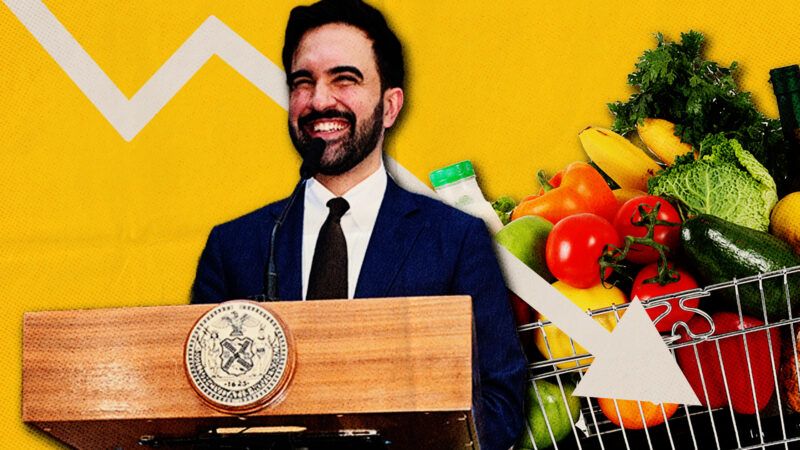
This week, New York City Mayor Zohran Mamdani gave more details about his administration's plan to open five city-owned, city-run grocery stores across all five boroughs. Although Monday's press conference provided some more clarity about the stores' discount rates and inventory, the plan is still no better than before (despite New York magazine's declaration that the stores "Sound Pretty Good").
The Mamdani administration has announced the locations of two stores: The first will open in Hunts Point in the Bronx by the end of next year, and another will open in East Harlem by 2029. In total, the city plans to spend $70 million in capital costs, with $30 million funding the ground-up construction of the East Harlem location. The city will cover the rent and property taxes for the five grocery stores located in each borough, and private operators will run the day-to-day operations of each store. Those operators will be "contractually required" to pass on savings to customers by offering discounts on a core basket of staples.
Until Monday's press conference, it was unclear which goods would be discounted and by how much. The core set of goods, Mamdani revealed, will include produce, meat, and seafood, along with 20 other items such as milk and bread. These items will be discounted by 30 percent compared to "typical retail prices" with "no exceptions, no gimmicks." Mamdani told reporters he arrived at the 30 percent figure because food prices have risen roughly 30 percent since 2019.
When asked whether the city-run grocery stores would threaten surrounding businesses, Mamdani told reporters that the city's stores would not pose a threat to bodegas and other grocery stores because they would not sell hot food or cigarettes, items he says drive revenue for existing bodegas and stores.
Even if the public stores do not threaten privately run businesses, there are few clear upsides to the plan. As philosophy and economics professor Daniel Muñoz noted on his Substack, if the goal of Mamdani's stores is progressive redistribution, a government-owned grocery store is an inefficient and "negative sum" solution.
"Notice that anyone can shop there—there is no means testing," Muñoz wrote. "By contrast, food stamps are designed to help the poor, and they don't cause long lines or put more efficient grocers out of business."
Mamdani has said that government intervention for food distribution is nothing new. On Monday, he explained that former New York City Mayor Fiorello La Guardia was inspired to create municipally owned markets after witnessing food riots several years earlier.
"He did so because he believed in a simple definition of the task of government to make people's lives better," Mamdani said.
La Guardia may have been partially motivated to create municipally owned markets to make goods affordable, but Mamdani conveniently left out another part of the story. La Guardia wanted to create municipal markets (like Essex Market in the Lower East Side) to get pushcarts off the streets.
According to a New York Times article from 1938, La Guardia wrote in a letter to commercial associations: "It is my policy, where a market is necessary, to build a proper covered market so that these same peddlers may be permanently placed in such market under proper and wholesome sanitary conditions." While municipal markets, like Essex Market, are still in use today, they are not proof of concept for city-run grocery stores. The vendors at Essex Market pay below-market rent, but the vendors are still private businesses subject to market fluctuations.
Even if the city-run stores push other grocers out of business, create resale markets, or produce other unintended consequences, the city will have little incentive to shut them down because taxpayers will always be there to foot the bill. Plus, the city can take credit for making life more "affordable" for New Yorkers.




