

'AI Kill Switch Act' Won't Stop Rogue AI, but It Will Slow Down Innovation
A bipartisan bill would give the Department of Homeland Security sweeping power to shut down powerful AI systems, with serious costs for competition and security.
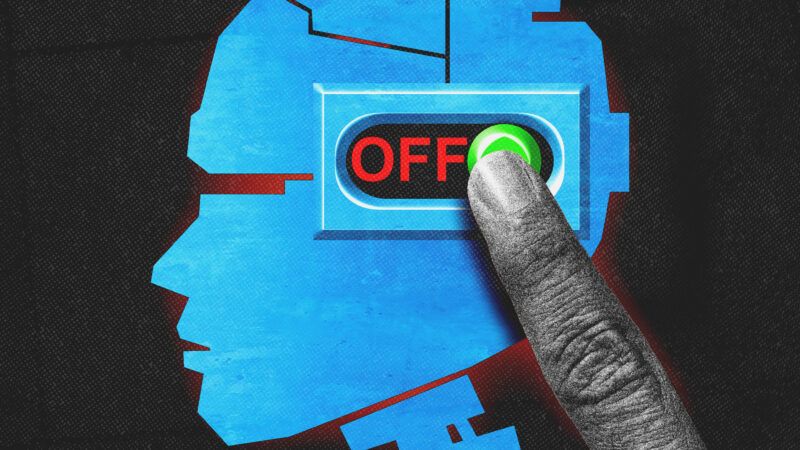
The federal government has increasingly tried to control America's burgeoning artificial intelligence (AI) sector, from proposing moratoriums on data centers to taking ownership stakes in tech firms. Now it wants to create a mandatory AI kill switch.
Last week, Reps. Ted Lieu (D–Calif.) and Nathaniel Moran (R–Texas) introduced the AI Kill Switch Act, which would require companies developing powerful AI systems to maintain the technical ability to restrict access to, throttle, suspend, or completely shut down their models. The bill would also allow the secretary of Homeland Security to order an AI company to limit or disable a system. Violations could result in fines of up to $2 million per day, rising to $20 million per day for violating an emergency order.
"We are moving from AI that answers questions to AI that takes actions….It is imperative that these AI systems have kill switches so we can keep this technology from causing catastrophic harm, and that the federal government has the clear authority and process to shut down rogue AI models," Lieu said in a press release.
The bill was introduced following one of the first examples of an AI system autonomously breaching its testing environment. Last week, ChatGPT creator OpenAI disclosed what it described as an "unprecedented cyber incident, involving state-of-the-art cyber capabilities," in which its experimental models left the test environment and hacked its way into the production systems of Hugging Face, a popular platform for hosting and sharing AI models.
OpenAI and Hugging Face are collaborating on an investigation and will share more details on the vulnerabilities, incident, and findings. "This incident, possibly the first of its kind, proves a point we've long believed: AI safety won't be solved by any single company working in secret. It will be solved in the open, collaboratively, with broad access to AI for every defender, everywhere," said Clem Delangue, co-founder and CEO of Hugging Face.
While support for the AI Kill Switch Act is bipartisan, there are serious concerns that the bill is an ill-thought-out, knee-jerk reaction to a single incident that could have a whole host of unintended consequences.
"By most accounts, what happened here was a system that was directed to do something, and then did it, and found software and cybersecurity vulnerabilities," Adam Thierer, a resident senior fellow with the Technology and Innovation team at the R Street Institute, tells Reason. Although the breach raised legitimate security concerns, "it still doesn't necessarily mean that a preemptive government-mandated kill switch is the proper way to address this."
It is unclear whether a federally mandated kill switch would actually stop the kind of emergency the bill is designed to address. Although companies may sometimes need to pull the plug on their own systems, Thierer says it is "very unlikely" that the government would be able to "immediately use a bill like this to solve various types of cyber intrusions or other types of problems in the future."
The measure is "far more likely to be used in the wrong ways or create different problems that we can't anticipate," he says. For example, it could change how AI companies calculate risk. Thierer warns that regulation can create a "lowest common denominator regulatory standard that everyone just tries to meet" rather than exceed. The result could be "a sort of false baseline of safety," in which companies satisfy the government's requirements and stop there, "as opposed to competing on safety."
America's lack of a commercial drone industry is one example of how maximizing regulatory safety on paper can stymie innovation. While the United States imposed years of approvals and paperwork to ensure a gold standard of safety, China took a more permissive approach and came to dominate the market.
The U.S. even lags behind developing nations. "We don't have remote blood delivery with drones like the way people have in Pacific Islands or in sub-Saharan Africa," says Thierer. "You can do that with a drone in Africa. You can get blood delivered in a far-off village. Can't do that in America: that's illegal."
Now a similar dynamic is emerging with AI, which puts the United States at risk of falling behind the rest of the world. "American law does not govern Chinese systems or global systems," says Thierer. With this regulatory approach, "you could put our companies, our developers, at a disadvantage."
The AI Kill Switch Act is not the first attempt to give the federal government emergency control over major information systems. In 2010, an "internet kill switch" for severe cyber or national-security emergencies was proposed. That effort was abandoned, partly due to concerns that concentrating control over the internet in government hands could threaten speech and create a single point of failure.
Thierer argues there are First Amendment concerns with heavy-handed attempts to regulate content. "Any time anyone in government is talking about having a mandated kill switch over any technological systems—but specifically an information or communications technology system—that should raise the hairs on the back of our heads, because that is an extraordinarily dangerous capability if it's abused," he says.




