

Will This Mississippi Man on Death Row Get a Chance To Prove His Innocence?
Recent court rulings in Louisiana and Texas give hope to Devin Bennett.
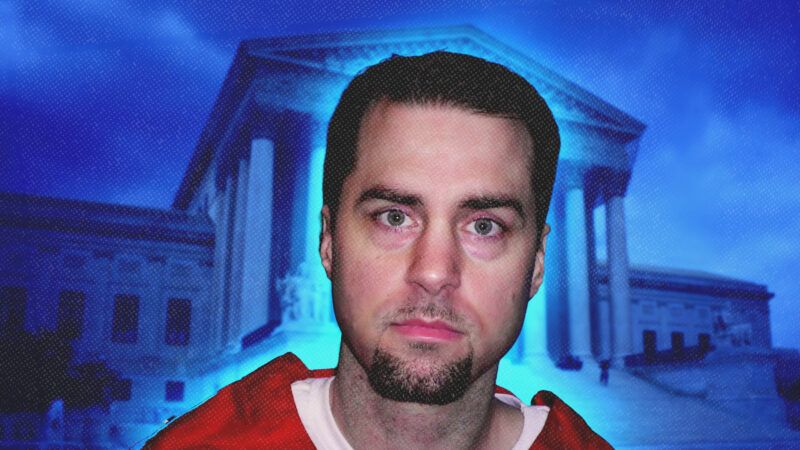
It was early in the morning on August 25, 2000. As Devin Bennett tells it, he put his 10-week-old son Brandon in a car seat and put the car seat on his bed—and then, as the father dozed in and out of sleep, Brandon fell.
The baby didn't appear to be hurt in the immediate aftermath of the fall, Bennett says, but hours later he noticed the boy was having trouble breathing. He rushed him to a hospital in Rankin County, Mississippi, where Brandon's heart stopped beating and he stopped breathing. After being transferred to another hospital, Brandon died.
Two and a half years later, a jury found Bennett guilty of capital murder and felonious child abuse and sentenced him to death. The medical examiners responsible for Brandon's autopsy—doctors Steven Hayne and Michael West, a pathologist and an odontologist who often worked together—presented evidence that the fatal injuries resulted from a kind of nonaccidental trauma that, at the time, was considered a sound medical diagnosis.
Their autopsy report, written by Hayne, cited "changes consistent with concurrent shaken baby syndrome."
Hayne and West reached this conclusion because the classic "shaken baby syndrome triad"—bleeding around the brain, bleeding behind the eyes, and brain swelling—were evident in Brandon. At the time, the triad was considered solid evidence of shaken baby syndrome.
Bennett has been fighting to prove his innocence since 2002. He and I speak frequently and frankly about his case, noting how it hinges on a flawed autopsy and the changing science around shaken baby syndrome. Fighting the state of Mississippi for decades to get an evidentiary hearing has generally left Bennett exhausted and frustrated.
But on June 30, he felt some hope.
The Case of Jimmie Duncan
On June 29, the Louisiana Supreme Court declared an inmate named Jimmie Duncan to be "factually innocent" after he spent 27 years on death row.
Duncan was convicted in 1998 of first-degree capital murder for sexually assaulting and drowning his girlfriend's 23-month-old toddler, Haley Oliveaux. Today he is free on bail—in part because, according to the Louisiana Supreme Court, "Duncan's conviction turned substantially on forensic evidence offered by experts whose reliability 'appears questionable at best.'"
When he read this decision, Devin Bennett took note. Those questionable experts were the same pathologist and odontologist who performed his son's autopsy: Hayne and West.
In the Duncan decision, the Louisiana Supreme Court cited "serious problems" with Haley's autopsy. Central to its concern was West's handling of alleged bite mark evidence on her body.
According to trial documents, West took a dental mold from Duncan and applied it to Haley's flesh—specifically over areas that he thought might have been bite marks—as part of his standard "comparative technique." A forensic expert later surmised that the bites West identified were not bites, but maybe bruises. The bite marks that West imprinted on Haley's body not only destroyed potential DNA evidence but were then identified by prosecutors as Duncan's actual bite marks.
The Louisiana court wrote that West's "'direct comparison technique' has been seriously questioned,' and that the [autopsy] video showed him 'forcibly thrusting' Duncan's dental molds into areas of Haley's face and body 'in a rather disturbing manner and to a rather disturbing degree.'"
A former head of the American Board of Forensic Odontology, Lowell Levine, testified that what West did was "a fraud, simply put." Even West himself later said of his own bite mark analysis in another case, "if I was asked to testify in this case again, I would say I don't believe it's a system that's reliable enough to be used in court."
The takeaway: Whatever passed for acceptable forensic science when Duncan was convicted in 1998 has since been "seriously undermined" by "new, reliable, and noncumulative evidence" that, had it been presented during the original trial, could have resulted in Duncan being found not guilty. Duncan is now out of prison.
As for Haley Oliveaux? Duncan's attorneys, relying on testimony from Haley's doctor, now suspect she drowned in a bathtub after suffering a seizure.
The Case of Hayne and West
Hayne and West didn't just reach questionable conclusions through questionable practices. There was also the matter of their basic competence.
Catherine Legge is a journalist who has researched Hayne and West for years for a documentary on Jimmie Duncan. Hayne and West, she says, worked within a context that "unfortunately allowed them to be shitty at their job."
Hayne (now dead) and West (retired) used dubious forensic practices in a legal system that permitted and maybe even encouraged it. Their autopsies—as documented in The Cadaver King and the Country Dentist, a 2018 book by Tucker Carrington and former Reason writer Radley Balko—raised suspicions among their peers that they were working in collusion with state prosecutors.
"Hayne and West were seen as tools for giving District Attorneys what they wanted," says Legge.
In its Duncan decision, the Louisiana Supreme Court wrote that Hayne and West's forensic work was "below the acceptable standard of care," "untruthful," "unreliable," "sloppy," and poorly documented. Forensic evidence they have produced in other cases has contributed to 9 convictions (8 in Mississippi) that were later overturned.
The sheer volume of their work encouraged sloppiness. Hayne worked on contract doing 8–9 autopsies a day, and anywhere from 1,000–1,600 a year. Medical forensic accreditation boards recommend a yearly total of around 250.
Under Hayne's contract, counties paid him by the body. Adding up the payments comes to a career total of around $10 million. At its height, his practice was doing 80 percent of Mississippi's autopsies. His practice was a factory.
Gradually—too slowly—the system took note of his sloppy work. In 2008, Mississippi prevented Hayne from doing autopsies. West was forced to leave the Board of Forensic Odontology in 2006. He often misidentified bite marks and, in one instance, claimed to have linked a suspect's teeth to a half-eaten sandwich. In another, he mistook crawfish bites on a body as human.
In The Cadaver King and the Country Dentist, Balko and Carrington write that Hayne and West "dominated the Mississippi death investigation system for twenty years. West testified in dozens of cases, Hayne in thousands."
They also quote a former police chief in Mississippi: "There's no question in my mind that there are innocent people doing time at Parchman Penitentiary due to the testimony of Dr. Hayne. There may even be some on death row."
The Case of Devin Bennett
Devin Bennett is on death row at Parchman penitentiary primarily because of Hayne's testimony. He wants a jury to reconsider Brandon's autopsy in light of the fuller story we now have on Hayne and West.
In Bennett's case, several forensic experts have concluded that Hayne and West made critical interpretive errors in Brandon's autopsy. Most notably, they attributed over a dozen abrasions on Brandon's body to Devin's alleged abuse. Yet when Brandon arrived at the first hospital, a nurse found no unusual marks on Brandon's body and noticed no abnormalities on the head or rest of the body.
Had anyone explored Brandon's previous medical records (which were at the hospital) or checked with child protective services, they would have learned that Brandon never showed medical evidence of bruising. Bennett and his girlfriend never missed a pediatrician appointment. According to Bennett, the only potentially negative thing they had ever been accused of doing to Brandon was overfeeding him.
Between the initial emergency room visit and Brandon's transfer to another hospital, Brandon underwent more than one unsuccessful intubation, several resuscitation efforts, and organ harvesting. All cause bruising and abrasions.
Bennett's attorneys argue that what Hayne presented as evidence of shaken baby syndrome could have been bruising caused by medical professionals trying to save Brandon from the effects of a fall.
At one point at Bennett's trial, Hayne told the jury that Brandon had "two skull fractures," one on each side of his skull. The implication was that Bennett had inflicted them. But these fractures are nowhere to be found in Hayne's autopsy report. The only reference in that report to evidence of a fracture—"bilateral focal fractures"—were later determined by expert medical examiners to be "wormian bones," which are natural bone chips located in the sutures of the skull.
Hayne "just made shit up," one of Bennett's attorneys complained.
The Case of Robert Roberson
What Bennett needs for a new hearing is post-conviction scientific evidence so convincing that it would reasonably lead a jury to this different outcome. On this front, there is good news for Bennett.
In October 2025, the conservative Texas Court of Appeals halted the execution of Robert Roberson. They did so in part on the grounds that the scientific status of "shaken baby syndrome" has changed enough to stay his execution under Texas' "junk science law."
Roberson, who is autistic, was sentenced to death in 2003 for killing his 2-year-old daughter, Nikki Curtis, by shaken baby syndrome. But in the face of weakening evidence of shaken baby syndrome as a valid medical diagnosis, Texas not only halted Roberson's execution but is moving to provide him an evidentiary hearing.
New research reveals that the so-called triad of shaken baby symptoms—brain bleeding, bleeding behind the eyes, brain swelling—could have resulted from accidents, including birth-related subdural bleeds, adverse reactions to medications, medical preconditions, and, yes, a short fall from a bed.
Reflecting this shift, the American Academy of Pediatrics now officially recommends the term "abusive head trauma" over "shaken baby syndrome."
If Bennett's case was heard today, the most convincing explanation for Brandon's death might be a preexisting condition (a head injury from forceps at birth) combined with a short fall. (For Roberson's daughter, newer evidence suggests that Nikki died from a combination of pneumonia and a chronic precondition.)
In the wake of the Roberson and Duncan decisions, Bennett is seeking a new hearing for his case. It remains to be seen if Mississippi will give him that chance.




