

Trump Scapegoats Gas Companies for Price Hikes Caused by His Iran War
The president is threatening gas companies and retailers over prices his own Iran policy helped create, while demanding that prices drop to a level the market hasn't seen since 2020.
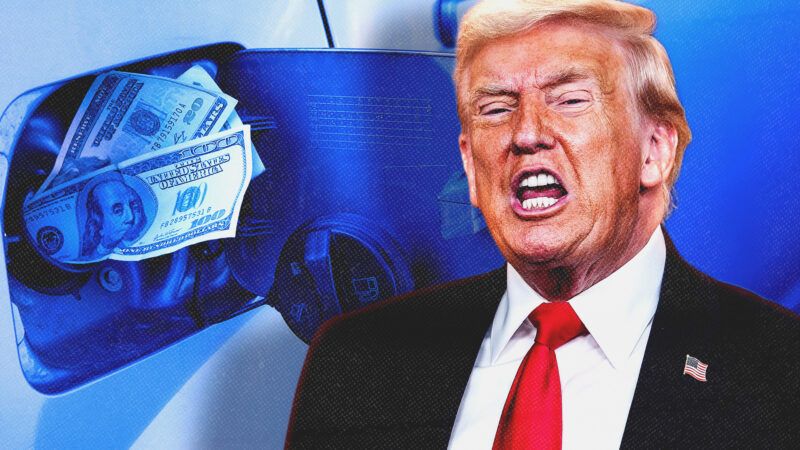
On Monday, President Donald Trump renewed his threats to the oil and gas industry, telling gasoline retailers they "must get their Prices down, IMMEDIATELY!" to around $2.50 per gallon. The president first threatened the "big Oil Companies" last Wednesday, when he ordered the Justice Department to investigate whether they were engaged in price gouging.
It's unclear how the president arrived at his asking price. When he first railed against higher prices last week, he estimated that gas prices should be "$2.25 right now at the pump," an unrealistic expectation based on the market data. (The average price for regular unleaded gasoline is $3.85 per gallon, according to AAA, and the last time the average price of gas hovered around $2.25 per gallon was May 2020.) Still, if the president is looking for someone to blame for higher gas prices, he should direct his ire at himself.
When Trump reentered office, the average price of gasoline stood at $3.48 per gallon, while the average per-barrel price of crude oil was $75.44. Through the first year of the president's second term, the average price of gas nationwide remained relatively stable between $3.20 and $3.60 per gallon, falling to a low of $3.19 per gallon in January, according to data from the U.S. Energy Information Administration.
Then, toward the end of February and leading into March, gas prices increased by 0.55 cents, a 16 percent jump sparked by the president's illegal war in Iran. With the Strait of Hormuz—which transports 20 percent of the world's petroleum supply—closed, crude oil prices continued to rise. After the average price of gas in the U.S. reached $4 per gallon in late March, crude prices peaked at an average of $112 per barrel in April, according to Business Insider.
Those prices eventually dropped following the announcement of a ceasefire that same month. Crude oil is currently hovering around $69 per barrel, close to the $67.02 per barrel average a day before the war began. All told, the war has cost Americans an extra $447 in higher energy costs per household, according to Moody's.
Considering gasoline retailers—the subjects of the president's discontent—are price takers, not makers, the president's demand that the price at the pump decrease "commensurate with" the price of crude oil seems unreasonable. Most gas stations, even those with nationally recognized brands, are independently owned, mom-and-pop operations. If they aren't obligated to buy fuel from their brand supplier, they buy from the global fuel market. And even when petroleum prices spike, gas stations make most of their money from snacks and food, not fuel sales, meaning they don't profit from the supposed price gouging Trump is accusing them of.
It's not the first time a president has accused the oil and gas industry of price gouging. As far back as Bill Clinton, presidents have used their expansive regulatory powers to investigate oil companies whenever prices were politically inconvenient. George W. Bush did it in 2006, Barack Obama in 2011, and Joe Biden in 2021.
In each case, federal regulators were unable to find any evidence of industry-wide price fixing. Regardless, lawmakers insist corrupt business practices are afoot. Last June, Rep. Janice Schakowsky (D–Ill.) introduced the Price Gouging Prevention Act of 2025, which would grant the federal government authority to regulate and criminalize price gouging. The bill has so far stalled in committee.
In an emailed response to a question about the status of a potential Justice Department investigation, a department spokesperson told Reason that gas prices are a "national security issue" affecting "every American," and that the department is committed to "ensuring affordability in this nation."
It's easy to cast the oil and gas industry as greedy capitalists profiting from scarcity during a war. Yet, they're simply reacting to foreign policy decisions by the Trump administration that have negatively affected the global supply chain.




