What To Expect From Colombia's New President
He ran a MAGA-style campaign in a nation beset by partisan violence. Will he make Colombia freer or more authoritarian?
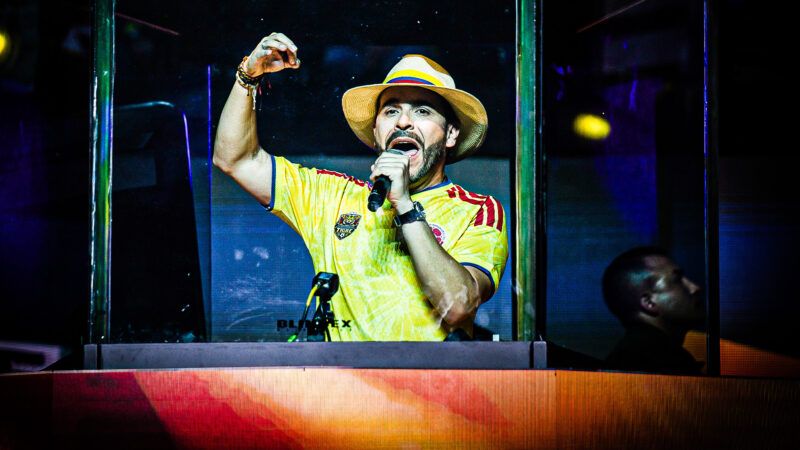
On Wednesday, leftist Iván Cepeda conceded the Colombian presidential election to his opponent, Abelardo de la Espriella, putting another right-leaning populist in charge of a Latin American country.
De la Espriella, who won by a margin of less than 1 percent, ran a brash, MAGA-reminiscent (and MAGA-endorsed) campaign blending laissez faire economics with traditionalist machismo social policy and a commitment to crack down harshly on violent crime and drug smuggling.
De la Espriella's platform borrowed from other Latin American presidents, including Nayib Bukele of El Salvador—de la Espriella has promised to build mega-prisons just like his—and Javier Milei of Argentina—whose budget-slashing he has pledged to repeat in Colombia. Milei called himself "the lion." De la Espriella goes by "the tiger."
When his term begins on August 7, de la Espriella will be taking charge of a Colombian economy more dependent on the state than ever. Under the leadership of Gustavo Petro, the incumbent left-wing president, Colombia has drastically expanded social programs for the poor. While it has reduced poverty, the spending meant more debt and higher taxes on financial institutions, accumulated wealth, and the fossil fuel industry. Inflation, which is down from a post-pandemic high of 13 percent, has begun to rise modestly, jumping from 5.68 percent in April to 5.84 percent in May (the largest increase since August 2024). And although unemployment has dropped below 9 percent, Petro's labor regulations—enacted in June 2025—threaten to "limit the pace of formal job creation and partially offset the gains observed over the past year," according to a Deloitte analysis.
In 2025, the International Monetary Fund suspended a $9.8 billion line of credit in response, citing Colombia's "widening fiscal deficit." Over the course of Petro's tenure, foreign direct investment dropped by a third.
De la Espriella's running mate told The Financial Times that they plan to "return Colombia to its historic position of macroeconomic stability," and de la Espriella has made a priority of bringing investors back to Colombia. To do that, however, he'll need to deliver not only fiscal responsibility, but also security from Colombia's notorious and powerful Marxist militias.
For decades, the most prominent of these, the Revolutionary Armed Forces of Colombia (FARC), rampaged across the countryside, displacing hundreds of thousands annually. In 2016, the government brokered a permanent peace, and FARC formally disarmed in 2017. But in their absence, other militias have flowered—the largest of which is the National Liberation Army—and "illegal armed groups have roughly doubled their membership in the last five years," according to the BBC.
The burgeoning left-wing militant scene has coincided with a rise in political violence. Last year, right-wing presidential hopeful Miguel Uribe was assassinated. Colombian authorities blamed the killing on a FARC-spinoff called Second Marquetalia, but presented no hard evidence linking the group to the act. That was the event which roused de la Espriella—who had been living with his wife and four children in Florence, Italy, for a year—and brought him back to "save" Colombia. After returning and announcing his candidacy, de la Espriella campaigned behind bulletproof glass and promised to wage war on the militias.
His presidency will also have the cartels to deal with; taken together, it's estimated that they produce and export nearly $200 billion worth of cocaine every year. Organized drug-smuggling poses an additional problem, but one that cannot be neatly separated from the partisan paramilitary issue—ideological militants raise their funds through the drug trade too.
In short, the new president has got his work cut out for him. It won't be easy to rein in wasteful spending on popular programs, maintain peace between all the dozens of active armed factions and the government, and build out a bunch of mega-prisons, while preserving Colombians' economic and political freedoms. Though it doesn't seem like de la Espriella is too concerned about those freedoms. He made the culture war a second focal point of his campaign, railing against "gender ideology" and opposing same-sex adoption rights: "a child needs a father and a mother, those roles," he said.
Yet another South American country has put a populist with authoritarian tendencies and a nominally laissez-faire economic policy in charge. De la Espriella has promised to protect Colombians from violent militias and to return the country to economic health. But there are aspects of his platform reminiscent of an old kind of Latin American macho-man—a kind that can be more trouble than he's worth.