

The Secret Origins of 'Conspiracy Theory'
A new book shows how a phrase made its way from the crime pages to our political arguments—and picked up a passel of meanings along the way.
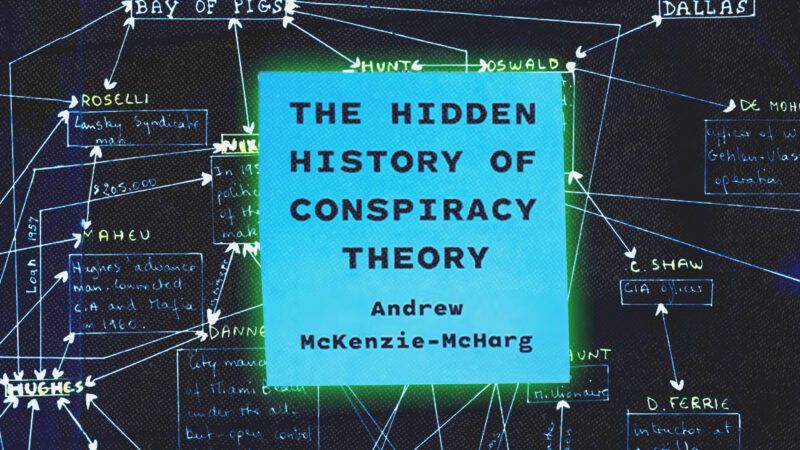
The Hidden History of Conspiracy Theory, by Andrew McKenzie-McHarg, Princeton University Press, 674 pages, $42.95
"Homer conceived the power of the gods in such a way that whatever happened on the plain before Troy was only a reflection of the various conspiracies on Olympus," Karl Popper told an Oxford lecture hall in 1948. "The conspiracy theory of society," the philosopher added, simply replaces those deities with "sinister pressure groups."
That passage, which Popper then revised and incorporated into the second edition of The Open Society and Its Enemies, is sometimes cited as the moment the expression "conspiracy theories" entered the language. But in The Hidden History of Conspiracy Theory, the most original study of the subject to come along in years, the Australian historian Andrew McKenzie-McHarg argues that this is both too late and too early for that honor—too late because the phrase is actually much older than that, too early because Popper's term was subtly different from the one people usually use today.
In the 19th century, McKenzie-McHarg shows, the words "conspiracy theory" were typically deployed in a forensic context. In the aftermath of a crime, a detective or lawyer or reporter might speak in entirely neutral terms about a conspiracy theory of what happened, meaning that more than one perp might have been involved. When the phrase came up in a political context, it was still being used that way: After President James Garfield was shot, the St. Louis Daily Globe-Democrat used the term while editorializing about the speculations around the assassination. The plural form, "conspiracy theories," was vanishingly rare.
Writers sometimes referred to the conspiracy theory of something: the conspiracy theory of a murder, for example. So when Popper spoke about the more cosmic "conspiracy theory of society"—or when the legal scholar Franz Neumann critiqued the "conspiracy theory of history," or others in the mid-20th century spoke about the "conspiracy theory of government" or "conspiracy theory of politics"—they were just extending that linguistic formula.
Even before then, the phrase "conspiracy" was sometimes used to stigmatize ideas. (In 1935, a former congressman mocked the "conspiracy complex" of people who blame world events on hidden forces.) But the phrase "conspiracy theory" did not, by itself, carry a stigma. Neumann himself was involved with the Nuremberg prosecutions of Nazi war criminals, where jurists used the term in an entirely non-pejorative manner: They were discussing whether to charge the defendants with conspiracy.
The phrase "conspiracy theory," in the sense that people use it today, became popular in the wake of commentaries like Popper's and Neumann's. There is, naturally, a conspiracy theory about how that happened: A widespread rumor claims that the CIA deliberately injected the phrase into the media to discredit dissident investigators. McKenzie-McHarg debunks that dubious tale, instead tracing a gradual process where people dropped the last two words of "conspiracy theory of history" or "conspiracy theory of society" and began to refer to "conspiracy theories" as a genre of stories. (Indeed, Neumann did that himself at one point in his talk, a minor milestone in the evolution of political rhetoric.) And once "conspiracy theories" existed as that sort of category, people were more likely to discuss the "conspiracy theorist" as a kind of guy.
Make that several kinds of guys. As McKenzie-McHarg shows, there is more than one media image of a conspiracy theorist; the popular options range from basement-dwelling nerd to millenarian militia terrorist. Reading that section of his argument, I was reminded of the trio of X-Files characters called the Lone Gunmen, each one carefully costumed to reflect a different stereotype.
* * *
If that were all there is to this book, it would be a neat little origin story, easily told in about 250 pages. But Hidden History is more than 600 pages long, and it covers far more ground than the century or so that I just described: It hops from the Italian Renaissance to the French Revolution to the present, with a cast of characters stretching from the leader of a tiny UFO cult to a literal Illuminati double agent. (The Bavarian Illuminati may be pure folklore today, but there was a genuine secret society by that name in Central Europe from 1776 until the authorities suppressed it about a decade later. And at one point it recruited the reactionary jurist Ludwig Adolf Christian von Grolman, who actually opposed its ideology, and who drew on that memory when writing a pamphlet titled News of a Large but Invisible League Against the Christian Religion and the Monarchical States.)
The book sprawls so much because its author is not merely an etymologist or genealogist. Yes, he explores the histories of terms here—not just "conspiracy theory," but the individual words "conspiracy" and "theory," plus "paranoid style," and "paranoid," and "style." (Never before has a work of narrative history felt so much like a lost volume of the Oxford English Dictionary.) But this book is also about what we mean by such terms, and how those different meanings have intersected with one another.
Thanks in part to its double origins, stretching back both to ordinary criminal investigations and to the machinations of Homer's gods, the phrase "conspiracy theory" can connote the image of either a detective working a case or a prophet revealing a vast, cosmic struggle—what McKenzie-McHarg calls the analytic and apocalyptic modes. But the term also, he argues, came to describe a space where one of those modes bleeds into the other. Where, say, one might begin by examining some genuinely open questions about the murder of Malcolm X, then start wondering if the larger series of '60s assassinations reflected a sinister pattern, then start looking for a hidden hand pulling the strings behind all those deaths and still more…
Another theme of the book is the way that "conspiring and conspiracy theorizing often dovetail into one another." It is no surprise, of course, that a real conspiracy can spark a conspiracy theory, but this also works in reverse: A conspiracy theory can spark a real conspiracy. Take that Illuminati double agent. Convinced that the secret society was still active in the 1790s—or, at the very least, convinced that it was useful to have people believe the Illuminati were still active—Grolman decided to form a secret "counter-association" against that "devilish union."
It is impossible for even a book this hefty to cover everything, and occasionally McKenzie-McHarg misses a detail that would have enriched his arguments. When he discusses the 1956 book When Prophecy Fails, a much-cited account of the aforementioned UFO cult, he notes that the authors' method—they infiltrated the sect—was in tension with their vaunted posture as neutral social scientists trying not to influence the movement they studied. He could have expanded on that thought considerably if he had brought in Thomas Kelly's recent critique of When Prophecy Fails, which drew on recently unsealed records to reveal that the researchers had manipulated the group and then distorted their account of what happened.
But there is plenty of meat in Hidden History without bringing in any extra courses. And the meatiest part of the book is the series of intellectual biographies that conclude it. In three long chapters, McKenzie-McHarg explores the lives and works of three figures: Franz Neumann, a Marxist legal scholar who delivered that lecture on the "conspiracy theory of history"; Richard Hofstadter, a liberal historian best known in this context for his early-'60s essay "The Paranoid Style in American Politics"; and Carl Oglesby, a New Left leader of the 1960s who in the '70s turned to writing about the JFK assassination, the Watergate break-in, and the secret war that he thought he saw lurking behind such crimes.
* * *
Here I should insert a disclosure. I know McKenzie-McHarg slightly—we both gave presentations at a couple of conferences on conspiracy theories—and he asked me to read his Oglesby chapter in advance. I gave him my feedback, and I helped him track down a little information. (His acknowledgments thank me for my "encyclopedic knowledge of the more abstruse corners of American counterculture," which I should put on a business card.) At the time, I thought the chapter was a very interesting account of an underappreciated historical figure. Now that I've read it in context, I see its place in a larger argument about the ways certain conspiracy stories have "quivered with the energy generated by the friction" between the analytic and apocalyptic modes.
But before we get to Oglesby, we should discuss the first two biographies. First Neumann, who delivered that lecture on the conspiracy theory of history a few months before his death in 1954. Much of this chapter is devoted to the man's ideas, but McKenzie-McHarg also notes that Neumann eventually ran directly into the conspiracist headwinds himself: Sen. Joseph McCarthy, a Wisconsin Republican known for throwing around accusations of red sympathies, cited the scholar as an alleged loyalty risk.
McCarthy was infamous for being sloppy with his charges, a fact that the book duly relates. But then the story takes a turn: According to the archives opened after the USSR collapsed, McKenzie-McHarg informs us, Neumann did, in fact, spy for Moscow during World War II. It wasn't exactly Cambridge Five–scale espionage—the book quotes an amusing cable where Neumann's higher-ups complain that their agent "does practically nothing"—but it still was espionage against the United States, even if the spy was a bit lazy. In the case of Franz Neumann and the red-hunters, the conspiracy theory turned out to be correct.
Neumann was personally acquainted with the subject of McKenzie-McHarg's second biography: He and Hofstadter were colleagues at Columbia University, and Hofstadter likely supplied some historical examples for Neumann's 1954 lecture. Hofstadter's appearance in Hidden History is no surprise: "The Paranoid Style in American Politics" may be the single most cited article ever written about conspiracy theories, though the phrase "conspiracy theory" appears nowhere in it.
McKenzie-McHarg is both respectful of that essay's contributions and blunt about its flaws, writing that Hofstadter's approach "walked a fine line between insight and misrepresentation." He discusses several scholars who pushed back against Hofstadter's ideas—for example, by refuting Hofstadter's claim that conspiracism usually takes root among only a "modest minority of the population." He also discusses scholarship that adopted some of Hofstadter's ideas but extended them in new directions. I was happy to see several pages on the historian David Brion Davis, who wrote two great works on the history of conspiracy theories: the 1960 paper "Some Themes of Counter-Subversion," which spelunked through antebellum anti-Catholic, anti-Masonic, and anti-Mormon literature, and the 1969 book The Slave Power Conspiracy and the Paranoid Style, which revisited the anxious tales that Northerners and Southerners told about each other during the run-up to the Civil War. Davis drew on Hofstadter, but I like Davis' work much better, and McKenzie-McHarg helps me see why: There is no way, reading a book like The Slave Power Conspiracy, that you could ever mistake its subjects for an easily pathologized movement of a social fringe.
Then we come to Oglesby, who treated Dallas, Watergate, and other ruptures in the politics of the '60s and '70s as moments in a long war between two wings of the ruling class: the old Eastern Establishment, which Oglesby dubbed the Yankees, and the new wealth bubbling in the Sunbelt, which he called the Cowboys. Oglesby once remarked that he was more a Sherlock Holmes than a Marx—more an investigator pursuing a case than a grand social theorist. Taking a critical look at Oglesby's theories, McKenzie-McHarg argues that the man was actually trying to play Sherlock Holmes and Marx. (Figuratively speaking, that is. Oglesby was not a Marxist, and in fact he eventually joined the Libertarian Party.) But he also argues, compellingly, that the man's most basic attitude was not that of either a detective or a social scientist. Oglesby, who had side careers as a playwright and a singer-songwriter, had a literary sensibility.
And so, I think, does McKenzie-McHarg. Don't get me wrong: This is a scholarly book written in a scholarly manner, with copious footnotes and dense prose. But at times it resembles a Pynchonian postmodern novel full of unexpected intersections and synchronicities. At one point, describing Oglesby's testimony at the trial of the Chicago Seven—the conspiracy trial of the Chicago Seven, I should say—McKenzie-McHarg notes that the prosecutor questioned Oglesby about an incendiary speech delivered by, of all people, Neumann's son. The author quickly adds that this was "no more than a coincidence," but an able conspiracist could surely find a way to connect those dots.
So I'll wrap up by recalling my favorite Carl Oglesby coincidence, one that McKenzie-McHarg restrained himself from highlighting—though I know he's aware of it, since he mentions the article where it appeared. When Oglesby was just 22, five years before President John F. Kennedy was assassinated in Dallas, The New York Times reviewed the future JFK theorist's play The Season of the Beast under the headline "Drama in Dallas." The piece featured a photo of the play's star, an actor named Kennedy.
In the analytic mode, that's just a funny fluke. But in an apocalyptic key, it looks more like a cosmic portent—as though one of Homer's gods was moving a chess piece into place.





