

Reason.com - Free Minds and Free Markets
Reason logo Reason logo
  • Latest
  • Magazine
    • Current Issue
    • Archives
    • Subscribe
    • Crossword
  • Video
    • Reason TV
    • The Reason Roundtable
    • Free Media
    • The Reason Interview
  • Podcasts
    • All Shows
    • The Reason Roundtable
    • The Reason Interview With Nick Gillespie
    • Freed Up
    • The Soho Forum Debates
  • Volokh
  • Newsletters
  • Donate
    • Donate Online
    • Ways To Give To Reason Foundation
    • Torchbearer Society
    • Planned Giving
  • Subscribe
    • Reason Plus Subscription
    • Print Subscription
    • Gift Subscriptions
    • Subscriber Support

Log In

Create new account

United Kingdom

Britain Wants To Ban Teens From Social Media. The Evidence Suggests It Won't Work.

Britain is following Australia into a policy that has already struggled to keep children off social media, while forcing adults through intrusive age checks.
Reem Ibrahim | 6.15.2026 5:17 PM

Share on FacebookShare on XShare on RedditShare by emailPrint friendly versionCopy page URL Add Reason to Google
Media Contact & Reprint Requests
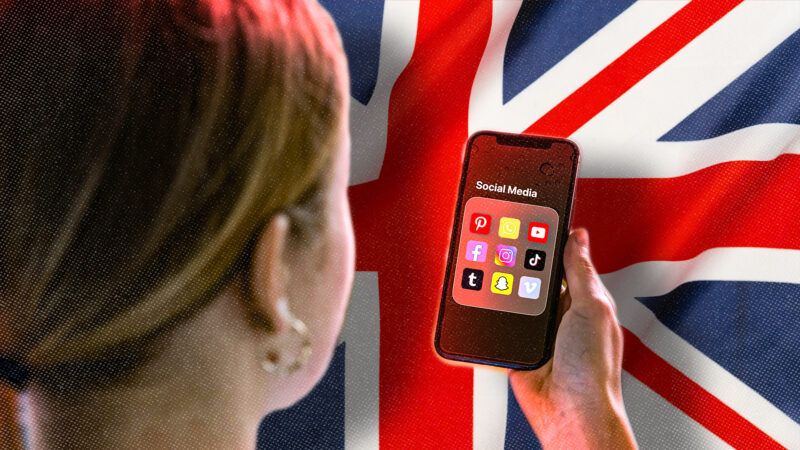
A teemage girl looking at a smartphone, with the United Kingdom flag in the background | Galyna Tymonko/imageBROKER/Jochen Tack/Newscom/Adani Samat
(Galyna Tymonko/imageBROKER/Jochen Tack/Newscom/Adani Samat)

The United Kingdom announced on Monday that it will become the second country to ban social media for children 15 and younger. Speaking at a press conference, Prime Minister Keir Starmer said, "Government is always about choices, and it's clear to me that a full ban is the right choice."

"Every parent can see it with their own eyes. Social media is making children unhappy. It's making it easier for bullies to harass and abuse them," Starmer added. "And it could even be harming their mental health, exposing them to content that is dangerous because that's what grabs their attention. It's designed to be addictive."

The ban, which is due to take effect next year, will cover a select number of "user-to-user" apps, including TikTok, X, YouTube, Instagram, Facebook, Reddit, and Snapchat. The full list of which platforms the ban will apply to has not yet been released.

The government is also considering overnight curfews and breaks in infinite scrolling for those under 19, with further details expected in July, according to the BBC. This could mean that 16- and 17-year-olds, who can already legally have sex, work, and pay taxes, and whom the government wants to let vote, would not be allowed to access social media at night.

The question of how this would be enforced remains up in the air. Australia, the only other country in the world to introduce a ban on those under 16 accessing social media, has struggled to do so. Around 70 percent of children who already had accounts on Instagram, Snapchat, TikTok, or Facebook still had them after the ban came into effect, according to a survey published by Australia's eSafety Commissioner.

Regardless of how the ban will be enforced, one thing is certain: It will come at the expense of the privacy of all British internet users. The government cannot ban children from social media without asking everyone else to prove they are not children. Ofcom,  Britain's communications regulator, says in its own guidance under the Online Safety Act that age checks can include facial age estimation, open banking, digital identity services, credit card checks, email-based age estimation, mobile network checks, and photo-ID matching.

Civil liberties groups have warned of privacy risks. Responding to the government's announcement, Jack Coulson, head of advocacy at Big Brother Watch, said that everyone will "face a 'papers, please' demand to get online," and that the proposals would force the public to trust sensitive identity documents to companies with "serious track records of leaks and hacks."

Even so, the government's plan appears to have been designed by people with very little understanding of how teenagers actually use the internet. As one survey of Europeans aged 13 to 18 found, 74 percent of teenagers on average said they watched videos on YouTube to learn something new for school, and 71 percent on average watched videos on YouTube to learn something new for fun or outside of school.

"My son is obsessed with classical music," author and journalist Stephen Pollard said on X. "He is a gifted cellist who wants to be a professional musician. He spends hours watching performances on YouTube - learning so much about the profession he hopes to pursue. To carry on watching these performances and lectures that can be found nowhere else, he will have to break the law. It's utterly mad."

Social media is also used to stay in touch with friends and family. According to an Ofcom report, almost three-quarters of 13- to 17-year-olds who use social media say they help them feel closer to friends. A majority of both girls (71 percent) and boys (60 percent) see being online as good for helping to build and maintain friendships.

Leading up to the ban, the government conducted a three-month public consultation that it said was needed to gather evidence. Now it's looking more like retroactive justification. Of the parents who responded to the consultation, 90 percent support a minimum age for children to access social media. But a consultation is not a poll, and respondents are not a representative sample of British parents. Those motivated enough to respond to a government consultation on children's social media use are likely to have stronger views on the issue, and are probably more supportive of restrictions than the average parent.

Parents are, of course, entitled to make different choices for their own children. If a parent wants to take YouTube or other apps away from their child, that is their decision. However, the children supposedly being protected by the ban do not seem especially convinced.

In a BBC interview with a room full of 11- to 14-year-olds, a presenter asked whoever supported the ban to raise their hands, which no child did. One student, Isabella, said she "didn't think it would actually happen," adding that she had expected the prime minister to "give it more time or more consideration." Her main concern was losing a way to contact friends, parents, and family. When the presenter asked what she would do with all of her newfound free time, Isabella succinctly replied: "stare at a wall."

Start your day with Reason. Get a daily brief of the most important stories and trends every weekday morning when you subscribe to Reason Roundup.

This field is for validation purposes and should be left unchanged.

NEXT: Colorado Becomes Second State To Create Right to an Attorney When Police Seize Your Property

Reem Ibrahim is a research fellow, policy and media at Reason.

United KingdomSocial MediaChildrenAustralia
Share on FacebookShare on XShare on RedditShare by emailPrint friendly versionCopy page URL Add Reason to Google
Media Contact & Reprint Requests

Hide Comments (32)

Editor's Note: As of February 29, 2024, commenting privileges on reason.com posts are limited to Reason Plus subscribers. Past commenters are grandfathered in for a temporary period. Subscribe here to preserve your ability to comment. Your Reason Plus subscription also gives you an ad-free version of reason.com, along with full access to the digital edition and archives of Reason magazine. We request that comments be civil and on-topic. We do not moderate or assume any responsibility for comments, which are owned by the readers who post them. Comments do not represent the views of reason.com or Reason Foundation. We reserve the right to delete any comment and ban commenters for any reason at any time. Comments may only be edited within 5 minutes of posting. Report abuses.

  1. Eeyore   2 months ago

    Just ban kids from using smartphones already. Can copy paste all of the alcohol laws relating to kids and contributing to the delinquency of kids and replace any reference to the word relating to alcohol with smartphone.

    It will read a little odd when whiskey, wine, or beer becomes smartphone, smartphone, or smartphone.

    1. Rise of the Impedance   2 months ago

      Android, Apple, or Pixel?

      1. Eeyore   2 months ago

        I didn't think anyone outside of the development team felt anything when they discontinued the Windows Phone.

        1. mad.casual   2 months ago

          Even at that, the Microsoft dev team didn't feel it in their souls.

          Windows phones get the absinthe treatment.

          1. SCOTUS gave JeffSarc a big sad   2 months ago

            It’s shocking how a company this large that spent so much money developing their own mobile OS failed so horribly.

  2. Vernon Depner   2 months ago

    while forcing adults through intrusive age checks.

    And that, of course, is the real reason for doing this. They want to increase surveillance of adult internet use. It's not about the safety of children.

    1. GOD OF PENGUIN ISLAND   2 months ago

      ^

    2. SCOTUS gave JeffSarc a big sad   2 months ago

      Great Britain is a quasi Marxist authoritarian state that is destroying their country with islamic migration, which is poison.

    3. Zeb   2 months ago

      Yup. This is what I came here to say. "For the children" (as much as I actually agree that social media has been terrible for everyone overall) is a stalking horse to make everyone show ID to use the internet so they can better be tracked and controlled.

  3. Don't look at me! ( Is the war over yet?)   2 months ago

    Has nobody ever heard of a VPN?
    I feel certain the kids have.

    1. Eeyore   2 months ago

      In the UK any VPN service must perform the same age verification checks that social media sites do.

      In theory.

      1. SCOTUS gave JeffSarc a big sad   2 months ago

        Yeah, that won’t be hard to bypass………

      2. mad.casual   2 months ago

        Remember how bitcoin was going to free everyone from tyranny by tracking 100% trustworthy and 100% anonymous exchanges of value across a centralized ledger?

        Well, there's no reason to keep a ledger for "age of consent" bona fides. They don't gain or lose value in the exchange. There's no reason for one 'adult' website selling alcohol and tobacco products to cross-reference with an 'adult' website selling 'feminine hygiene' products or literal educational videos to cross-reference with an *adult* website selling explicitly salacious content the way they would want to track value with a currency. The way they would gain or lose value is by failing to gatekeep. Even pooling/tumbling (arguably) enhances their value, as long as gatekeeping is conserved, as it makes it more difficult for someone trying to generate and/or transfer CP to know they're (not) interacting with minors. "Platforms" can rely on the tumblers to discourage CP in such a fashion, while offloading liability for gatekeeping to the crypto exchanges or... token generators, if you will.

        Again, I'm not opposed to porn or free speech or even CP as much as maybe the next guy is. If someone over the age of 18 currently holds a copy of Brooke Shields from Sugar 'n' Spice from 1975, I don't really have a problem with it, regardless of how Brooke Shields may feel (I unequivocally agree that her mother and Gary Gross should be hung by the toes to whatever degree would satisfy Shields).

        Given the prevalence of cookies, SSL, and several other layers of technology to establish trust and veracity on the internet and the yoctobytes of porn flying around, a scant few bytes to keep people from sexualizing and/or brainwashing minors doesn't seem *impossible* or unduly burdensome.

        Whether any given nation State decides to use them to prevent 20 yr. olds from buying handguns or 11 yr. olds from accessing email is the same old, on-the-ground/meatspace gatekeeping it is now and/or has always been.

        I must say, the idea that people need ID to vote but children (or adults) *needing* to access snuff films, "How to act like you have MPD" instructional content, and CP without any identity or age verification whatsoever seems fundamentally conflicted.

        1. See.More   2 months ago

          I must say, the idea that people need ID to vote but . . .

          The idea that age-gating online content is no different than age-gating products/activities (e.g. buying tobacco or alchohol products, voting, etc) in the meatspace is fundamentally out of touch.

          Showing a physical ID to a real person at the point of transaction has no useful digitial record of the ID. No one can hack the identifying data from those transactions. Different identifying data, like credit card numbers, may be hackable from point-of-sale digital records, but not the information from an ID card or other documentation.

          Age verification in cyberspace, however, is an automated process where the user is safest in assuming that the data will be stored and will be shared/sold. No matter what the chatbox, pop-up, wizard, or whatever manner the verification app is presented says, there is zero way for the user to verify the truth of any claims that "your data will not be saved" or "your data will not be shared." Sure. The app could be programmed to simply set a boolean flag "Verified? Y/N," but the user has no way to know. And it is far more likely that the government will require that identifying information be stored for audit/enforcement purposes.

          At least at the liquor store, I am watching the cashier look at my card and hand it back to me, and I can intercede if they attempt to "store" the information (i.e. write it down, scan, photocopy, or photograph it, etc).

          1. Zeb   2 months ago

            You are starting to see ID scanners more often now, which troubles me a bit. I think they aren't supposed to save any record, but who knows?

  4. shadydave   2 months ago

    They have zero desire to ban kids from social media. What they want is to monitor everyone's social media, and to use the "ban" as the means to do so. They want to become the greatest and most oppressive surveillance state in the history of man.

  5. Rev Arthur L kuckland (5-30-24 banana republic day)   2 months ago

    Is it still okay to rape and stab them if your name is mohamad?
    Asking for murderous cult

    1. SCOTUS gave JeffSarc a big sad   2 months ago

      I don’t think Reem has a problem with that.

  6. SCOTUS gave JeffSarc a big sad   2 months ago

    Reem, this is the LEAST of Britain’s problems.

    1. Zeb   2 months ago

      Yes, but it's still an important one. This is how they monitor everyone online to control the political discourse. It's not about kids and social media.

  7. John C. Randolph   2 months ago

    Starmer the quisling is full of shit. iOS and Android already have parental controls. The entire purpose of this power-grab is to create the means to suppress dissent online.

    -jcr

  8. NoVaNick   2 months ago

    After cutting them off from tobacco and vapes, now social media, labour wants to allow 16 year olds to vote. Wonder how that will work out? Hopefully they’ll give labour a swift kick in the arse

  9. mad.casual   2 months ago

    When the presenter asked what she would do with all of her newfound free time, Isabella succinctly replied: "stare at a wall."

    Regardless of how I feel about the ban one way or the other, this doesn't exactly bode well for Britons, libertarianism, or civilized society.

    Even "New Soviet Man" liberals should be concerned the answer isn't "read classic literature", "paint", or "breed orchids" or whatever enlightened activity they think subjects would do when all of their oppressive social needs have been met.

    "Eat bugs, sleep in pods, rent a phone and network plan, be happy."

    1. BYODB   2 months ago

      It's ok, it's a teen girl so this is what is known as 'being dramatic'.

      I'd wager she couldn't stare at a wall for longer then ten minutes without getting critically bored, and after all television still exists.

      1. Zeb   2 months ago

        Yeah, they'll find something else to do. Maybe even go out into the world and actually physically interact with their peers.

      2. mad.casual   2 months ago

        It's ok, it's a teen girl so this is what is known as 'being dramatic'.

        So you're saying it may be possible that Reason is being a tad melodramatic on behalf of teens who, themselves, are being melodramatic?

        That keeping teens off of the platforms that perpetuated a censorship and social influence campaign that the Soviets/Nazis could only dream of isn't *all* bad?

        Huh.

  10. mad.casual   2 months ago

    Britain Wants To Ban Teens From Social Media. The Evidence Suggests It Won't Work.

    IKR? Look at how horribly prohibition has worked at keeping teens from drinking too exce... er... uh... look at this data we compiled from the last two months in Australia!

  11. NoVaNick   2 months ago

    Considering that most trans/nonbinary kids would not exist without social media, where is the outrage from the woke left here?

    1. mad.casual   2 months ago

      They were trans/nonbinary from birth. There's even a question as to whether it's genetic. Just ask their parents and their gender-affirming medical professional.

    2. Zeb   2 months ago

      They can't admit that. If you acknowledge the social contagion theory you are worse than Hitler.

  12. See.More   2 months ago

    "Every parent can see it with their own eyes. Social media is making children unhappy . . .

    Sure. There are zero other reasons that your children are unhappy.

    I'm sure being pursued by rape gangs is a tremendous balm to British girls' happiness.

    1. Zeb   2 months ago

      Those are lower class girls, so can safely be ignored. Until their fathers start setting shit on fire.

Please log in to post comments

Mute this user?

  • Mute User
  • Cancel

Ban this user?

  • Ban User
  • Cancel

Un-ban this user?

  • Un-ban User
  • Cancel

Nuke this user?

  • Nuke User
  • Cancel

Un-nuke this user?

  • Un-nuke User
  • Cancel

Flag this comment?

  • Flag Comment
  • Cancel

Un-flag this comment?

  • Un-flag Comment
  • Cancel

Latest

Trump Promised Transparency. His Administration Keeps Finding New Ways to Hide Records.

Matthew Petti | 8.15.2026 8:00 AM

New Jersey Revives the Fight To Reclassify Gig Workers as Employees

C. Jarrett Dieterle | 8.15.2026 7:00 AM

Colombia's New President Wants More U.S. Military Help Fighting Cartels

Tosin Akintola | 8.14.2026 4:23 PM

The War on Free-Range Kids Makes The New York Times

Lenore Skenazy | 8.14.2026 3:55 PM

Virginia Man Argues His 'FTP&ATF' License Plate Is Free Speech. The Supreme Court Might Hear His Case.

C.J. Ciaramella | 8.14.2026 3:11 PM

Recommended

  • About
  • Browse Topics
  • Events
  • Staff
  • Jobs
  • Donate
  • Advertise
  • Subscribe
  • Contact
  • Media
  • Amazon
Reason Facebook@reason on XReason InstagramReason TikTokReason YoutubeApple PodcastsReason on FlipboardReason RSS Add Reason to Google

© 2026 Reason Foundation | Accessibility | Privacy Policy | Terms Of Use

This site is protected by reCAPTCHA and the Google Privacy Policy and Terms of Service apply.

Reason's July 4 Special!

For America's 250th, Get 2 Years of Reason for $17.76

Celebrate your independence with a subscription to Reason magazine, your most trusted source of honest, insightful news and analysis.

Subscribe to Reason

