

Steven Spielberg's Disclosure Day Has Some Strange Assumptions About the Media
The best way to release secret footage of alien life is…local TV news?

Given the recent success of Backrooms, a movie based on a YouTube series that was itself based on a meme, it's tempting to view Steven Spielberg's often crackling but frequently frustrating Disclosure Day in the same light. This is the beard's riff on the old "ancient aliens" meme, the popular-on-the-internet History Channel freeze frame featuring a zap-haired "expert" who somehow always seemed to be conveying the same amusingly crazy idea: I'm not saying it was ancient aliens—but it was ancient aliens.
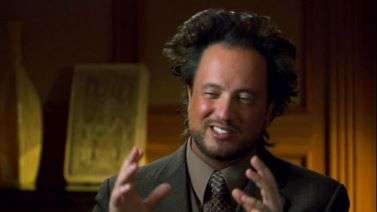
Spoiler alert: In Spielberg's movie, the aliens aren't quite ancient; they've only been around since the 1940s, at least as far as the United States government and its sinister corporate tentacles know. But this isn't much of a spoiler, given the trailers and the fact that the basics of alien existence are revealed to the viewer by the end of the first act.
Indeed, that's the setup, rather than the resolution: aliens exist, there is copious archival footage to prove it, and shadowy forces have been engaged in a massive cover-up in order to gain power over alien technology and cow the public. The movie, then, is about the quest to release the evidence to the world.
That quest starts with the hacker Daniel Kellner, played with quiet intensity by the increasingly excellent Josh O'Connor, who makes off with a cache of drives containing classified footage depicting alien contact and technology as the movie opens. It expands quickly to a consortium of aliens-are-real devotees led by Hugo Wakefield (Colman Domingo), as well as Margaret Fairchild (a marvelous Emily Blunt), a scatterbrained local TV weather woman who finds herself speaking in foreign, even alien, tongues. Kellner and Fairchild are connected by a kind of psychic alien destiny, like Elliot and E.T. in Spielberg's kiddie-alien classic, and Wakefield is something like a John the Baptist figure, preparing the way for the prophets of the stars.
The challenge they face is that the secret of alien existence has been hidden by Wardex, a nefarious corporation with ties to the U.S. military that has been hiding the revealing footage. The corporation's central figure is Noah Scanlon (Colin Firth), who has appropriated some alien tech for himself in the form of a little stone obelisk that, when clutched, allows him to create a psychic connection with others, including Kellner's girlfriend Jane Blankenship (Eve Hewson). The scenes where he burrows into her mind, like a hacker pwning a network, are electric, and nearly make up for the fact that none of this makes even a single alien blood droplet of sense.
The movie's problems start with the fact that everyone speaks in breathless riddles and oblique teases, as if they are background characters on some late-breaking spinoff of Lost, rather than explaining themselves in clear language to each other. But the bigger problem is the nature of the disclosure itself.
Spielberg wants viewers to take for granted that aliens are real, and that the video proof, contained on what amounts to a bunch of thumb drives, would simply and instantly convince everyone who sees it. The videos themselves look like what they are—Hollywood fakes made using a combination of computer effects, costumes, and puppetry. Often, they are just seconds long. Sometimes they are shot in the grainy, blurry style of real-world, official UFO footage, which as we know proves little and fails to convince many people. Sometimes they are a good bit clearer, but in a way that makes them look like high-end Hollywood frauds.
The movie simply assumes that broadcasting this footage to the world will convince the general public that aliens are real. Most of the movie's second act is organized around the mad dash to get the footage out, which turns out to mean playing it on a local NBC News affiliate. (The movie is distributed by Universal, part of the same media conglomerate that owns NBC.) By the very end, the movie conveniently hopscotches this problem, but it does so in a way that renders the quest to broadcast the footage, which is to say most of the movie's narrative, completely unnecessary.
For most of the movie's runtime, however, the plan is simply for a hacker and a local TV weather reporter to release the footage. I know Blunt's character is just a fun-loving weather personality, but surely she has some sense of journalistic values? Has anyone in this movie heard of verification? Asking for comment? This is why no one trusts the media.
Indeed, this is part of what makes this movie so odd: It's set in a contemporary United States, in which it's assumed that essentially everyone does trust the media. There are iPhones and internet connections, but we see no podcasters, no YouTubers, not even any skeptical mainstream media pundits, let alone the sort of sketchy, attention-seeking politicians who would want to turn this headline news event into fodder for self-aggrandizement. Aliens are real, and that's why we must tax billionaires and oligarchs, now please donate to my campaign, said no one in this movie.
From Close Encounters of the Third Kind to E.T. to that one Indiana Jones movie that we've all tried to forget about, Spielberg has long been obsessed with aliens. Here, he wants to hammer home a grand, heartwarming idea about how radical empathy is what connects people, animals, and perhaps even big-eyed mystical space aliens, but the movie is almost shockingly naive about the willingness of the masses to peacefully and productively converge around a controversial belief. In the movie's dramatic scheme, the only significant barrier to their acceptance of alien life is a villainous corporate entity with an impressively large collection of tactical vests and black vehicles.
The good news is that on a scene-by-scene basis, Disclosure Day is taught, thrilling, and worth arguing with, which is to say it's a Steven Spielberg movie. The bad news is that it exists in an unrecognizable parallel universe—and not because of the beings from outer space. The world of Disclosure Day is a world without ancient aliens-obsessed wacko experts, without memespeak nihilism, without paranoiacs and grifting conspiracy mongers, without partisan argument or propaganda or meaningful skepticism of any kind. This movie isn't actually a meme, but it probably should have had more of them.




