Reason.com - Free Minds and Free Markets
Reason logo Reason logo
  • Latest
  • Magazine
    • Current Issue
    • Archives
    • Subscribe
    • Crossword
  • Video
    • Reason TV
    • The Reason Roundtable
    • Free Media
    • The Reason Interview
  • Podcasts
    • All Shows
    • The Reason Roundtable
    • The Reason Interview With Nick Gillespie
    • Freed Up
    • The Soho Forum Debates
  • Volokh
  • Newsletters
  • Donate
    • Donate Online
    • Ways To Give To Reason Foundation
    • Torchbearer Society
    • Planned Giving
  • Subscribe
    • Reason Plus Subscription
    • Print Subscription
    • Gift Subscriptions
    • Subscriber Support

Log In

Create new account

History

Gordon Wood's Enduring Defense of the American Revolution

Plus: when tattoos meet copyright law

Damon Root | 6.11.2026 7:00 AM

Share on FacebookShare on XShare on RedditShare by emailPrint friendly versionCopy page URL Add Reason to Google
Media Contact & Reprint Requests
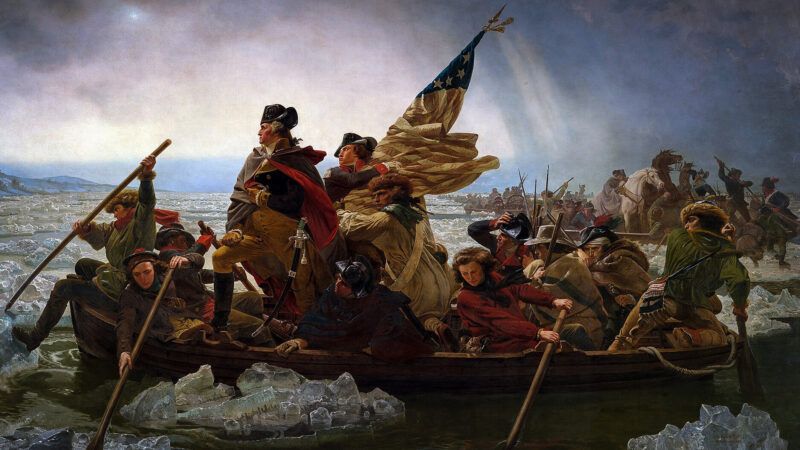
A painting depicting American troops with flags during the American Revolution | Washington Crossing the Delaware/Emanuel Leutze
(Washington Crossing the Delaware/Emanuel Leutze)

In 1775, the great British essayist and lexicographer Samuel Johnson entered the political fray over the American Revolution with a scorching pamphlet that attacked the wayward colonials for their disloyalty to the crown and hypocritical talk of freedom. "How is it," Johnson demanded, "that we hear the loudest yelps for liberty among the drivers of negroes?"

That sort of question still looms large over many contemporary debates about the American Revolution. "Why should anyone take seriously the founders' odes to liberty," the argument may go, "when many of those same founders participated in the vile institution of slavery?"

You’re reading Injustice System from Damon Root and Reason. Get more of Damon’s commentary on constitutional law and American history.

This field is for validation purposes and should be left unchanged.

I got to thinking about Johnson's pamphlet the other day after I learned about the tragic death of the towering American historian Gordon Wood. The connection came to mind because Wood had offered his own response to such Johnsonian questioning in what was, to my mind, his best book, The Radicalism of the American Revolution. Here is what Wood had to say:

To focus, as we are today apt to do, on what the Revolution did not accomplish—highlighting and lamenting its failure to abolish slavery and change fundamentally the lot of women—is to miss the great significance of what it did accomplish; indeed, the Revolution made possible the anti-slavery movement and women's rights movements of the nineteenth century and in fact all our current egalitarian thinking.

The example of John C. Calhoun, the famous South Carolina statesman and inveterate defender of slavery, may help to buttress Wood's point. In 1848, Calhoun denounced both the Declaration of Independence and its author, Thomas Jefferson, for promulgating the idea that "all men are created equal," which Calhoun described as "the most false and dangerous of all political errors." Calhoun was no fool. He well understood that if the Declaration of Independence was ever followed to its logical conclusion, it would spell doom for American slavery.

The great abolitionist hero Frederick Douglass knew that, too. The only difference was that while Calhoun disparaged Jefferson's words, Douglass celebrated them. By the middle of the 19th century, it was Douglass, and the antislavery movement to which he devoted his life, that truly embodied the radical principles of the American Revolution.

"It was no accident," Wood wrote, "that Americans in Philadelphia in 1775 formed the first anti-slavery society in the world." For them, just like for Douglass several decades later, the principles underlying the American Revolution could point nowhere else.


In Other Legal News

The U.S. Supreme Court is expected to issue opinions today in one or more argued cases. As of this writing, we're still waiting on huge opinions dealing with executive power, birthright citizenship, immigration, and more.

As we wait for those big SCOTUS decisions to drop, I wanted to highlight a fascinating copyright case that's been bouncing around in the lower courts. If you're familiar with the tattoo-based reality TV shows Miami Ink or LA Ink, you may also be familiar with the tattoo artist who goes by the name Kat Von D. Well, a few years ago, Von D tattooed an image of Miles Davis on one of her friends. That image was based on a picture of Davis taken by a photographer named Jeff Sedlik. After Sedlik learned about the tattoo, he demanded to be paid a licensing fee. A federal copyright suit eventually followed.

Writing at Courthouse News, Edvard Pettersson lays out the legal and artistic differences between the parties:

Von D testified that no one in the tattoo world gets licenses to use photographs as references for their creations. She maintained her use of the Miles Davis image was "fair use" because it was her interpretation of the image and served an entirely different purpose than Sedlik's work….

Sedlik, however, turned out to be a stickler when it comes to unlicensed use of his work; he regularly scans the internet to find infringers. He testified how in 2014 he tracked down another tattoo artist who had posted on social media a tattoo he had done based on the same Miles Davis photo.

I am sympathetic to Von D's fair use argument in this case. And while it's not exactly pertinent to this particular dispute, I might add that I am sympathetic to the legal plights of tattoo artists in general, as this venerable profession has long suffered under bogus regulations and other unjustifiable government interference. Indeed, it was not until 2010 that a federal judge finally held that "the tattoo itself, the process of tattooing, and the business of tattooing are forms of pure expression fully protected by the First Amendment."

In any event, Sedlik v. Von Drachenberg looks to be a copyright case to watch, as its final outcome may have costly implications for many tattooists at work today.

Start your day with Reason. Get a daily brief of the most important stories and trends every weekday morning when you subscribe to Reason Roundup.

This field is for validation purposes and should be left unchanged.

NEXT: 1776 All-Stars: Why Thomas Jefferson Is the Most Fascinating Founder

Damon Root is a senior editor at Reason and the author of A Glorious Liberty: Frederick Douglass and the Fight for an Antislavery Constitution (Potomac Books). His next book, Emancipation War: The Fall of Slavery and the Coming of the Thirteenth Amendment (Potomac Books), will be published in June 2026.

HistoryAmerican RevolutionLaw & GovernmentSlaveryCourts
Share on FacebookShare on XShare on RedditShare by emailPrint friendly versionCopy page URL Add Reason to Google
Media Contact & Reprint Requests

Hide Comments (1)

Editor's Note: As of February 29, 2024, commenting privileges on reason.com posts are limited to Reason Plus subscribers. Past commenters are grandfathered in for a temporary period. Subscribe here to preserve your ability to comment. Your Reason Plus subscription also gives you an ad-free version of reason.com, along with full access to the digital edition and archives of Reason magazine. We request that comments be civil and on-topic. We do not moderate or assume any responsibility for comments, which are owned by the readers who post them. Comments do not represent the views of reason.com or Reason Foundation. We reserve the right to delete any comment and ban commenters for any reason at any time. Comments may only be edited within 5 minutes of posting. Report abuses.

  1. minus the clever name   1 hour ago

    Gordon Wood was a great help to me, read his last book just some months ago, but he was deficient in the religious/philosophical mooring of our Founding.

    Benjamin Rush, a signer of the Declaration of Independence from Pennsylvania, said:
    "We neglect the only means of establishing and perpetuating our republican forms of government, that is, the universal education of our youth in the principles of Christianity, by means of the Bible; for this divine book, above all others, favours that equality among mankind, that respect for just laws, and all those sober and frugal virtues, which constitute the soul of republicanism."

    Log in to Reply

Please log in to post comments

Mute this user?

  • Mute User
  • Cancel

Ban this user?

  • Ban User
  • Cancel

Un-ban this user?

  • Un-ban User
  • Cancel

Nuke this user?

  • Nuke User
  • Cancel

Un-nuke this user?

  • Un-nuke User
  • Cancel

Flag this comment?

  • Flag Comment
  • Cancel

Un-flag this comment?

  • Un-flag Comment
  • Cancel

Latest

'Find Some Kids': How Health Officials Drummed Up Fake Support for Tobacco Bans in Massachusetts Towns

Guy Bentley | 6.11.2026 8:00 AM

Gordon Wood's Enduring Defense of the American Revolution

Damon Root | 6.11.2026 7:00 AM

1776 All-Stars: Why Thomas Jefferson Is the Most Fascinating Founder

Ronald Bailey | From the July 2026 issue

Brickbat: 'Less Serious' Theft

Charles Oliver | 6.11.2026 4:00 AM

The House Just Passed a 'Pro-Worker' Bill That Takes Power Away From Workers

Reem Ibrahim | 6.10.2026 8:27 PM

Recommended

  • About
  • Browse Topics
  • Events
  • Staff
  • Jobs
  • Donate
  • Advertise
  • Subscribe
  • Contact
  • Media
  • Shop
  • Amazon
Reason Facebook@reason on XReason InstagramReason TikTokReason YoutubeApple PodcastsReason on FlipboardReason RSS Add Reason to Google

© 2026 Reason Foundation | Accessibility | Privacy Policy | Terms Of Use

This site is protected by reCAPTCHA and the Google Privacy Policy and Terms of Service apply.

r

I WANT FREE MINDS AND FREE MARKETS!

Help Reason push back with more of the fact-based reporting we do best. Your support means more reporters, more investigations, and more coverage.

Make a donation today! No thanks
r

I WANT TO FUND FREE MINDS AND FREE MARKETS

Every dollar I give helps to fund more journalists, more videos, and more amazing stories that celebrate liberty.

Yes! I want to put my money where your mouth is! Not interested
r

SUPPORT HONEST JOURNALISM

So much of the media tries telling you what to think. Support journalism that helps you to think for yourself.

I’ll donate to Reason right now! No thanks
r

PUSH BACK

Push back against misleading media lies and bad ideas. Support Reason’s journalism today.

My donation today will help Reason push back! Not today
r

HELP KEEP MEDIA FREE & FEARLESS

Back journalism committed to transparency, independence, and intellectual honesty.

Yes, I’ll donate to Reason today! No thanks
r

STAND FOR FREE MINDS

Support journalism that challenges central planning, big government overreach, and creeping socialism.

Yes, I’ll support Reason today! No thanks
r

PUSH BACK AGAINST SOCIALIST IDEAS

Support journalism that exposes bad economics, failed policies, and threats to open markets.

Yes, I’ll donate to Reason today! No thanks
r

FIGHT BAD IDEAS WITH FACTS

Back independent media that examines the real-world consequences of socialist policies.

Yes, I’ll donate to Reason today! No thanks
r

BAD ECONOMIC IDEAS ARE EVERYWHERE. LET’S FIGHT BACK.

Support journalism that challenges government overreach with rational analysis and clear reasoning.

Yes, I’ll donate to Reason today! No thanks
r

JOIN THE FIGHT FOR FREEDOM

Support journalism that challenges centralized power and defends individual liberty.

Yes, I’ll donate to Reason today! No thanks
r

BACK JOURNALISM THAT PUSHES BACK AGAINST SOCIALISM

Your support helps expose the real-world costs of socialist policy proposals—and highlight better alternatives.

Yes, I’ll donate to Reason today! No thanks
r

FIGHT BACK AGAINST BAD ECONOMICS.

Donate today to fuel reporting that exposes the real costs of heavy-handed government.

Yes, I’ll donate to Reason today! No thanks