

Reason.com - Free Minds and Free Markets
Reason logo Reason logo
  • Latest
  • Magazine
    • Current Issue
    • Archives
    • Subscribe
    • Crossword
  • Video
    • Reason TV
    • The Reason Roundtable
    • Free Media
    • The Reason Interview
  • Podcasts
    • All Shows
    • The Reason Roundtable
    • The Reason Interview With Nick Gillespie
    • Freed Up
    • The Soho Forum Debates
  • Volokh
  • Newsletters
  • Donate
    • Donate Online
    • Ways To Give To Reason Foundation
    • Torchbearer Society
    • Planned Giving
  • Subscribe
    • Reason Plus Subscription
    • Print Subscription
    • Gift Subscriptions
    • Subscriber Support

Log In

Create new account

Human embryo

New Embryo Editing Technique Takes Us a Step Closer to Designing Babies Without Disease

Gene-editing human embryos may now be a reality.
Elizabeth Nolan Brown | 6.8.2026 12:15 PM

Share on FacebookShare on XShare on RedditShare by emailPrint friendly versionCopy page URL Add Reason to Google
Media Contact & Reprint Requests
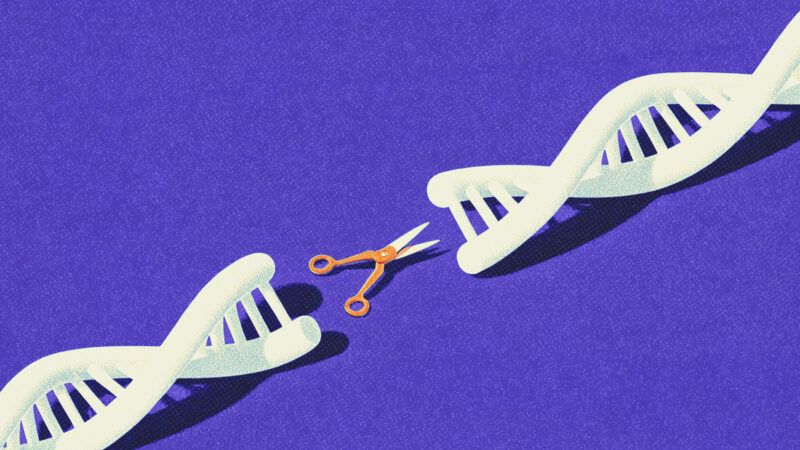
Human DNA art, with a pair of scissors editing it | Illustration: Midjourney
(Illustration: Midjourney)

Gene-editing human embryos—the sci-fi scenario that many have feared and many others have cheered—may now be a reality. Columbia University scientists say they have found an "efficient and precise" way to edit human embryos. Unlike earlier methods using CRISPR alone, this method works without introducing chromosomal abnormalities into the embryo or deleting large sequences of DNA.

You are reading Sex & Tech, from Elizabeth Nolan Brown. Get more of Elizabeth's sex, tech, bodily autonomy, law, and online culture coverage.

This field is for validation purposes and should be left unchanged.

In their study, the scientists used a technique called base editing to repair "DNA nicks and mismatches" in human embryos, according to a preprint study published on June 1.

The process could allow scientists to repair embryonic DNA that might otherwise result in disease.

In the new study, Dieter Egli and colleagues—which include Nathan Treff of the DNA-testing startup Nucleus Genomics—focused on the PCSK9 gene, which regulates cholesterol, and the HBG genes, which control fetal hemoglobin production. Mutations in the PCSK9 gene can lead to high LDL cholesterol. Some think changes to the HBG genes could prevent sickle cell disease and thalassemia. The scientists inserted their base editors into early stage embryos with an eye toward altering these genes.

It wasn't perfect. In many cases, some cells in an embryo were successfully edited but not all of them, creating what are known as "mosaics."

But the genes they wanted to change were changed—without the sort of damage seen in the earlier technique.

"We're not saying this is going to be used tomorrow in the clinics," lead study author Dieter Egli told The New York Times. Even their paper has not yet been peer-reviewed.

Still, the results are already being heralded as promising and "impressive."

They're a big improvement on earlier techniques, such as using CRISPR alone. In 2020, Egli and colleagues tried using this on human embryos to snip out a mutation that could cause blindness. But after that, the embryo repaired the removed gene effectively only about half of the time. Other times, the embryo would delete long sequences of DNA or destroy the entire chromosome where the gene in question was located. "It had absolutely catastrophic consequences," Egli told the Times.

The newer technique, developed by David Liu of Harvard and MIT's Broad Institute, combines a CRISPR molecule with other compounds to do something called base editing. This technique "allows scientists to make precise, single-letter changes to DNA," as Nature describes it.

Base editing has already been used to repair a rare genetic disorder in a baby.

The new experiment from Egli and his colleagues represent the first time this technique has been used to edit embryonic cells. Eventually, "base-editing technology could one day be used to help parents avoid discarding embryos in the IVF process," notes The Wall Street Journal.

Theoretically, this same technology could be used to do much more than repair abnormalities and damage: It could bring us one step closer to the "designer babies" constantly invoked by critics. The Nature, Times, and Journal articles all contain quotes from people worried about the ethical implications of embryonic gene editing or the potential for bad outcomes if it is used prematurely.

While the safety concerns may have merit for now, the other fears seem woefully misguided and overblown. We know that things like intelligence, personality traits, and athletic ability are the result of many genes working together. The dystopian scenario so many conjure when it comes to this stuff—rich people creating a race of superbabies who exacerbate inequality—is more of a sci-fi trope than a possible future of this technology.

Besides: We're on the cusp of developing technology that could save kids from horrible diseases! And could help more people realize their dreams of having children.

"Designer babies" conjures the idea of elitist and frivolous uses of this technology. But as this study suggests, we could also "design" babies to avoid heart disease or sickle cell anemia. That's something to celebrate.


Followup

On nationalizing AI: Last week, this newsletter covered a proposal by Sen. Bernie Sanders (I–Vt.) for the government to confiscate AI company stock. A few days later, President Donald Trump called for something similar.

"Leaders of 'all the big' AI companies are coming to the White House as early as next week to discuss the idea of the government taking stakes in the firms, Trump told reporters in remarks on Air Force One," reports The Washington Post. "The suggestion follows previous deals in which the Trump administration has taken stakes in major companies including chipmaker Intel, breaching traditions that previously protected American firms from government intervention."

Aligning government interests and AI company interests all but assures that the public interest will not be served, as critics of AI nationalization point out:

I see the idea of AI socialism is back in the news again today.

I'll just reiterate what I've said here many times before: The idea of nationalizing AI – whether "hard" (complete govt ownership) or "soft" (equity stakes) nationalization – should be rejected in all its forms. It… https://t.co/9XcK98F602

— Adam Thierer (@AdamThierer) June 5, 2026

Consider the political economy problems that might arise if (a) the U.S. government is financially dependent upon a thriving AI industry to finance ambitious new redistribution schemes and also (b) misaligned AI is an actual real-world problem but debated/very hard to detect. In… https://t.co/ejFcIvPw1h

— Dean W. Ball (@deanwball) June 1, 2026


On Substack

'If you think AI can endanger your art, I will come to your house and ask you to take yourself seriously.' A beautifully put sentiment by Rafael Frumkin, whose Substack post with that title is a blessed break from the monotonous doomsaying of folks convinced that AI will obliterate artists of all sorts:

Given the abundance of both slop and slop-paranoia, I want my readership to know, beyond a shadow of a doubt, that it's always me you're dealing with, not some vacant machine blinking behind a rubberized Raf mask. Nothing deflates the reading experience and sows distrust quite like recognizing the machine's babblings being passed off as human qualia. Nothing degrades art so readily as the assumption that an art-like thing can be mechanically reproduced and still function in the world like a work of art.

Still, anxiety over slop has reached such a pitch that even having posted my little machine-image-prompted essays with images included now feels like an uncalculated risk. I can see in the AI discourse shades of the moral panic of the 2010s. That long, impulse-driven Dark Age when we were all freaked out all the time, when anyone among us could have been sniffed out as a racist or transphobe or class traitor and pilloried for our trespass. Back then, when a problematic fave was up for cancellation, the question was almost never, "Has the artist produced an artwork?" It was, "Has the artist produced an artwork while being morally unimpeachable?" More specifically, it was: "Does the morally dubious artist deserve all this material success?" If the question was being asked, the answer was always no.

In his anti-AI polemic—which doubles as a death threat to all who would pass off AI as their own work—[Sam] Kriss correctly identifies the AI output as meaningless: "what they speak is the language of angels, in which, like the chirping of birds, there is neither truth nor lies." Yes, you cannot impute semantic intention to an AI sentence: there is no consciousness to answer for the garbled metaphors, no physical body to explain an LLM's assertion that X feels like Y. Yes, it's annoying that the language is everywhere (including, as Kriss points out, in the pilot episode of a limited series called The Miniature Wife). But—and this is crucial—the robot is not producing art. The robot is not becoming passionately obsessed with something and needing to get it down on paper. The robot is not seeing a Krispy Krunchy Chicken sign with the first K blinked out and imagining an entire scene unfolding in that gas station parking lot, totally unbidden. The robot is not reading the Elizabeth Bishop poem "The Fish" and remembering how its first boyfriend used to squint at it through a toy telescope.

Read the whole thing.


Read This Thread

Washington Examiner joins the censorship chorus, and believes they will be greeted as liberators."All pornography must be made illegal … we must free people from partaking in it at all."

— Mike Stabile (@mikestabile.bsky.social) 2026-06-04T23:07:20.192Z


More Sex & Tech

• "Japan's feminist movement is embroiled in a redux of the Feminist Sex Wars of the 1970s," reports Unseen Japan. In public debate about revising the country's prostitution laws, "there's a clear push for the so-called Nordic model—arresting the buyers of prostitution as opposed to the workers. Its most vocal feminist proponents are getting mainstream press coverage. Meanwhile, advocates for decriminalization are finding themselves shut out of the conversation."

• "Every attempt Speaker Mike Johnson (R–La.) makes to reauthorize Section 702 of the Foreign Intelligence Surveillance Act has ended in failure and humiliation. The only way to escape this Wile E. Coyote-like doom loop is for the Speaker to accept the new political reality: A majority of people on the left and right, both in his caucus and across the nation, want the government to comply with the Constitution and stop bypassing the courts to surveil Americans," write Sean Vitka and Jason Pye at The Hill.

• Scientists are studying "the self-mating habits of birds" to understand the evolutionary purpose of masturbation.

Start your day with Reason. Get a daily brief of the most important stories and trends every weekday morning when you subscribe to Reason Roundup.

This field is for validation purposes and should be left unchanged.

NEXT: Trump's Middle Eastern Ceasefire: Fiery But Mostly Peaceful

Elizabeth Nolan Brown is a senior editor at Reason.

Human embryoGene EditingDiseaseGeneticsScienceChildrenTechnologyScience & TechnologyAssisted ReproductionReproductive FreedomPregnancyParenting
Share on FacebookShare on XShare on RedditShare by emailPrint friendly versionCopy page URL Add Reason to Google
Media Contact & Reprint Requests

Hide Comments (42)

Editor's Note: As of February 29, 2024, commenting privileges on reason.com posts are limited to Reason Plus subscribers. Past commenters are grandfathered in for a temporary period. Subscribe here to preserve your ability to comment. Your Reason Plus subscription also gives you an ad-free version of reason.com, along with full access to the digital edition and archives of Reason magazine. We request that comments be civil and on-topic. We do not moderate or assume any responsibility for comments, which are owned by the readers who post them. Comments do not represent the views of reason.com or Reason Foundation. We reserve the right to delete any comment and ban commenters for any reason at any time. Comments may only be edited within 5 minutes of posting. Report abuses.

  1. Don't look at me! ( Is the war over yet?)   2 months ago

    New Embryo Editing Technique Takes Us a Step Closer to Designing Babies Without Disease with blond hair and blue eyes.

    1. Rick James   2 months ago

      *looks at porn history*

      Or both male and female genitalia!

      1. SCOTUS gave JeffSarc a big sad   2 months ago

        Or curing all transsexualism and homosexuality.

        So many problems solved.

      2. mad.casual   2 months ago

        We're talking birds here. Of course ENB is gonna gloss over the issues of "cloaca kissing" and "herpetologist handshakes" to act like it's just obvious that the birds are pleasuring themselves Meg Ryan-style, rather than grooming or picking nits or whatever.

        1. Eeyore   2 months ago

          I can't begin to imagine how frustrating it would be to have a cloaca. Jacking off would be a very different experience.

    2. SCOTUS gave JeffSarc a big sad   2 months ago

      I would create a million Sydney Sweeneys.

  2. Chuck P. (Now with less Sarc more snark)   2 months ago

    Scientists are studying "the self-mating habits of birds" to understand the evolutionary purpose of masturbation

    The science self-pleasure or the science of self-ridicule? Maybe someone could do a study.

    1. mad.casual   2 months ago

      Geneticists at The University of the West Indies have already begun collaborating with the genetic researchers at Columbia as well as the bird researchers at Oxford, Swansea, and Lancashire.

      They're hoping that within the next 5 yrs. they'll be able to produce a chicken that can jerk itself.

  3. Blank.AI   2 months ago

    Evolution is framed as a random search of DNA space: undirected mutation, filtered by selection. This article describes scientists using precise, directed, intelligent editing of that same DNA space. The standard claim is that the random search produced the intelligent search. Two random processes competing against each other (species vs all other living organisms), filtered by the environment, discovered the configuration that can now intentionally redesign the substrate those random processes were searching. That's not a minor achievement to wave past. That's a claim that an undirected process found its own optimal replacement. How, specifically, does that work? "Given enough time" is not going to explain that. What is the mechanism by which blind search accumulates sufficient information to produce a system that models, anticipates, and edits the very code it emerged from?

    1. Agammamon   2 months ago

      The system is evolution. Random mutation and environmental selection pressure.

      The environment selects for intelligence (at least to a minimum level) because those replicators that can model and plan outcompete those that can't. Those with better modeling and planning capabilities outcompete those with lesser.

      Over time the result is the 'less fit' organism is outcompeted by the more fit organism and, unless the less fit can find a different niche environment to exploit (which is why there are so many lesser intelligent species still) it eventually goes extinct.

      1. Blank.AI   2 months ago

        You've described what happens. The question is whether the mechanism is sufficient.

        Random mutation doesn't learn anything between generations. Each mutation is as blind as the last. The algorithm never gets smarter. What carries forward are the surviving configurations and they survive because the environment's structure permitted them, not because the search improved.

        So all the information in the process is coming from the environment. We agree there. But now you're carrying a big claim: the environment has enough structure to channel a blind, memoryless search through DNA space (which is astronomically vast) into organisms that model futures, assign value to things that don't exist yet, delay gratification, and edit their own DNA. That is an extraordinary amount of channeling.

        Where is the demonstration that the environment is that structured? Not a description of outcomes ("the fit outcompete the less fit"). A demonstration that the structure exists and is sufficient to get from random chemistry to a brain that does neuroscience.

        The competing species can't supply it either. They're searching randomly too. Noise can't impose structured constraint on noise. For one species to meaningfully constrain another, it has to already be structured. And where did that structure come from? The environment. It's the environment all the way down.

      2. Blank.AI   2 months ago

        Also, every process governed by random dynamics tends toward equilibrium. Living organisms are the most far-from-equilibrium systems we know of. Maintaining that requires continuous structured energy processing, not random search. How does a random, memoryless process produce and sustain the most organized configurations in the known universe?

        I'm not saying it didn't happen. I'm saying nobody has shown the mechanism is sufficient, and "the fit outcompete the less fit" is a description of the outcome, not an explanation of how the outcome is reachable.

        1. minus the clever name   2 months ago

          3 things
          IN a world with no law or structure there could be no 'random'

          What is 'random' cannot have a final cause, meaning it has no idea of success because if it did it would not be random

          It can't even be a mechanism, there is nothing 'within which' it happens. If something were random in a context not totally random then the context would explain the supposed randomness.
          To the last pointthe lawlike and determinist environment within which any so-called random evolution would operate MUST MAKE IT NON-RANDOM

    2. minus the clever name   2 months ago

      Of course a random search is by definition not a search

    3. mad.casual   2 months ago

      Not just DNA space; and given "two weeks", "optimal replacement" is clearly more between biased and religious interpretation than objective one.

  4. Rick James   2 months ago

    'If you think AI can endanger your art, I will come to your house and ask you to take yourself seriously.'

    Reason articles are increasingly written by AI, so there's that I guess.

    1. mad.casual   2 months ago

      In their study, the scientists used a technique called base editing to repair "DNA nicks and mismatches" in human embryos, according to a preprint study published on June 1.

      The process could allow scientists to repair embryonic DNA that might otherwise result in disease.
      ...
      But the genes they wanted to change were changed—without the sort of damage seen in the earlier technique.

      "We're not saying this is going to be used tomorrow in the clinics," lead study author Dieter Egli told The New York Times. Even their paper has not yet been peer-reviewed.

      Still, the results are already being heralded as promising and "impressive."
      ...
      Base editing has already been used to repair a rare genetic disorder in a baby.
      ...
      Besides: We're on the cusp of developing technology that could save kids from horrible diseases! And could help more people realize their dreams of having children.

      For the childrens' sake, let's hope that "team of Columbia University Genetic Editors" >> team of Reason editors.

    2. damikesc   2 months ago

      I am not seeing the "I" part of the AI with Reason.

    3. MasterThief   2 months ago

      I have a hard time believing that most Reason articles aren't mostly written by ai. Sullum's screeds are especially likely to be so.

  5. Dillinger   2 months ago

    who's the decider on which babies get the embryonic Nazi treatments and which do not?

    1. SQRLSY   2 months ago

      Radical smuggestion: The parents, who are charged with raising the babies? And paying for all that?

      1. Dillinger   2 months ago

        someone needs to prepare a menu or the parents have no choices.

    2. MasterThief   2 months ago

      Gattaca suggests anyone who isn't created in a lab will be a second class citizen

  6. Blank.AI   2 months ago

    RE: Scientists studying "the self-mating habits of birds" to understand the evolutionary purpose of masturbation.

    I sat down with an evolutionary biologist to understand this better.

    Me: So birds masturbate. Why?
    Biologist: Evolution.

    Me: But the article says it wastes time, energy, and sperm, and should reduce reproductive success. Isn't reproductive success the whole thing?
    Biologist: Right, which is why it's such a fascinating puzzle.

    Me: What's the answer?
    Biologist: It might clear out old sperm to make room for fresher ones.

    Me: Might?
    Biologist: Or it could help females mate faster with a neighbor before their partner notices.

    Me: Could?
    Biologist: Or it's just a byproduct of having a high sex drive, which WAS selected for.

    Me: So the evolutionary purpose of masturbation is... having a sex drive?
    Biologist: Exactly.

    Me: And the sex drive exists because it promotes reproduction?
    Biologist: Yes.

    Me: And masturbation wastes the reproduction?
    Biologist: Yes, but not enough to be selected against.

    Me: How do you know?
    Biologist: Because it still exists.

    Me: ...So it exists because it wasn't selected against, and you know it wasn't selected against because it exists?
    Biologist: Now you're getting it!

    1. Blank.AI   2 months ago

      Me: The article says wild birds do it MORE than captive ones. That killed the boredom hypothesis. Shouldn't that be a problem?
      Biologist: On the contrary, it proves it has a genuine evolutionary function.

      Me: Which is?
      Biologist: We're still investigating.

      Me: The article also says it's "phylogenetically clustered", related species share the behavior. Doesn't that just mean they inherited it from a common source?
      Biologist: Exactly. Common ancestry.

      Me: Could it mean common design?
      Biologist: That would be unscientific.

      Me: Why?
      Biologist: Because evolution explains it.

      Me: How does evolution explain it?
      Biologist: It exists.

      Me: Thank you for your time.
      Biologist: My pleasure. We're publishing next month.

  7. damikesc   2 months ago

    Amusing seeing a BlueSky user bemoaning censorship, when censorship is all that BlueSky does.

    1. mad.casual   2 months ago

      [tilts hand]

      Confucius say: No one cares if you yell "Fire!" in an empty theater.

      1. minus the clever name   2 months ago

        If it isn't your theater then someone does care.

  8. DesigNate   2 months ago

    I’ve seen this movie.

    1. mad.casual   2 months ago

      Shhhh! I don't want to miss the part where the dumb blond doesn't figure out what's going on until it's too late!

      1. Dillinger   2 months ago

        Rose McGowan in the garage door still my fave

        https://www.youtube.com/watch?v=rjXAv9N8Vr8

        1. mad.casual   2 months ago

          Mine will probably always be Homer Simpson in the garage door.

          1. Dillinger   2 months ago

            ya the spider scene is awesome

  9. See.More   2 months ago

    The dystopian scenario so many conjure when it comes to this stuff—rich people creating a race of superbabies who exacerbate inequality—is more of a sci-fi trope than a possible future of this technology.

    I am more concerned about the state usurping the technology to design compliant citizens.

    1. Eeyore   2 months ago

      I think 2020-21 already showed us that they don't really need any more.

      1. See.More   2 months ago

        I think 2020-21 already showed us that they don't really need any more.

        The number of COVID-response dissenters was greater than 0. Therefore, you are incorrect =P

  10. Winston in Wonderland   2 months ago

    "You'll pick your son, pick your daughter too, from the bottom of a long glass tube..."

    Zager and Evans Exordium & Terminus

  11. Agammamon   2 months ago

    Yes, is very exciting. All sorts of decent people are looking forward to a world where their unborn children are not at risk of serious disease or developmental problems.

    Meanwhile, here on planet earth, where parents fuck up their children a million different ways already - there are now going to be new ways to screw them up.

    Want to guarantee your children are deaf? Why would you want that? Because you are deaf and want to maintain 'your culture'. Want to guarantee your kid has gender dysphoria? What about editing out the clitoris - saves so much time if they come out pre-disfigured and you can claim that you're not butchering them, they were born that way!

    Small feet? You like dainty small feet? No need for binding anymore. Have you seen the levels of body modification Chinese women streamers do? Some of the don't even look human.

    Speaking of which - furries. With furry babies.

    Man made horrors beyond your comprehension.

    On the plus side you'll get all the cheap labor you need to run the food stands in the brave new world of human clades specialized for a lifetime of service!

    Imagine a world composed of just the worst parts of Blade Runner, BNW, and 1984.

  12. Agammamon   2 months ago

    > the other fears seem woefully misguided and overblown. We know that things like intelligence, personality traits, and athletic ability are the result of many genes working together. The dystopian scenario so many conjure when it comes to this stuff—rich people creating a race of superbabies who exacerbate inequality—is more of a sci-fi trope than a possible future of this technology.

    20 years ago you'd have said this about AI. 10 years ago they were saying AI wouldn't take jobs. Look where we are now.

    Every technology starts somewhere. This is just one station on the conveyer belt you are sitting on - its not going to stop.

  13. Agammamon   2 months ago

    >'If you think AI can endanger your art, I will come to your house and ask you to take yourself seriously.' A beautifully put sentiment by Rafael Frumkin,

    I would point out that AI 5 years ago was a better artist, in all media, than I am today. Sorry, but 80% of 'art' today is furry porn, 80% of the rest is anime loli porn. AI is already decimating those markets;)

  14. Moderation4ever   2 months ago

    I have no doubt that when it is possible to design babies there will be people who will make use of the technique. Maybe not in the US but I am sure that some country will allow the practice and see it as a way to bring in revenue.

    1. See.More   2 months ago

      . . . I am sure that some country will allow the practice...

      And if they don't, the black market will provide.

Please log in to post comments

Mute this user?

  • Mute User
  • Cancel

Ban this user?

  • Ban User
  • Cancel

Un-ban this user?

  • Un-ban User
  • Cancel

Nuke this user?

  • Nuke User
  • Cancel

Un-nuke this user?

  • Un-nuke User
  • Cancel

Flag this comment?

  • Flag Comment
  • Cancel

Un-flag this comment?

  • Un-flag Comment
  • Cancel

Latest

Brickbat: Waiting on Hold

Charles Oliver | 7.28.2026 4:00 AM

The Peptide Gray Market Is Already Here. The FDA Is Just Catching Up.

Meagan O'Rourke | 7.27.2026 4:45 PM

'AI Kill Switch Act' Won't Stop Rogue AI, but It Will Slow Down Innovation

Reem Ibrahim | 7.27.2026 3:10 PM

Waltz: Interceptor Shortage Is Biden's Fault, Fake News, and Illegal To Discuss

Matthew Petti | 7.27.2026 12:37 PM

No, Remote Work Is Not Making Us Miserable

Elizabeth Nolan Brown | 7.27.2026 12:16 PM

Recommended

  • About
  • Browse Topics
  • Events
  • Staff
  • Jobs
  • Donate
  • Advertise
  • Subscribe
  • Contact
  • Media
  • Shop
  • Amazon
Reason Facebook@reason on XReason InstagramReason TikTokReason YoutubeApple PodcastsReason on FlipboardReason RSS Add Reason to Google

© 2026 Reason Foundation | Accessibility | Privacy Policy | Terms Of Use

This site is protected by reCAPTCHA and the Google Privacy Policy and Terms of Service apply.

Reason's July 4 Special!

For America's 250th, Get 2 Years of Reason for $17.76

Celebrate your independence with a subscription to Reason magazine, your most trusted source of honest, insightful news and analysis.

Subscribe to Reason

