
New Embryo Editing Technique Takes Us a Step Closer to Designing Babies Without Disease
Gene-editing human embryos may now be a reality.
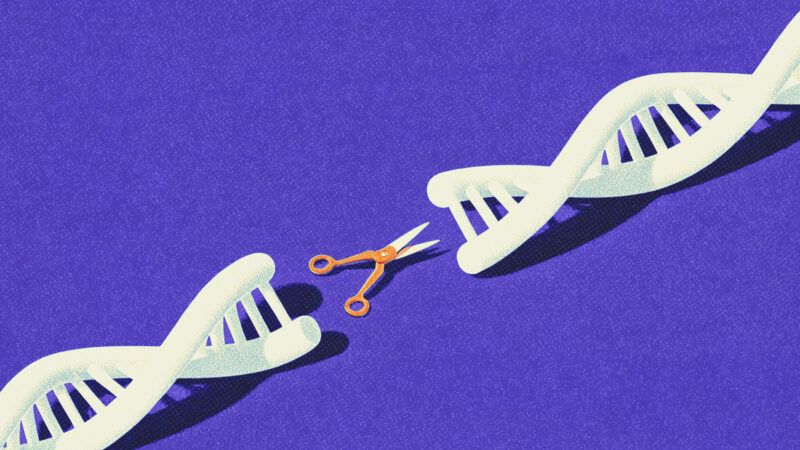
Gene-editing human embryos—the sci-fi scenario that many have feared and many others have cheered—may now be a reality. Columbia University scientists say they have found an "efficient and precise" way to edit human embryos. Unlike earlier methods using CRISPR alone, this method works without introducing chromosomal abnormalities into the embryo or deleting large sequences of DNA.
You are reading Sex & Tech, from Elizabeth Nolan Brown. Get more of Elizabeth's sex, tech, bodily autonomy, law, and online culture coverage.
In their study, the scientists used a technique called base editing to repair "DNA nicks and mismatches" in human embryos, according to a preprint study published on June 1.
The process could allow scientists to repair embryonic DNA that might otherwise result in disease.
In the new study, Dieter Egli and colleagues—which include Nathan Treff of the DNA-testing startup Nucleus Genomics—focused on the PCSK9 gene, which regulates cholesterol, and the HBG genes, which control fetal hemoglobin production. Mutations in the PCSK9 gene can lead to high LDL cholesterol. Some think changes to the HBG genes could prevent sickle cell disease and thalassemia. The scientists inserted their base editors into early stage embryos with an eye toward altering these genes.
It wasn't perfect. In many cases, some cells in an embryo were successfully edited but not all of them, creating what are known as "mosaics."
But the genes they wanted to change were changed—without the sort of damage seen in the earlier technique.
"We're not saying this is going to be used tomorrow in the clinics," lead study author Dieter Egli told The New York Times. Even their paper has not yet been peer-reviewed.
Still, the results are already being heralded as promising and "impressive."
They're a big improvement on earlier techniques, such as using CRISPR alone. In 2020, Egli and colleagues tried using this on human embryos to snip out a mutation that could cause blindness. But after that, the embryo repaired the removed gene effectively only about half of the time. Other times, the embryo would delete long sequences of DNA or destroy the entire chromosome where the gene in question was located. "It had absolutely catastrophic consequences," Egli told the Times.
The newer technique, developed by David Liu of Harvard and MIT's Broad Institute, combines a CRISPR molecule with other compounds to do something called base editing. This technique "allows scientists to make precise, single-letter changes to DNA," as Nature describes it.
Base editing has already been used to repair a rare genetic disorder in a baby.
The new experiment from Egli and his colleagues represent the first time this technique has been used to edit embryonic cells. Eventually, "base-editing technology could one day be used to help parents avoid discarding embryos in the IVF process," notes The Wall Street Journal.
Theoretically, this same technology could be used to do much more than repair abnormalities and damage: It could bring us one step closer to the "designer babies" constantly invoked by critics. The Nature, Times, and Journal articles all contain quotes from people worried about the ethical implications of embryonic gene editing or the potential for bad outcomes if it is used prematurely.
While the safety concerns may have merit for now, the other fears seem woefully misguided and overblown. We know that things like intelligence, personality traits, and athletic ability are the result of many genes working together. The dystopian scenario so many conjure when it comes to this stuff—rich people creating a race of superbabies who exacerbate inequality—is more of a sci-fi trope than a possible future of this technology.
Besides: We're on the cusp of developing technology that could save kids from horrible diseases! And could help more people realize their dreams of having children.
"Designer babies" conjures the idea of elitist and frivolous uses of this technology. But as this study suggests, we could also "design" babies to avoid heart disease or sickle cell anemia. That's something to celebrate.
Followup
On nationalizing AI: Last week, this newsletter covered a proposal by Sen. Bernie Sanders (I–Vt.) for the government to confiscate AI company stock. A few days later, President Donald Trump called for something similar.
I see the idea of AI socialism is back in the news again today.
I'll just reiterate what I've said here many times before: The idea of nationalizing AI – whether "hard" (complete govt ownership) or "soft" (equity stakes) nationalization – should be rejected in all its forms. It… https://t.co/9XcK98F602
— Adam Thierer (@AdamThierer) June 5, 2026
Consider the political economy problems that might arise if (a) the U.S. government is financially dependent upon a thriving AI industry to finance ambitious new redistribution schemes and also (b) misaligned AI is an actual real-world problem but debated/very hard to detect. In… https://t.co/ejFcIvPw1h
— Dean W. Ball (@deanwball) June 1, 2026
On Substack
'If you think AI can endanger your art, I will come to your house and ask you to take yourself seriously.' A beautifully put sentiment by Rafael Frumkin, whose Substack post with that title is a blessed break from the monotonous doomsaying of folks convinced that AI will obliterate artists of all sorts:
Given the abundance of both slop and slop-paranoia, I want my readership to know, beyond a shadow of a doubt, that it's always me you're dealing with, not some vacant machine blinking behind a rubberized Raf mask. Nothing deflates the reading experience and sows distrust quite like recognizing the machine's babblings being passed off as human qualia. Nothing degrades art so readily as the assumption that an art-like thing can be mechanically reproduced and still function in the world like a work of art.
Still, anxiety over slop has reached such a pitch that even having posted my little machine-image-prompted essays with images included now feels like an uncalculated risk. I can see in the AI discourse shades of the moral panic of the 2010s. That long, impulse-driven Dark Age when we were all freaked out all the time, when anyone among us could have been sniffed out as a racist or transphobe or class traitor and pilloried for our trespass. Back then, when a problematic fave was up for cancellation, the question was almost never, "Has the artist produced an artwork?" It was, "Has the artist produced an artwork while being morally unimpeachable?" More specifically, it was: "Does the morally dubious artist deserve all this material success?" If the question was being asked, the answer was always no.
In his anti-AI polemic—which doubles as a death threat to all who would pass off AI as their own work—[Sam] Kriss correctly identifies the AI output as meaningless: "what they speak is the language of angels, in which, like the chirping of birds, there is neither truth nor lies." Yes, you cannot impute semantic intention to an AI sentence: there is no consciousness to answer for the garbled metaphors, no physical body to explain an LLM's assertion that X feels like Y. Yes, it's annoying that the language is everywhere (including, as Kriss points out, in the pilot episode of a limited series called The Miniature Wife). But—and this is crucial—the robot is not producing art. The robot is not becoming passionately obsessed with something and needing to get it down on paper. The robot is not seeing a Krispy Krunchy Chicken sign with the first K blinked out and imagining an entire scene unfolding in that gas station parking lot, totally unbidden. The robot is not reading the Elizabeth Bishop poem "The Fish" and remembering how its first boyfriend used to squint at it through a toy telescope.
Read the whole thing.
Read This Thread
Washington Examiner joins the censorship chorus, and believes they will be greeted as liberators."All pornography must be made illegal … we must free people from partaking in it at all."
— Mike Stabile (@mikestabile.bsky.social) 2026-06-04T23:07:20.192Z
More Sex & Tech
• "Japan's feminist movement is embroiled in a redux of the Feminist Sex Wars of the 1970s," reports Unseen Japan. In public debate about revising the country's prostitution laws, "there's a clear push for the so-called Nordic model—arresting the buyers of prostitution as opposed to the workers. Its most vocal feminist proponents are getting mainstream press coverage. Meanwhile, advocates for decriminalization are finding themselves shut out of the conversation."
• "Every attempt Speaker Mike Johnson (R–La.) makes to reauthorize Section 702 of the Foreign Intelligence Surveillance Act has ended in failure and humiliation. The only way to escape this Wile E. Coyote-like doom loop is for the Speaker to accept the new political reality: A majority of people on the left and right, both in his caucus and across the nation, want the government to comply with the Constitution and stop bypassing the courts to surveil Americans," write Sean Vitka and Jason Pye at The Hill.
• Scientists are studying "the self-mating habits of birds" to understand the evolutionary purpose of masturbation.