

D.C.'s Crime Drop Didn't Require a Military Deployment
A new study finds the National Guard deployment to Washington, D.C., cost taxpayers over $300 million and failed to return even $1 for every dollar spent.
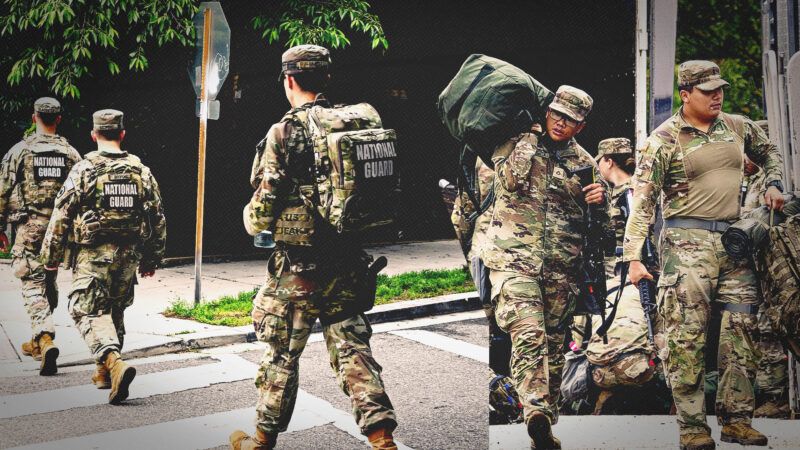
In August 2025, President Donald Trump deployed 800 National Guardsmen to Washington, D.C., as part of his plan for "restoring law and order" in the city. In the 10 months since, this number has ballooned to 2,673 troops. While crime in the city has dropped significantly, a new study from the Niskanen Center suggests that the city's police department could have achieved the same result for far less money.
So far in 2026, D.C. has seen a 2 percent reduction in violent crime and a 25 percent reduction in property crime, according to the latest available data from the Metropolitan Police Department (MPD). The president has attributed D.C.'s drop in crime to the presence of the National Guard in the city during the decline, but the city's police officers seem to have been the driving force behind the change.
Richard Hahn, senior manager for research and evidence at the Niskanen Center and one of the report's authors, tells Reason the declining crime rate is likely correlated with what the MPD did while deployed, rather than simply where officers were deployed.
This was done by focusing on what Hahn describes as "proactive, problem-oriented policing." By concentrating officers in nightlife areas and violent hot spots and making them highly visible, the MPD was able to increase its arrest rate by 40 percent even as its presence "actually thinned in several of the highest-crime corridors."
It's fair to wonder whether the MPD's statistics can be trusted, given that the department is under investigation for manipulating crime data. However, the study dispels the notion that the declining crime rate is fabricated, concluding that the data are "precisely what a real crime reduction would produce." Data from the FBI's Crime Data Explorer also mirror much of the MPD's dashboard, showing D.C. has indeed seen a drop in property and violent crimes, excluding assaults.
The National Guard's show of force also seems to have had an impact on opportunistic crime intrinsic to tourist spots with heavy foot traffic, but it'd be difficult to call it money well spent. As Hahn says, "we can spend far less and get a similar or better result."
The National Guard enforcement came at a cost of $607 per soldier per day (or more than $300 million over 11 months) and yielded an estimated societal benefit of less than $185 million. By contrast, the Niskanen study, which relies on MPD data, shows the MPD used "fewer officers" to generate "substantially more enforcement output." The MPD spent only $384 per officer per day, yielding an estimated societal benefit of $2.2 billion.
Instead of spending hundreds of millions of dollars on additional National Guard deployments, "our better option," Hahn says, would be to "put money into police" with "targeted hotspots deployment" that concentrates officers in known high-crime corridors instead of a blanket increase in the number of officers employed by the MPD.
If the $185 million spent on the National Guard had gone to the MPD, the estimated social benefit would be as much as $6.5 billion, a return on investment of about $35 for every $1 spent, compared to the Guard's ROI of less than $1 for every dollar spent during its deployment.
The uptick in arrests also led to 65 new lawsuits in 2025, resulting in $2.2 million in payouts across 18 cases. Seven of the settlements involved officers accused of Fourth Amendment violations, according to MPD data.
In an email to Reason, White House spokeswoman Abigail Jackson credited the president's Safe and Beautiful Task Force and the presence of the National Guard with transforming D.C. "from a crime-ridden city into a safe and beautiful haven for residents and visitors alike." Still, the administration's use of the National Guard to police American cities appears to have been wholly unnecessary.
D.C. was already experiencing a drop in crime before the National Guard's deployment, coinciding with a nationwide 9.3 percent drop in violent crime, according to FBI data. Still, crime data analyst Jeff Asher tells Reason the declining crime rate isn't exclusive to D.C. and could likely have been achieved without the guard deployment. "This is happening everywhere," he says, adding, "you could name dozens of places that are seeing similar drops without any sort of heavy-handed interventions."
Despite all of this, it doesn't seem like the National Guard will be slowing down in D.C. Last Month, the U.S. Marshals Service Director Gadyaces Serralta asked for an additional 1,500 Guardsmen to serve in the nation's capital in preparation for what he called a "summer surge" of visitors celebrating America's 250th anniversary.




