

Donald Trump's Deeply Disappointing Would-Be Assassin
Cole Tomas Allen's actions just don't make sense, even in his own words, or in a time of political polarization.
On September 5, 1975, Lynette "Squeaky" Fromme, a member of the Manson Family cult, stood a few feet away from President Gerald Ford in Sacramento, California, pointed a pistol at him, and unsuccessfully tried to shoot him. Less than three weeks later in San Francisco, a different woman, an accountant named Sara Jane Moore, managed to actually fire her weapon but missed Ford before being tackled by a bystander.
Was there any deep meaning to such violent and potentially world-changing actions? According to her biographer, Fromme "had no personal feelings about [Ford] one way or another….She felt he was destroying the redwoods." The motivations of Moore, who died last year at age 95, were similarly vague and impersonal, if a bit more political. The Washington Post noted in its obituary that she at various points was a "suburban Republican matron," an FBI informant, and "enthralled" by San Francisco's "radical activists and their Marxist rhetoric." As the Post summarized her comments at her sentencing hearing, "I finally understood and joined those who have only destruction and violence for a means of making change…and came to understand that violence can sometimes be constructive."
The twin attempts to assassinate Gerald Ford, one of America's least consequential but also least offensive presidents, remain puzzling, to say the least. As conspiracy theorists will remind you, Ford was part of the Warren Commission and thus guilty of something, right? He was appointed vice president by Richard Nixon and confirmed by the Senate in December 1973, after Spiro Agnew resigned due to corruption charges but long before it became apparent Nixon might have to quit the Oval Office. Ford came in for a fair amount of abuse when he became president in August 1974 and immediately gave Nixon, by then the most hated person in the country, a "full, free, and absolute pardon…for all offenses against the United States which he, Richard Nixon, has committed or may have committed."
Yet nobody, even his would-be assassins, could muster strong feelings about Ford. Maybe the assassination attempts say less about him and his would-be killers and more about the times. The 1970s were, in the words of historian Kevin Starr, "the goofiest decade of the century for California…in terms of its sheer ominous weirdness."
We desperately want our times to make sense and not just be goofy, ominous, and weird. When confronted with monstrous and seemingly inexplicable acts, we want their perpetrators to make sense too. Villainy and evil demand a backstory. But if Ford's two near misses with death a half-century ago suggest anything, it's that we are often left unsatisfied not just by history but by the people who would change its course.
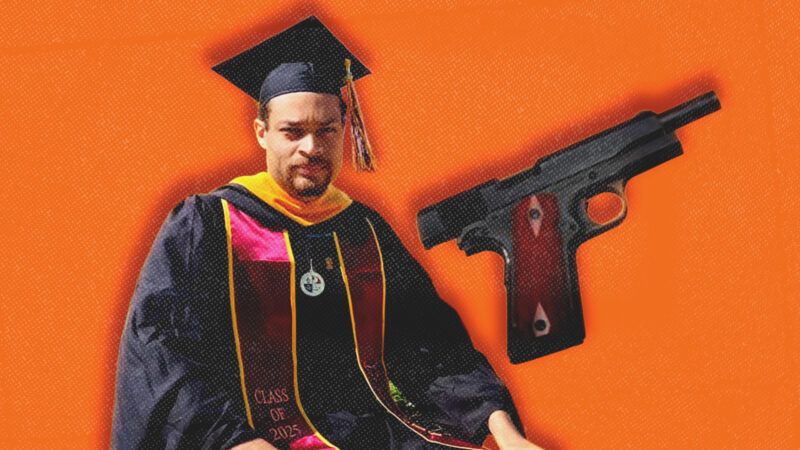
That certainly seems to be the case with Cole Tomas Allen, the 31-year-old alleged gunman at last week's White House Correspondents' Dinner. His biography and manifesto provide some clues to his actions and state of mind but very little in the way of satisfactory answers that explain the sheer lunacy of what he tried to do.
He graduated from the prestigious California Institute of Technology in 2017 with an engineering degree, picked up a master's in computer science from Cal State Dominguez Hills last year, and was working as a tutor right before he took a cross-country train trip to kill the president. Described in news accounts as "highly intelligent, shy, socially reclusive," and "at one point a devoted Christian," it's possible to patch together an outline of a character frustrated by a failure to deliver on early promise. But how does one get from there to trying to kill the president?
Allen's manifesto is an odd document, not least of which because of its chipper opening: "Hello everybody!" Though tidy and mostly temperate, there are signs of a deep-seated, internal struggle in lines such as this:
I am no longer willing to permit a pedophile, rapist, and traitor to coat my hands with his crimes.
(Well, to be completely honest, I was no longer willing a long time ago, but this is the first real opportunity I've had to do something about it.)
Though only a thousand or so words, the document rambles and shifts from basic declarations to a series of "Rebuttals to objections" in which he raises issues ("As a Christian, you should turn the other cheek") and then answers them ("Turning the other cheek when *someone else* is oppressed is not Christian behavior; it is complicity in the oppressor's crimes"), in a format that suggests (to me, anyway) he might have used an AI program or some other compositional aid. While mostly presented in mild, clinical language, the manifesto strongly suggests a disordered mind, one incapable of staying focused on the import of the task at hand. One of the objections he raises, for instance, is "This is not a convenient time for you to do this." That doesn't suggest a revolutionary in the throes of ideology as much as someone struggling to hang on to basic reality. Perhaps strangest of all, he signs off with advice that seems fully misplaced: "Stay in school, kids."
It's unlikely that whatever else we learn about him will help explain his behavior or motivation in any way that's more satisfying than Squeaky Fromme's or Sara Jane Moore's. People on the right might argue that the left has created a "permission structure" for political violence, especially toward Donald Trump, who is reviled as a dictator, tool of Russian autocrat Vladimir Putin, and, per Allen's manifesto, a child molester. They point to the continuing support for the alleged killer of healthcare executive Brian Thompson by radical chic journalists and podcasters such as Jia Tolentino and Hassan Piker. Given such a context, who can be surprised when violence erupts?
But hyperbolic language that seems to be a call to action by any means necessary is evident on the right, too, as when presidential adviser Stephen Miller tells Fox News that "the Democrat Party is not a political party. It is a domestic extremist organization." More importantly, as the Cato Institute's Alex Nowrasteh has documented, "politically motivated violence is a small threat" and one that shows no substantial uptick in recent years. In his study of "killings by ideology" in the United States between 1975 and 2025, he notes that "Islamism" is by far and away the largest motivating factor but concludes, "there isn't…a statistically significant increase in the number of victims over time, as the deadliest triennial period was 2014-2016, and the safest was 2005-2007."
Cole Tomas Allen—like virtually all would-be and actual presidential assassins, he has been given a three-part name, a sick variation on teen mag conventions—didn't just fail in his grim and deranged task of killing the president. He has failed to explain himself. And it's unlikely that we will do a better job.




