
Trump's Answer to Iran's Hormuz Crisis: Sell Oil We Don't Have
The administration claims we're a "net oil exporter," but unfortunately that's not quite true.
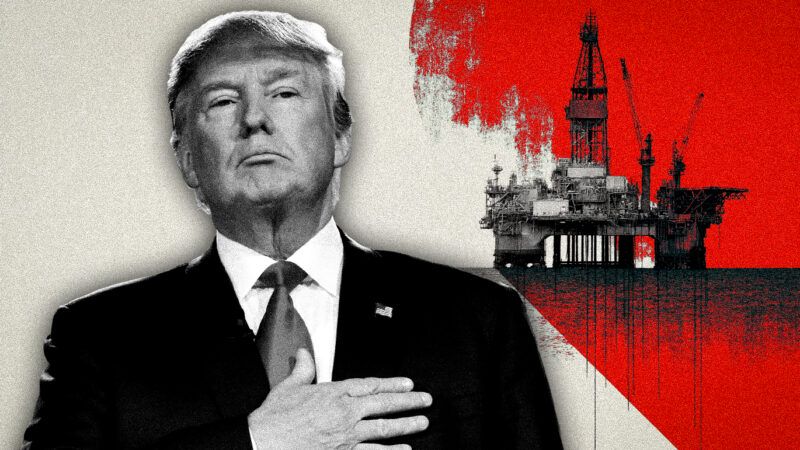
President Donald Trump's war of choice against Iran has already had negative consequences. Perhaps most visibly, we've seen higher gas prices after Iran shut down the Strait of Hormuz, the narrow waterway through which 20 million barrels of crude oil once passed each day, constituting a quarter of the total global supply.
This week, Trump addressed the status of the war in a rambling, disjointed prime time speech largely free of specifics on how we would get out of the mess he got us into.
One thing he did say is that any country dependent on oil flowing through the Strait of Hormuz should simply pivot and buy that oil from the U.S.
But that's not likely to happen, because we simply don't have it to spare.
"Under my leadership, we are [the] No. 1 producer of oil and gas on the planet, without even discussing the millions of barrels that we're getting from Venezuela," Trump boasted. "The United States imports almost no oil through the Hormuz Strait and won't be taking any in the future. We don't need it."
"So to those countries that can't get fuel," he added, "I have a suggestion. No. 1, buy oil from the United States of America. We have plenty. We have so much. And No. 2…go to the strait and just take it, protect it, use it for yourselves." (This was a slightly softer tone than he took on social media just days earlier, when he told the United Kingdom, "Go get your own oil!")
"When this conflict is over," he optimistically predicted, "the strait will open up naturally."
It is a common refrain from this administration, that the U.S. makes all the oil it needs. "Most countries in the world are significant net oil importers," Department of Energy Secretary Chris Wright told Fox News last month. "Fortunately, the United States—we produce more oil than we consume. We're a net oil exporter."
This is not quite true—at least, not literally. And despite Trump's pledge, it doesn't mean we can start supplying the rest of the world.
According to the U.S. Energy Information Administration (EIA), "the United States has been an annual net total energy exporter since 2019," but "U.S. crude oil imports and exports both increased in 2024, and the United States remained a net crude oil importer."
Part of the confusion stems from liquefied natural gas (LNG): The U.S. is currently the world's largest exporter of LNG. But while crude oil is refined into gasoline and diesel fuel, LNG is typically used to generate heat and electricity.
Our LNG output helps tip the balance and make us net fuel exporters, but with crude oil in particular, we still bring in more than we send out.
According to EIA statistics, in the week ending March 27, the U.S. produced about 13.66 million barrels of crude oil per day. But over that same time, we imported 6.45 million barrels per day and only exported 3.52 million—making us net importers by nearly 3 million barrels.
The reason is because not all oil is the same. "The type of oil produced in the United States tends to be higher-quality, so-called sweet oil, but domestic refineries are set up to handle heavy and sour oil," Emmett Lindner wrote at The New York Times. "It is often more cost efficient to sell the sweet and buy the heavy."
As recently as 2023, we received just over half of our oil imports from Canada.
"The amount of crude oil U.S. refineries process greatly exceeds U.S. crude oil production," requiring imports to make up the difference, adds American Fuel & Petrochemical Manufacturers, a petroleum industry trade association.
In his speech, Trump noted "the millions of barrels that we're getting from Venezuela." In January, after ousting that country's leader, Trump claimed the U.S. would receive "between 30 and 50 MILLION Barrels" of that country's heavy crude oil. The plan was light on specifics, but even if it's true, it does almost nothing to replace what has been disrupted in recent weeks.
Venezuela produced just over 900,000 barrels of crude per day in February—a slight improvement over the previous month. Even if Trump could lay claim to that country's entire output, it would pale in comparison to the 20 million daily barrels that until recently flowed through the Strait of Hormuz.
It makes sense that Trump would be desperate for a solution: In a CNN survey conducted before his address this week, only about a third of Americans felt he had a "clear plan," while two-thirds disapproved of the decision to pursue military action. But while a clear plan would certainly be an improvement, it should at least have some basis in reality.
