
We Could Have Flying Cars by 2028
But only if politicians learn to focus on the boring basics of aviation policy.
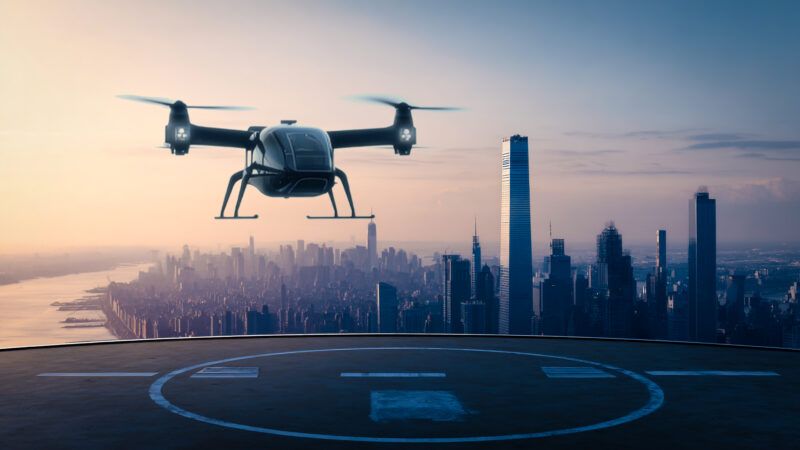
Flying cars have hovered in the public imagination since The Jetsons. But the techno-optimism of the space age has since given way to a more jaded cultural milieu, captured by financier Peter Thiel's Founders Fund 2011 manifesto, subtitled, "We Wanted Flying Cars, Instead We Get 140 Characters." But in 2026, there may be room for cautious optimism.
Advanced air mobility (AAM) encompasses a range of aviation technologies and operational uses, though much of the attention has focused on electric vertical takeoff-and-landing (eVTOL) aircraft for commercial air taxi services. Developers pitch their eVTOL air taxis as far cheaper to operate than traditional helicopters. While AAM has yet to be commercialized, a few eVTOL aircraft developers are deep into regulatory certification with the U.S. Federal Aviation Administration (FAA) and its international counterparts. Both the AAM industry and the U.S. government are aiming for a 2028 launch of commercial air taxi operations, in time to showcase them at the Summer Olympic Games in Los Angeles.
Like all aircraft, eVTOLs will require specialized infrastructure, most importantly the vertiports from which they will take off and land. And it is through policy around vertiports that well-meaning state lawmakers may prevent our flying-car future from taking off.
Companies such as Archer Aviation, Joby Aviation, and Beta Technologies are developing eVTOL aircraft capable of carrying four or five passengers over distances of less than 200 miles. While most eVTOL prototypes can fly horizontally like an airplane using tilting or dedicated propellers, all take off and land vertically like helicopters.
Batteries impose a significant range constraint due to their relatively low energy density, so why go electric? Reducing both the costs and impacts of helicopter-like transportation is seen as critical to AAM's commercial viability. That eVTOLs do not consume petroleum-based fuel is an obvious win for environmentalists, but beyond reducing emissions, eVTOLs can mitigate the noise and safety concerns that have led many communities to tightly restrict where helicopters can take off and land, particularly in urban areas.
The electric motors of an eVTOL turn multiple small distributed-power propellers, which is much quieter than conventional helicopters with a large main rotor. Having independent motors turning multiple propellers also allows for redundancy and for an eVTOL to remain airborne if one of them fails. With typical helicopters, the main rotor presents a single point of failure that can lead to catastrophic consequences, which is why the fastener that holds the main rotor in place has been nicknamed the "Jesus nut"—because the only thing you can do if it fails is pray.
Electric power could also slash operating costs. Beta Technologies estimates that its Alia A250 eVTOL will enjoy a 90 percent reduction in energy costs per flight hour compared to a Bell 407, a popular utility helicopter of similar size.
On-demand air taxi services are today a niche market. FAA survey data indicate that air taxi flight hours have increased by less than 1.5 percent annually since 1990. For eVTOLs to democratize air taxi service, AAM will need to scale far faster, requiring high-tempo operations and a large fleet. Supporting those operations requires vertiports where eVTOL aircraft land, charge, and are serviced.
All of this entails a large amount of risk. An October 2025 Aviation Week article catalogued the demise of 13 AAM manufacturers over the past two years, including some previously considered to be market leaders. AAM has not been proven to be commercially viable, so it is unclear what the actual infrastructure demands will be. Premature infrastructure investments could lead to white elephants, as Dallas learned in the 1990s when the city built a massive vertiport atop its convention center in anticipation of a civilian V-22 Osprey tiltrotor market that never materialized.
The challenge then is how to minimize taxpayer risk while still providing sufficient infrastructure to support initial operations and growth.
The FAA currently classifies vertiports as a type of heliport and has issued interim, nonbinding design guidance. As with heliports, state and local governments will likely play a dominant role in approving vertiports' locations, designs, construction, and operations. In a new Reason Foundation policy study, I examine how state-level policy could either enable or obstruct vertiport development and AAM services.
Most vertiports are likely to be privately owned and operated, which is the case for about 90 percent of the 5,633 heliports operating in the United States, according to the FAA's Airport Data and Information Portal. That poses little risk to taxpayers. However, for larger vertiports designed to support multiple eVTOL operators, especially in cities, there is a strong case for public-use vertiports that share facilities.
Public-use vertiports may be privately owned—as is the case with 26 of the 57 public-use U.S. heliports—and many initial projects will involve retrofitting existing heliports. But sustained growth will require new construction. Allowing vertiport developers to leverage vacant or underused public property could be a win-win for both governments and the AAM industry, while minimizing risk to taxpayers.
Take publicly owned urban parking facilities. Many central business districts still face reduced office occupancy post-pandemic, leading to lower parking demand and revenue. While they may lack cars, multistory parking structures offer what vertiport developers need—obstacle clearance and strong ground transportation connections—which makes the top deck a particularly attractive site location.
Cities could lease all or part of these structures to vertiport developers, which would finance and build the infrastructure required to support AAM operations. Cities would revitalize underperforming assets, and the AAM industry would expand its footprint in desirable locations at lower cost. The concession model, which has successfully transferred risk from taxpayers to private investors in a variety of procurement contexts, could prove equally valuable for public-use vertiport development.
Unfortunately, state lawmakers have inadvertently prohibited these beneficial public-private partnerships. Arkansas, Oregon, Utah, and West Virginia have enacted "open access" public-use vertiport mandates, and the conservative American Legislative Exchange Council has adopted this framework as model legislation. In 2026, variants of this legislation were introduced in Arizona and Iowa. Though intended to promote competition and spur vertiport development, these "open access" requirements would effectively prohibit privately financed public-use vertiports.
There are two main problems with this approach. First, these laws prohibit government agencies from granting exclusive rights to public-use vertiport operators, effectively banning concession contracts. This is supposedly aimed at preventing the monopolization of public-use vertiports by eVTOL operators. But federal aviation law already solves that problem: public-use vertiports, by definition, are open to the public and cannot discriminate among competing eVTOL operators. There is no need for an additional layer of "open access" because it is already baked into the nature of "public use."
Second, versions of this legislation generally mandate the FAA's review of vertiport layout plans in circumstances where the agency lacks the legal authority to conduct such reviews. The easiest way to cure this Kafkaesque compliance problem would be to fund vertiports with federal grants, which would create an FAA "zone of interest" and trigger a formal layout plan review. Federal vertiport grants do not appear to be forthcoming, but even if they were, limiting public-use vertiport projects to only those subsidized by Congress is a strange way to foster the competition that "open access" proponents claim to seek. It would also expose taxpayers to substantial AAM market risk.
Will eVTOLs be grounded by well-meaning but confused politicians? Perhaps. But there is a simpler way to clear them for takeoff. State lawmakers should focus instead on the basics to create an open environment for AAM by defining key terms in statute, incorporating vertiports into state aviation system planning, providing technical assistance to localities, and establishing uniform statewide policies that enable public-private partnerships in AAM infrastructure procurement.
While politicians are naturally drawn to sweeping policies, if they focus on doing the boring parts of their jobs well, flying cars might just become a reality at the 2028 Olympics and beyond.
