

Reason.com - Free Minds and Free Markets
Reason logo Reason logo
  • Latest
  • Magazine
    • Current Issue
    • Archives
    • Subscribe
    • Crossword
  • Video
    • Reason TV
    • The Reason Roundtable
    • Free Media
    • The Reason Interview
  • Podcasts
    • All Shows
    • The Reason Roundtable
    • The Reason Interview With Nick Gillespie
    • Freed Up
    • The Soho Forum Debates
  • Volokh
  • Newsletters
  • Donate
    • Donate Online
    • Ways To Give To Reason Foundation
    • Torchbearer Society
    • Planned Giving
  • Subscribe
    • Reason Plus Subscription
    • Gift Subscriptions
    • Print Subscription
    • Subscriber Support

Log In

Create new account

Debt

The Federal Spending Spree Will Make the Next Economic Shock Even Worse

Growing federal debt hobbles the government’s ability to respond to crises.
J.D. Tuccille | 3.18.2026 7:00 AM

Share on FacebookShare on XShare on RedditShare by emailPrint friendly versionCopy page URL Add Reason to Google
Media Contact & Reprint Requests
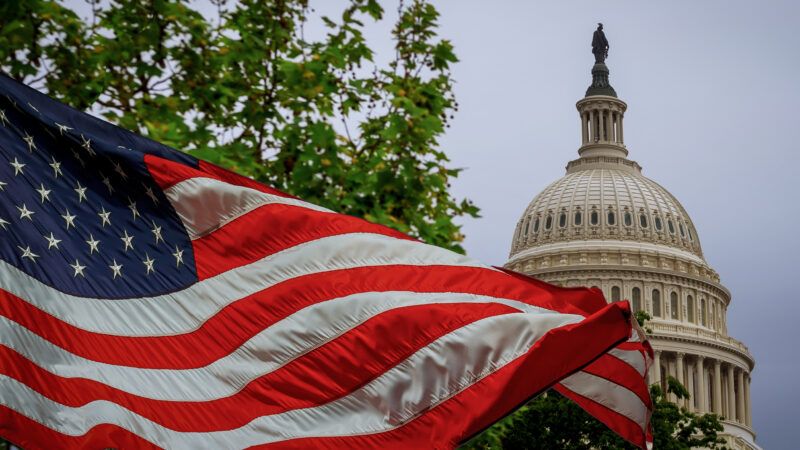
An American flag flaps, with the U.S. Capitol in the background. | Photovs/Dreamstime
(Photovs/Dreamstime)

You're probably tired of hearing about the U.S. government's looming debt crisis, because it's a continuing backdrop to political conversations in this country. Unfortunately, the government's debt problem comes up so often because most politicians do very little to address the issue. Year after year, they spend more than the government collects in revenue. A new report cautions that growing federal debt not only guarantees a day of reckoning but hobbles chances of fixing the situation.

You are reading The Rattler from J.D. Tuccille and Reason. Get more of J.D.'s commentary on government overreach and threats to everyday liberty.

This field is for validation purposes and should be left unchanged.

The Federal Government Will Face the Next Crisis Burdened by Debt

"The U.S. has never experienced an economic shock as indebted as we are today," notes the Committee for a Responsible Federal Budget (CRFB) in a paper published March 10. "Unfortunately, the U.S. has far less capacity to address the next shock than it has previously. The national debt increased by a combined 65% of Gross Domestic Product (GDP) over the past two recessions and recoveries, with the federal government entering them with debt at 35% and 80% of GDP, respectively. Today, debt totals 100% of GDP—only a few percentage points from the previous record set after World War II. This situation leaves the U.S. immensely vulnerable."

The CRFB previously addressed what that next shock might look like in a January paper. It considered several scenarios, including a financial crisis in which reduced confidence in U.S. Treasury markets leads to a spike in interest rates, inflation resulting from efforts by the government to monetize (devalue the dollar) its way out of trouble, austerity caused by harsh tax increases and tough spending cuts, overt default on the debt, or a long-term, gradual national slide into poverty—something like Argentina before Javier Milei's presidency. You could also see a combination of these effects, because crises are rarely neat and clean.

"The United States is deeply indebted, and its finances are on an unsustainable long-term trajectory," the January paper concluded. While forecasting trouble ahead if debt is left unaddressed, the paper didn't specify when the crisis might materialize.

Economists with the Penn Wharton Budget Model (PWBM) were more willing to place the federal government's debt woes within a timeframe in a 2023 analysis. "We estimate that the U.S. debt held by the public cannot exceed about 200 percent of GDP even under today's generally favorable market conditions," they wrote, though they considered 175 percent a more plausible ceiling. "Under current policy, the United States has about 20 years for corrective action after which no amount of future tax increases or spending cuts could avoid the government defaulting on its debt whether explicitly or implicitly (i.e., debt monetization producing significant inflation)."

That 20-year period was the authors' "best case" scenario. They cautioned that if financial market participants lose faith that the federal government will eventually address its debt problem, the grace period could be substantially shortened.

Federal Debt Is Wildly Underestimated

Interestingly, the authors of that PWBM analysis, Jagadeesh Gokhale and Kent Smetters, separately wrote in January 2025 that federal debt is wildly underestimated. While the U.S. Treasury currently puts national debt at $38.9 trillion ($31.2 trillion if you just count debt held by the public rather than money the government owes itself), they say that unfunded Social Security and Medicare obligations need to be considered as part of the full picture: "Adding explicit debt ($26.2 trillion) and implicit obligations ($65.7 trillion) brings total federal indebtedness to $91.9 trillion, or 340% of 2023 GDP."

Last week Smetters, the faculty director of PWBM and a former deputy assistant secretary for economic policy at the U.S. Department of the Treasury, told Fortune's Nick Lichtenberg that the full sum of national debt is now closer to $100 trillion.

Incidentally, the U.S. Treasury quietly acknowledges the dramatic shortfall for funding Medicare and Social Security. While it puts the shortfall at varying figures depending on assumptions and timeframes, unfunded obligations are never estimated at less than tens of trillions of dollars. The Treasury warned in 2024 that "this need can be satisfied only through increased borrowing, higher taxes, reduced program spending, or some combination." That funding gap isn't reflected in official debt figures.

A Short List of Possible Remedies

The Treasury's proposed solution of borrowing, taxes, and spending cuts reflects CRFB's thinking on the matter, too. In what they call a "Break Glass Plan" the authors recommend that additional short-term borrowing to address the next crisis should involve "offsets that generate two dollars of savings for every one dollar of near-term support." They also call for a budget mechanism that "would freeze the indexation of most tax and spending parameters, impose a nominal freeze on appropriations levels, and phase in a deficit reduction surtax." CRFB also wants a bipartisan commission to "make specific recommendations to lower health care spending, cap discretionary appropriations levels, reform the tax code, restore solvency to Social Security and Medicare, reduce fraud and abuse, cut wasteful spending and tax breaks, and/or reform the budget process."

If you're rolling your eyes at the word "bipartisan" in the current political environment and wondering how yet another commission will produce any substantial fixes for how Congress goes about the business of spending taxpayer (and borrowed) money, you're not alone. It's very difficult to imagine legislators working together to make hard choices about spending less, offsetting borrowing, and taxing more. It's also very difficult to imagine higher taxes would contribute to fiscal discipline. Spending consistently grows faster than revenue increases.

"Since Congress last balanced the budget in 2001, revenues have grown at a robust annual average rate of 3.9 percent, which was higher than the average inflation rate since 2001, 2.5 percent," the Cato Institute's Chris Edwards pointed out in 2024. "The problem is that spending has grown at a much faster pace, 5.5 percent annually, which has led to today's large deficits."

Higher taxes are more likely to fuel increased spending than to help eliminate deficits and pay down the federal debt. That means even more pain; the Congressional Budget Office estimates "the economic cost of a dollar of tax revenue range from 20 cents to 60 cents over and above the revenue raised." Short-term borrowing might help address an immediate crisis, but it also means more debt to be repaid.

Ultimately, the federal government needs to spend less—much less. But when have legislators ever agreed to rein in the shopping spree? In truth the solution to the next economic shock is unlikely to be selected after calm deliberation. It'll be forced on the government by raw necessity.

The Rattler is a weekly newsletter from J.D. Tuccille. If you care about government overreach and tangible threats to everyday liberty, this is for you.

This field is for validation purposes and should be left unchanged.

NEXT: Brickbat: Other People's Money

J.D. Tuccille is a contributing editor at Reason.

DebtNational DebtDeficitsGovernment SpendingEconomics
Share on FacebookShare on XShare on RedditShare by emailPrint friendly versionCopy page URL Add Reason to Google
Media Contact & Reprint Requests

Hide Comments (11)

Editor's Note: As of February 29, 2024, commenting privileges on reason.com posts are limited to Reason Plus subscribers. Past commenters are grandfathered in for a temporary period. Subscribe here to preserve your ability to comment. Your Reason Plus subscription also gives you an ad-free version of reason.com, along with full access to the digital edition and archives of Reason magazine. We request that comments be civil and on-topic. We do not moderate or assume any responsibility for comments, which are owned by the readers who post them. Comments do not represent the views of reason.com or Reason Foundation. We reserve the right to delete any comment and ban commenters for any reason at any time. Comments may only be edited within 5 minutes of posting. Report abuses.

  1. SQRLSY   2 hours ago

    JDT, DR!

    SEE?!?!?!? THAT is how to solve problems, is to ignore them, and to ignore the fools who bring them to light! Ignorance is strength, Cumrades!!!

    Log in to Reply
  2. SQRLSY   2 hours ago

    The "solution" is to raid the cuntents of all of our 401 K accounts! Savings will then be accumulated, snot under the mattress (too much inflation), butt in food, building materials, booze, cocaine, and hooker-sex-slaves!

    (Taxing your Social Security only if ye have been TOO responsible and sober-minded, and have saved TOO MUCH in your 401 K, was already the first step in this exact direction. You SHOULD have spent all of your could-be-saved money on fancy vacations, mansions, booze, cocaine, and hooker-sex-slaves, and then you would SNOT be facing these extra taxes!)

    Log in to Reply
  3. JFree   1 hour ago

    Growing federal debt hobbles the government’s ability to respond to crises.

    Responding to crises - legitimate crises - means mobilizing the population to do what needs doing. The stuff that debt supposedly PAYS FOR. Not debt itself. Of course debt doesn't pay for anything that resolves a legitimate crisis because debt is basically a free lunch and free lunches create corruption not crisis resolution.

    In fact repudiation of excessive debt is probably the best way to deal with a legitimate crisis. Even though it comes with its own costs.

    Log in to Reply
  4. Fu Manchu   1 hour ago

    Good thing we had DOGE, which very visibly pretended to cut government spending but didn't actually cut shit, had no legal mandate to cut shit, left government systems exposed when it disabled all firewalls followed by suspicious internet traffic to China, and then had a dude walk out with a USB drive with the Social Security database and try to upload it to a private company's servers.

    Log in to Reply
    1. JesseAz (RIP CK)   45 minutes ago

      Thanks maddow.

      You kept demanding he ask congress to cut a single penny retard. You raged against all government audits like a good leftist. Even defend fraud.

      Log in to Reply
  5. Get To Da Chippah   50 minutes ago

    Most of the electorate doesn't understand how to deal with personal debt, much less national debt. They figure we can always just print more money.

    Log in to Reply
    1. Leo Kovalensky II   43 minutes ago

      The bad news is we can always just print more money. What the electorate doesn't like is the "affordability crisis" and inflation over the last 10 years has largely been a result of this. But nobody in Washington is telling them that truth, instead always blaming affordability on the other party not doing enough of the right kind of central planning.

      All spending is a tax. It will either be paid with higher taxes now, higher taxes in the future, or by devaluing the currency (inflation). The only thing the electorate needs to understand is the concept of TANSTAAFL. It used to be taught in high school economics class.

      Log in to Reply
    2. JFree   42 minutes ago

      We CAN always print more money.

      Internally nothing restrains that beyond conflict between creditors and debtors.

      Externally - you print too much, your currency drops, and you can no longer buy anything from overseas. That is actually a serious constraint.

      Log in to Reply
  6. Leo Kovalensky II   46 minutes ago

    DOGE was the one area of a potential Trump presidency that I was happy about. But alas, it largely failed to do much meaningful cutting before Trump lost interest in it. Is this even still a thing? The only complaint I had about DOGE was that it seemed to be highly centralized. I would have preferred DOGE demanding a budget percent cut among the agencies and then allowing the director of the agency itself to determine how it would achieve that. That's largely how the corporate world works.

    Rand Paul has a plan to cut spending just 6% year-over-year and balance the budget in 5 years. While that is highly ambitious, a plan that cuts across the board is the only way to achieve bi-partisanship on this issue. If you allow Congress to pick and choose what it funds you end up with nothing being cut and every pet project growing over time.

    Log in to Reply
    1. JFree   19 minutes ago

      I would have preferred DOGE demanding a budget percent cut among the agencies and then allowing the director of the agency itself to determine how it would achieve that. That's largely how the corporate world works.

      That is not how the Constitution works. The Constitution requires Congress to determine spending. It allows Congress - but NOT the President or some CEO type - to delegate that among agencies.

      A CEO may be an effective agent of shareholders in theory (definitely not in practice) but CinC is definitely NOT an effective agent of citizens in either theory or practice. People who think govt should 'work like the corporate world' are a huge part of the problem since they always want to simply eliminate citizenship in favor of 'ownership'.

      Fix Congress so that it is back under the governance of citizens rather than 'owners' ('donors'). Or kill it.

      Log in to Reply
      1. Leo Kovalensky II   4 minutes ago

        I don't see why Congress can delegate nearly all regulatory power to agencies but NOT delegate agencies to be able to control their finances within budgetary limits for things like headcount and overhead spending.

        You might argue that the founders never intended Congress to be able to delegate any power, and you won't get an argument from me on that one. But here we are in an age where SCOTUS allow Congress to delegate nearly everything. Yet you think an agency wanting to operate below it's budget is a Constitutional hill for libertarians to die on?

        Log in to Reply

Please log in to post comments

Mute this user?

  • Mute User
  • Cancel

Ban this user?

  • Ban User
  • Cancel

Un-ban this user?

  • Un-ban User
  • Cancel

Nuke this user?

  • Nuke User
  • Cancel

Un-nuke this user?

  • Un-nuke User
  • Cancel

Flag this comment?

  • Flag Comment
  • Cancel

Un-flag this comment?

  • Un-flag Comment
  • Cancel

Latest

Flight Prices Rise

Peter Suderman | 3.18.2026 9:30 AM

The Federal Spending Spree Will Make the Next Economic Shock Even Worse

J.D. Tuccille | 3.18.2026 7:00 AM

Brickbat: Other People's Money

Charles Oliver | 3.18.2026 4:00 AM

Brendan Carr's Crusade To Reshape TV Journalism Is Blatantly Unconstitutional

Jacob Sullum | 3.18.2026 12:01 AM

Prairieland Verdict: Texas Man Found Guilty of Transporting Constitutionally Protected Pamphlets

Autumn Billings | 3.17.2026 5:10 PM

Recommended

  • About
  • Browse Topics
  • Events
  • Staff
  • Jobs
  • Donate
  • Advertise
  • Subscribe
  • Contact
  • Media
  • Shop
  • Amazon
Reason Facebook@reason on XReason InstagramReason TikTokReason YoutubeApple PodcastsReason on FlipboardReason RSS Add Reason to Google

© 2026 Reason Foundation | Accessibility | Privacy Policy | Terms Of Use

This site is protected by reCAPTCHA and the Google Privacy Policy and Terms of Service apply.

r

I WANT FREE MINDS AND FREE MARKETS!

Help Reason push back with more of the fact-based reporting we do best. Your support means more reporters, more investigations, and more coverage.

Make a donation today! No thanks
r

I WANT TO FUND FREE MINDS AND FREE MARKETS

Every dollar I give helps to fund more journalists, more videos, and more amazing stories that celebrate liberty.

Yes! I want to put my money where your mouth is! Not interested
r

SUPPORT HONEST JOURNALISM

So much of the media tries telling you what to think. Support journalism that helps you to think for yourself.

I’ll donate to Reason right now! No thanks
r

PUSH BACK

Push back against misleading media lies and bad ideas. Support Reason’s journalism today.

My donation today will help Reason push back! Not today
r

HELP KEEP MEDIA FREE & FEARLESS

Back journalism committed to transparency, independence, and intellectual honesty.

Yes, I’ll donate to Reason today! No thanks
r

STAND FOR FREE MINDS

Support journalism that challenges central planning, big government overreach, and creeping socialism.

Yes, I’ll support Reason today! No thanks
r

PUSH BACK AGAINST SOCIALIST IDEAS

Support journalism that exposes bad economics, failed policies, and threats to open markets.

Yes, I’ll donate to Reason today! No thanks
r

FIGHT BAD IDEAS WITH FACTS

Back independent media that examines the real-world consequences of socialist policies.

Yes, I’ll donate to Reason today! No thanks
r

BAD ECONOMIC IDEAS ARE EVERYWHERE. LET’S FIGHT BACK.

Support journalism that challenges government overreach with rational analysis and clear reasoning.

Yes, I’ll donate to Reason today! No thanks
r

JOIN THE FIGHT FOR FREEDOM

Support journalism that challenges centralized power and defends individual liberty.

Yes, I’ll donate to Reason today! No thanks
r

BACK JOURNALISM THAT PUSHES BACK AGAINST SOCIALISM

Your support helps expose the real-world costs of socialist policy proposals—and highlight better alternatives.

Yes, I’ll donate to Reason today! No thanks
r

FIGHT BACK AGAINST BAD ECONOMICS.

Donate today to fuel reporting that exposes the real costs of heavy-handed government.

Yes, I’ll donate to Reason today! No thanks


