

100 Years of Murray Rothbard
Remembering America's most radical and definitive modern libertarian intellectual.
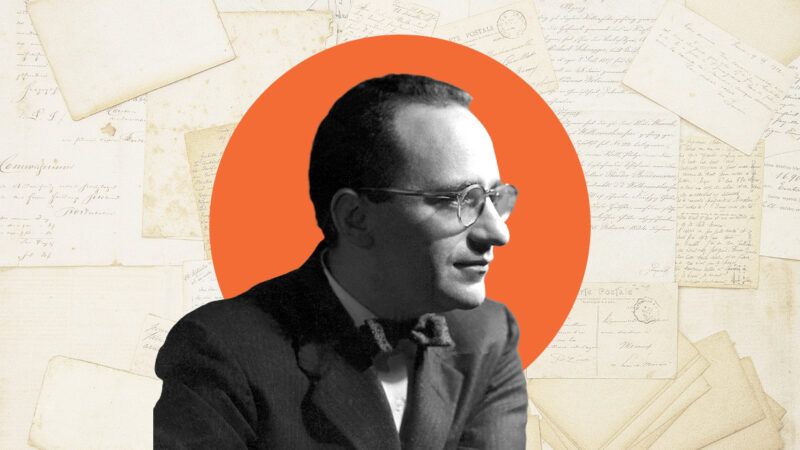
Today is the centennial of the birth of Murray Rothbard. While he was alive, Rothbard was the most significant direct influence both on a wide range of individual libertarian scholars and activists and on the major institutions that constituted the American libertarian movement in the second half of the 20th century. He was key to the functioning of the Volker Fund, the Institute for Humane Studies, the Libertarian Party, the Center for Libertarian Studies, the Cato Institute, and the Mises Institute.
Rothbard's intellectual goal was to forge a systematic approach to liberty, covering all the humane sciences—his particular specialties were economics, political philosophy, and history. He was a dedicated economics scholar and teacher, as well as a polemicist and movement builder. Most young libertarian writers and activists who arose from the 1950s through the '70s credit Rothbard as a key influence, both intellectual and personal. For a time in the 1960s, per movement lore, the American libertarian movement was both forged and contained in his New York City living room.
In the 1950s, Rothbard formed a student gang of libertarians, Circle Bastiat, and helped the libertarian philanthropic organization the Volker Fund vet books and intellectuals for their value to the libertarian cause. In the 1960s, he launched both a huge foundational economics text (Man, Economy, and State, 1962) and a highly personal zine (The Libertarian Forum) to cover libertarian movement thoughts and activities as they unfolded. (In that same decade, he tried to forge an alliance with the then-rising New Left through his short-lived journal Left and Right.) In the 1970s, he allied with the oil industrialist and philanthropist Koch family to help create an academic revival of the Austrian economics tradition he advocated, helping launch both an organization for scholarly meetings, papers, and journals (the Center for Libertarian Studies) and one focused more on of-the-moment policy analysis (the Cato Institute).
During that decade, he also published a detailed exposition of how market anarchism would work (For a New Liberty, 1973) for a major New York trade publisher, Macmillan. Still a foundational text, the book argues that an anarchist society based strictly in property rights could meet all the needs government now arrogates to itself, including such tough cases such as roads, defense, and justice.
By the end of the 1980s, however, Rothbard had withdrawn support and alliance from all aspects of the movement other than the Mises Institute, founded in 1982 and run by his friend Lew Rockwell. He joined Rockwell in promoting "paleolibertarianism"—a combination of libertarian political ideology with cultural conservatism. With the Cold War over and the right no longer obsessed with anti-communism, Rothbard thought it a propitious time to revive what he wrote about as "the Old Right"—the anti-war and anti-state conservative movement that preceded the Cold War. He supported the protectionist Republican presidential candidate Pat Buchanan in 1992 because of Buchanan's opposition to foreign interventionism.
In fact, the best way to make sense of Rothbard's seemingly erratic changes of political partnership is to see them as a search for the dominant antiwar political movement of any given moment. While the political ideas he advocated as the end goal remained largely the same, he whipsawed as to what he believed was the best realistic candidate or party to get closer to them at any given time. After Buchanan failed to win the GOP nomination in '92, Rothbard supported first Ross Perot, for his general "upset the two-party paradigm" spirit, and then ultimately George H.W. Bush, because he wasn't Bill Clinton.
Rothbard the paleolibertarian found in the work of one of his disciples, Hans-Hermann Hoppe, an excuse to turn from his previous core libertarian commitment to the free movement of people as well as goods and ideas. Very roughly, Hoppe insisted that the government ought to manage public property the way a private property manager would. He further argued that doing so with respect to the choices of the public would mean refusing outsiders access to the American commons. Hoppe's argument thus gave a fake libertarian veneer to nativism, and an excuse to harm people who had not harmed anyone else's person or property—the core action that libertarianism as a political philosophy is meant to be against. Rothbard himself, in his 1970 work Power and Market, clearly understood that, contra Hoppe, "caught in an insoluble contradiction are those believers in free markets who still uphold immigration barriers. They can do so only if they concede that the State is the owner of all property."
This move to supporting immigration restrictionism on allegedly libertarian terms has been key to a large part of his current influence, more than 30 years after his unexpected death in 1995. He is firmly established as the libertarian thinker most admired (at least after Hoppe himself) by a younger generation of right-wing-oriented people who like to call themselves libertarians. It is also the key to why he is considered a controversial and even unsavory influence. When thinkers outside the movement attempt to link it to the rise of Donald Trump and MAGA, they point to Rothbard, especially in those last few years of his career.
Rothbard as Mr. Libertarian
Rothbard did, for the bulk of his career, embody the intellectual concerns and approaches that most defined the modern American libertarian movement, especially as distinct from the conservatism of that period.
There were several major elements to this Rothbardianism. Central to his thinking was an anarchism rooted in an Aristotelian natural law ethic. To distinguish it from the left-wing anarchism that advocates eliminating private property along with the state, Rothbard's variety became known as "anarcho-capitalism." (If you run into people online using this term, there's a good chance they are devotees of Rothbard.) Rothbard promoted and extended the 19th century American anarchist tradition as exemplified by Lysander Spooner and Benjamin Tucker. Equally important to Rothbard was free-market economics in the Austrian/Misesian tradition. He blended this with historical scholarship that was dedicated to sniffing out the evils and errors of state action—and unafraid to explore the ulterior motives in ways that some read as "conspiracy theory" but which he preferred to call "power elite analysis."
Rothbard's Aristotelian natural rights arguments for libertarianism, based on the natural right of self-ownership and a Lockean theory of how people can acquire property by homesteading elements of the natural world, are similar to Ayn Rand's. Rothbard's political philosophy could be described as propertarian. All human rights, he thought, were ultimately property rights. (While this reads to many as an attitude that tenaciously defends the status quo, Rothbard was aware that many current land titles are based in past thefts and that justice often demanded taking away illegitimate "property rights" from current legal landowners.)
In his time, Rothbard was the guy writing definitive libertarian takes on economics (Man, Economy, and State; America's Great Depression), political philosophy (The Ethics of Liberty), and American history (Conceived in Liberty). He was friend or foil—and often both over the course of his contentious life—to pretty much every other libertarian thinker and activist in the second half of the 20th century. He was an (informal) student of Ludwig von Mises during Mises' days at New York University. When I interviewed Milton Friedman the year Rothbard died, I learned that Friedman continued to worry over Rothbard's critiques for decades, despite being a more famous and respected Nobel winner. Rothbard's critiques of Hayek's Constitution of Liberty were considered a subterranean scandal in the movement until published long after his death. Rothbard considered the canonical libertarian work positively "evil" both for arguing for anti-statism on strictly utilitarian grounds and for giving intellectual permission to far too wide a range of government actions.
Rothbard was, nearly everyone who dealt with him ratified, an unforgettable character to meet and deal with. I interviewed dozens of his associates when researching my 2007 book Radicals for Capitalism, though alas Rothbard himself passed away when the idea for the book was just barely forming. Ronald Hamowy, a classical liberal scholar who palled around with Rothbard from the Circle Bastiat days in the 1950s until his death, said "I'm more annoyed at the right's tack on social issues than I am the left. So it took effort to be a friend of Murray's. But I'll tell you after 40 years it was worth every effort I put in. Knowing him was the most rewarding experience of my life."
The recent death of one of Rothbard's former partners with whom he had a falling out—Ed Crane, co-founder of the Cato Institute—helps limn some of Rothbard's powers and peccadilloes as a movement figure. A Facebook post from libertarian movement organizer Mark Skousen noting Crane's death mentioned how shaken Crane was by news of his old partner Rothbard's death, even 15 years after Rothbard had broken with Crane harshly and publicly. Rothbard had that kind of charisma that's key to movement building—but, key to his falling out with Crane in the early 1980s, he also had a foundational love of outsiderism, of being the guy who would lock in to his core beliefs and follow them with relentless rationality to places even many who think of themselves as libertarians feared to tread.
This was a man whose property-based political and ethical thinking led him to think that libel and blackmail should not be actionable crimes. Rothbard also held that children should be able to emancipate themselves whenever they want just by leaving the parental home and fending for themselves—and that in the meantime parents are not obligated by justice even to feed them. Rothbard thought his former Cato allies were blunting the edges of pure libertarian-anarchist radicalism in the pursuit of respectability.
The Cato approach that Rothbard abjured obviously had plenty of real-world success, and helped make for a policy and political world more understanding of, and in some cases accepting of, libertarianism. But that doesn't mean Rothbard's more radical and less collegial approach was wrong. A successful movement for ideological change has to cover a wide range of approaches to help change a world in which the audience it is trying to sway has a wide range of different temperaments and mentalities.
Rothbard's combination of intellectual consistency and courage, and his general tone—often mean and funny, almost always colloquial—made him a powerfully attractive thinker to young people. Especially in late 20th century America, many began to think that maybe there was something just not right about running human society via an institution that operates by such vast amounts of murder, theft, and control over others' bodies and behavior. It might appeal to those young people to see such a system attacked, even hated, with incisive explanations as to why it was wrong and unnecessary via economics and philosophy.
The Ron Paul movement's particular brand of libertarianism was closest in spirit to Rothbard than to any other libertarian luminary. Indeed, Rothbard and Paul had been mutual fans. The Paul phenomenon, the largest U.S. movement of this generation to be driven by distinctly libertarian ideas about money, war, and the role of government, was distinctly Rothbardian in its concerns and style—the mass anti-war, anti-state, anti–Federal Reserve agitation that Rothbard dreamed about his entire adult life.
And now a major nation is run by an avowed Rothbardian: Javier Milei of Argentina, who has swung at socialists and statists with a very Rothbardian style of utterly contemptuous invective. Milei has had to make the sort of concessions to political reality that Rothbard in most cases would have understood—he was aware that progress toward a libertarian paradise had to make intelligent strategic decisions shaped by the world as it is—he has also made some impressive progress toward bettering Argentina's circumstances by shrinking many aspects of the Argentine state.
In 1956, Rothbard wrote to a friend an interesting summation of the movement he was trying to create: "What, then, are we? We are first of all radicals—because (a) we go to the root of things, we construct fundamental principle, and follow truth wherever it leads; and (b) we therefore advocate fundamental change from our present political structure. And we are libertarians because we believe in individual liberty. I used to think that we were 'true liberals', but I have recently come to the conclusion that it is better not to be identified with the old liberals of the 19th century. Despite their merits, they were (a) great advocates of democracy and majority rule, and (b) adherents of the public school system, and (c) anti-clerical to the extent of banishing Jesuits, etc. Best to start afresh with the 'libertarian' appellation, which, for once, we have seized from the leftists instead of vice versa."
Rothbard was equally scabrous against the American right in his letters of that period, especially its obsession with militant international anti-communism. "The Right-wing masses care little and know nothing about liberty or economics," he wrote to a fellow libertarian organizer in 1954. "They are 'for' Christ and the Constitution, and they are against foreigners, Communists, atheists, and Jews." And "I am getting more and more convinced," he wrote another libertarian associate in 1959, "that the war-peace question is the key to the whole libertarian business, and that we will never get anywhere in this great intellectual counter-revolution (or revolution) unless we can end this Verdamte cold war—a war for which I believe our 'tough' policy is largely responsible." He cheekily told a different friend "I realize that this is heresy for a professional economist to say, but I think the issue of peace vs. nuclear annihilation of the world is considerable more important than whether we have a 2% or 4% per annum rise in prices, or whether taxes on the upper income brackets are raised or lowered by 2%."
It is irresistible—especially for those who dislike libertarianism to begin with—to connect Rothbard to the evils of MAGA and neoreaction on the American right, especially because his firm belief that no mere attitude was so vile that it deserved state punishment can make his paradigm attractive to bigots. Rothbard himself publicly framed his views as anti-racist in the 1960s, but did not have trouble adopting the opposite rhetoric in his paleolibertarian period. In one of the few times he wrote publicly about racial differences, in the context of the controversy over Charles Murray and Richard Herrnstein's 1994 book The Bell Curve, he praised their book for highlighting "the almost self-evident fact that individuals, ethnic groups, and races differ among themselves in intelligence and in many other traits, and that intelligence, as well as less controversial traits of temperament, are in large part hereditary." While noting he wanted everyone of every race or capacity to be equally free of state depredations, he suggested that a belief in such intelligence differences did have a role in the defense of a fully free market society, since it would help blunt arguments by "those ethnic and other groups who might be concentrated in lower-income or less prestigious occupations…that free-market capitalism is evil and 'discriminatory' and that therefore collectivism is needed to redress the balance."
Critics who focus on such ideas, barely touched on in his vast body of work, miss the true meaning of the phenomenon of Rothbard as a political theorist and activist. The vast majority of Rothbard's writing and advocacy was about realizing a human society bound by the unavoidable logic of free markets to maximize how human beings can best serve each other through the free exchange of private property, free from violent interference against the peaceful. It's a vision that's highly noble and highly energizing, and it will continue to influence generations of libertarians to help make the world a richer, freer, and more just place.




