
Iran's Supreme Leader, Ayatollah Ali Khamenei, Is Reported Dead
Khamenei's rule was marked by a combination of cruelty and incompetence. His death may have unfolded much the same way.
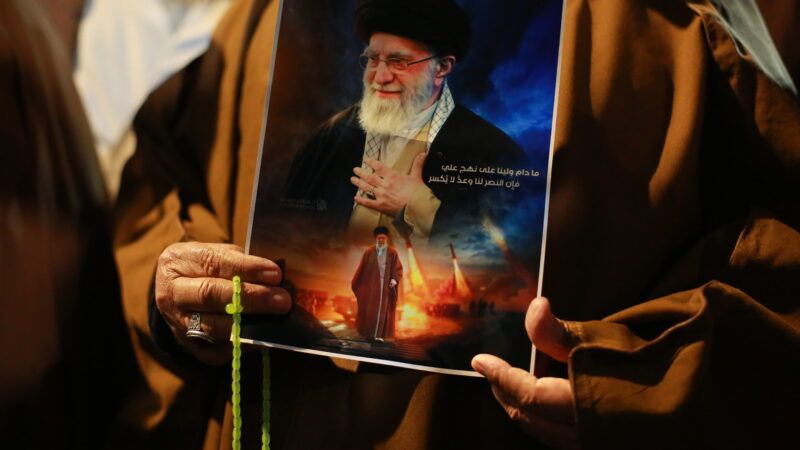
Iranian Ayatollah Ali Khamenei was killed in his palace at the beginning of the U.S.-Israeli war in Iran on Saturday morning, ending 37 years as Iran's Supreme Leader, U.S. President Donald Trump claimed on Saturday afternoon. Khamenei's reported death was a culmination of his governing style: stubborn enough to make enemies, but too passive and weak to overcome them. Even as a U.S. armada loomed off the coast of Iran, the autocrat remained a sitting duck in his palace.
Iranian state media is so far denying the report, claiming instead that Khamenei is still "steadfast and firm in commanding the field."
Though Khamenei is often mistaken for his predecessor, Ruhollah Khomeini, the two are nothing alike. Khomeini was a revolutionary with an air of mystique who built a state from the ground up; Khamenei was a doddering bureaucrat who inherited that state and ran it back into the ground.
The past few years of Khamenei's reign were marked with escalating waves of unrest and repression, each one more deadly and frequent than the last. From the crackdown on student reformists in 1999, which killed three people, to the uprising and massacres this year, which killed hundreds, Khamenei gradually muscled out his rivals within the Islamic Republic and pushed Iranians to hate that republic. In between each explosion, corruption and nepotism built up within the system. Khamenei focused immense resources into unpopular culture war bugbears, such as mandatory hijab, while neglecting the country's basic resources.
Meanwhile, the sharks circled from the outside. Khamenei was just scary enough for hawks in the United States to present as an enemy, yet just predictable enough that they could manage the consequences of escalation. He carried out a uranium enrichment program, then insisted that actually building a nuclear bomb would go against his religion. Khamenei raised an army of anti-Israel militias across the Middle East at great cost in blood and treasure, then watched Israel pick them off one-by-one over the past three years.
After all, Khamenei's own path to power was paved by the same combination of cruelty and incompetence. Khomeini's successor was originally supposed to be Ayatollah Hussein-Ali Montazeri. In 1988, however, left-wing Iranian rebels joined forces with an invading Iraqi army, and the Islamic Republic responded with mass executions of leftist dissidents. When Montazeri protested the killings, Khomeini dismissed him as successor. After Khomeini's death, the succession council elevated Khamenei, a yes-man who himself admitted that he was not qualified.
But the system that Khamenei shaped does not necessarily die with him—at least, not in the way that his assassins might have hoped. If Trump was looking for a cost-free Venezuela-style decapitation, Iran did not provide it. Even as Khamenei's palace lay in ruins and the leader incommunicado, the Iranian military immediately fired back at U.S. forces and partners across the Middle East, and began attempting to blockade oil shipping. The fighting is intense and ongoing.
It remains to be seen who would become the new public face of the system. Before the war, the CIA assessed that Khamenei would be succeeded by a hardline military dictator. An even bigger question is whether Iranians will heed Trump's call to overthrow the Islamic Republic. History has very few good precedents for regime change under wartime conditions. But one thing seems certain: Khamenei will not be around to see the final, bloody consequences of his rule.
