

Trump's New Tariffs Are Probably Illegal Too
Attorneys for the Trump administration even admitted that Section 122 can't be applied to address trade deficits. Trump is now trying to do that anyway.
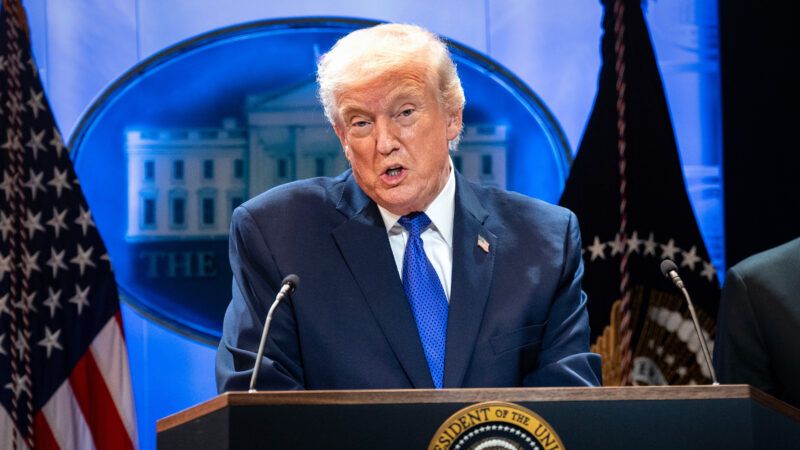
Hours after the Supreme Court struck down the tariffs that President Donald Trump had imposed by invoking emergency executive powers, Trump signed a new order imposing another set of tariffs under a different law.
Just one problem: These new tariffs are likely unlawful too.
Indeed, Trump's own attorneys even admitted as much during the legal battle over the original tariffs.
OK, let's back up. The tariffs struck down by the Supreme Court on Friday had been imposed under the International Emergency Economic Powers Act (IEEPA). That effort ran into two problems. First, the law does not actually allow the president to use tariffs in response to an emergency—and the court did not buy the Trump administration's argument that the power to "regulate" included the power to tariff. Second, the tariffs ran up against the major questions doctrine, which effectively says that economically significant policies must be approved by Congress. Trump's IEEPA tariffs were not.
The new tariffs that Trump ordered on Friday afternoon seem to have similar statutory and constitutional problems.
In this case, Trump is leaning on Section 122 of the Trade Act of 1974, which the White House claims "empowers the President to address certain fundamental international payment problems through surcharges and other special import restrictions."
Except that's not quite what the law says.
Section 122 allows presidents to impose tariffs of up to 15 percent for up to 150 days to "deal with large and serious United States balance-of-payments deficits."
What's that? The Trump administration wants to pretend—or perhaps wrongly believes—that it's the same thing as a trade deficit. It's not.
A balance-of-payments deficit is an archaic problem that existed before the introduction of floating exchange rates for foreign currencies. Changes made to the international monetary system in the 1970s—changes that Milton Friedman advocated, it's worth noting—eliminated the circumstances that could lead to a balance-of-payments deficit.
"The United States does not have an international payments problem, fundamental or otherwise, and has not had one since we adopted a floating exchange rate more than five decades ago," explains Bryan Riley, director of the Free Trade Initiative at the National Taxpayers Union. "Therefore, Section 122 does not give President Trump the legal authority to impose tariffs."
Just like with the IEEPA tariffs, Trump's use of Section 122 ignores the plain language of the law and invokes a broad executive power where Congress clearly provided a narrow one.
"There is no rationale under Section 122 to impose tariffs," writes Andrew McCarthy, a longtime legal analyst for National Review. "Because President Trump has no unilateral authority to order tariffs, he must meet the preconditions of Section 122 to justify levying them. He cannot. Not even close."
But don't take my word for it, or Reily's, or McCarthy's. Look at what Trump's own attorneys said during the IEEPA case.
While that lawsuit was in front of the U.S. Court of Appeals for the Federal Circuit, lawyers challenging the tariffs suggested that Trump would be on firmer ground by using other laws, including Section 122.
That wouldn't work, the administration's lawyers responded, because balance-of-payment deficits are "conceptually distinct" from the trade deficits that Trump is trying to address.
Exactly.
Beyond the clear statutory issues with imposing these tariffs under Section 122, there's also the lingering major questions problem. Justice Neil Gorsuch put it quite directly in his concurring opinion in the tariff case: "The Constitution lodges the Nation's lawmaking powers in Congress alone, and the major questions doctrine safeguards that assignment against executive encroachment."
What Trump is trying to do with Section 122 seems to go well beyond "executive encroachment." He is interpreting the law to give him powers that clearly do not exist and that Congress did not provide.
Of course, there is a difference between an executive action being obviously illegal and the president being prevented from doing it. Stopping Trump's Section 122 tariffs would require action from Congress—yes, it's OK to laugh—or another legal challenge, which will likely take months to put together and to advance through various courts. Remember, a federal court ruled against Trump's IEEPA tariffs in May, but it took nine more months for the Supreme Court to confirm that decision.
Despite Friday's Supreme Court ruling, the reality of American tariff policy hasn't changed much. Many imports will continue to be subject to higher taxes that have been imposed under questionable legal means by a president who is unwilling to recognize the limits on his powers.




