
The Olympics Will Never Achieve World Peace If It Keeps Clamping Down on Free Speech
Plus: Olympic hockey almost didn’t happen, how to pad the medal count, and a reader survey on fixing the Olympics
Hello and welcome to another edition of Free Agent! Do whatever it takes to get across the finish line today, even if you've got to do it backward.
We've got a jam-packed newsletter today full of Olympics content for you. From free speech issues to construction issues and some thoughts on the medal count, there's plenty to enjoy. At the end, you'll find a reader survey where you can sound off on your ideas for changing the Olympics.
Don't miss sports coverage from Jason Russell and Reason.
Locker Room Links
- The head of the Major League Baseball Players Association is resigning, adding more drama to the labor negotiations and potential lockout after this season.
- News you can use: Sports Illustrated's Mitch Goldich has been posting a very useful schedule of Olympic events every day.
- Eileen Gu grew up in California and studies at Stanford. Beverly Zhu was born in America to immigrants. Both compete for China, not the U.S.—probably because the Chinese government paid them a combined $6.6 million, according to The Wall Street Journal.
- The two cities with the most Olympic viewers are Ft. Myers, Florida, and curling hotbed Minneapolis. (Could those two cities be any more different?)
- The International Olympic Committee (IOC) was heavily criticized for selling a T-shirt commemorating the 1936 Berlin Olympics (you know, the one with Hitler), which has now sold out. They're selling shirts for a wide variety, but not all, of past Olympiads.
- Surprising, but true: Until Saturday, no one representing a South American country had ever won any kind of medal at the Winter Olympics.
- Remember my coverage of the Trump administration's takeover of a few Washington, D.C., golf courses? A new lawsuit is hoping to stop that.
- Elsewhere in Reason: "How Much Is Kristi Noem's Alleged Adultery Airplane Costing You?"
- The evidence is clear:
Chloe Kim:
2018: Gold Medal
2022: Gold Medal
2025: Starts dating a Cleveland Brown
2026: Silver Medal— Danny Neckel (@DNeckel19) February 13, 2026
Peace Through Speech
Some of the most famous moments in Olympic history, the ones that make the games so special, have been acts of expression: a legendary line in the final moments of an upset, an unstoppable release of emotion, or a silent act of free speech.
Naturally, the IOC wants to tamp down on those expressions.
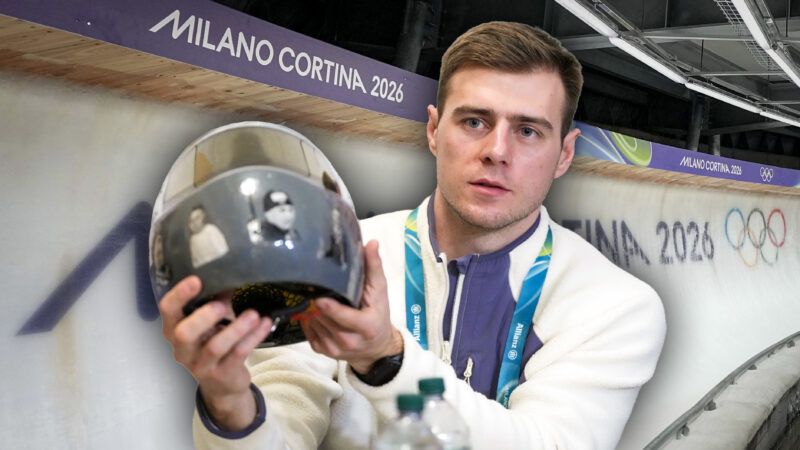
Last week, Ukrainian Vladylsav Heraskevych was banned from competing in skeleton (similar to luge and bobsledding) because he was going to wear a helmet with images of Ukrainian athletes killed in Russia's war against Ukraine.
The IOC's statement on the ban included some gibberish: "Mourning is not expressed and perceived in the same way everywhere in the world….the IOC has put in place multifaith centres in the Olympic Villages and a place of mourning….There is also the possibility to wear a black armband during competition under certain circumstances." It added a valid point, that athletes can still express their views "in the media mixed zones, on social media, during press conferences and in interviews." The IOC's Guidelines on Athlete Expression had input from thousands of athletes, and their strict rules for jersey imagery are well known.
Even with all that, banning Heraskevych is still a bunch of hogwash.
The whole point of the Olympics, so they say, is bigger than sports: It's world peace. "The goal of the Olympic Movement is to contribute to building a peaceful and better world…through sport," the IOC says on its website. Likewise, part of its mission is "to place sport at the service of humanity and thereby to promote peace."
Trying to achieve all that by clamping down on free speech is awfully authoritarian. In a dispute, more speech (and listening) leads to more understanding. That may not always lead to agreement, but it's still progress. Especially in the Olympic context, athletes need to learn to respect the abilities and sportsmanship of their competitors, even when they disagree with their politics.
This is not to say that athletes should or shouldn't make political statements at the Olympics. The IOC, of course, is a private organization and can set its own rules. But allowing for more free expression will only help the Olympics further its lofty aims.
Not in My Ice Rink
The return of NHL players to the Olympics has been a joy to watch. It almost didn't happen—not just because the NHL finally relented after keeping its players away from the 2018 and 2022 games. Even a month or two ago, there were major concerns about whether the hockey arena would be built in time, and whether its ice would be safe.
Yes, even with seven years of notice, the hockey arena almost wasn't finished in time. In 2022, a "not in my backyard" (NIMBY) lawsuit delayed the start of construction by a year.
In this case, the NIMBYs were nuns (a notably powerful interest group in Italy).
"Construction of the Santagiulia Ice Hockey Arena was supposed to begin in 2022, but a lawsuit filed by an order of Roman-Catholic nuns delayed the project by roughly a year," Jeff Eisenberg wrote for Yahoo Sports. "The nuns unsuccessfully argued that construction would encroach on their property and violate noise ordinances."
Of course, these weren't the only issues. The rink is three feet shorter than an NHL rink (which is surprising, if you've noticed the large gap between the boards and the seats). The project is also way over budget—as a libertarian, I wish I could blame this on the government, but it was actually a private German company that was in charge of construction.
Thankfully, none of these problems seems to have affected the actual hockey games. Let's hope the preparations for 2030 go more smoothly.
If you think the Milan Cortina 2026 hockey arenas have had issues… this is the plan for French Alps 2030.
Two rinks, width wise on the soccer pitch at at Stade De Nice with 17,000 seats each.
Going to be quite the test. pic.twitter.com/OIgMttJFH0
— Ben Steiner (@BenSteiner00) February 4, 2026
Padding the Medal Count
Readers who made it to the end of last week's newsletter noticed my amazement that biathlon, a niche sport that requires skill in both cross-country skiing and rifle shooting, gets to award 11 gold medals in various events at these Olympics, almost a tenth of the total. Freestyle skiing is awarding 15 gold medals. So if your country is good at one of these sports (France has four biathlon gold medals so far, plus three silver and two bronze), it's easy to rack up medals and work your way up the medal table.
But if your country is good at ice hockey, there are only two medals up for grabs there.
The same dynamic is at play in the Summer Olympics. With 36 sports awarding 351 gold medals, each sport gives out an average of 9.75 gold medals. There are 41 gold medals in swimming, but just four in basketball, three in golf, and two each in cricket, handball, surfing, and squash (as random examples).
There's no ideal solution here. We shouldn't expect every sport to have the same number of events. Swimming need not cut its lengthy event list down just because other sports can't get to 41 events. But it would be fun and interesting to see other sports expand with other versions of their sports.
We have five-on-five hockey, let's add three-on-three too (there's already a professional league for this, and its first world cup is coming this summer). Add a shootout competition as well, and between the men's and women's sides you now have six hockey events instead of two. Basketball was allowed to do this with the addition of 3x3 basketball. Next they should add some kind of shooting accuracy competition too—and maybe a dunk competition.
Time To Go for Gold
In the spirit of that last section, let's fix the Olympics together. We've got a very quick two-question survey for readers this week. The first question is open-ended: What ideas do you have for improving the Olympics? Ideas for the summer or winter games are fine. Then I'm curious if you look at the medal table and care more about each country's gold medals or total medals.
Let me know what you think. Maybe you have ideas for more sports or more formats. Maybe they should skip the hosting rigmarole and just have the games in the same permanent facilities every four years. Or maybe you've got a great idea for who should light the Olympic torch in Los Angeles in 2028. And if you can figure out how to fix the judging in figure skating once and for all, please do the world a favor and let us know what to do.
Whatever is on your mind, sound off in the survey and we'll discuss next week, after the games have wrapped up. Feel free to come back and answer again if you have a great idea later on.
Replay of the Week
The last lap of the Daytona 500 always delivers. It's one of the few times that if cars start crashing everywhere, the people in charge just say "Keep racing!" This year, there were two big crashes in the span of 2.5 miles, with the last one happening just as the final pass for the win occurred. (Congratulations, Michael Jordan!)
That's all for this week. Enjoy watching the real event of the week, the four-man bobsled competition on Saturday and Sunday (or feel free to watch Cool Runnings on Hulu).
