
American Presidents Shouldn't Endorse Foreign Political Candidates
Trump's endorsements of Viktor Orbán and Sanae Takaichi, like Clinton's support for Boris Yeltsin or Obama's opposition to Benjamin Netanyahu, do not make America great.
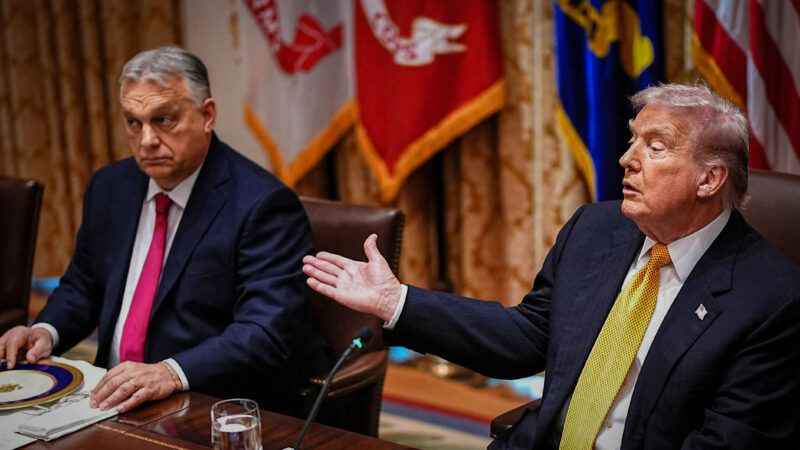
President Donald Trump on Thursday did what few American presidents have ever done—issue explicit electoral endorsements to foreign candidates for the highest political office in electoral democracies.
"[Japanese] Prime Minister [Sanae] Takaichi is someone who deserves powerful recognition for the job she and her Coalition are doing and, therefore, as President of the United States of America, it is my Honor to give a Complete and Total Endorsement of her, and what her highly respected Coalition is representing," the president Truth-Socialed Thursday afternoon, ahead of Japan's snap elections this weekend.
Minutes later, Trump reiterated the favor for longtime Hungarian Prime Minister (and role model for America's illiberal-conservative movement) Viktor Orbán, who faces a more uphill struggle in his country's April elections. Orbán, the president stated, is
a truly strong and powerful Leader, with a proven track record of delivering phenomenal results. He fights tirelessly for, and loves, his Great Country and People, just like I do for the United States of America. Viktor works hard to Protect Hungary, Grow the Economy, Create Jobs, Promote Trade, Stop Illegal Immigration, and Ensure LAW AND ORDER! Relations between Hungary and the United States have reached new heights of cooperation and spectacular achievement under my Administration, thanks largely to Prime Minister Orbán. I look forward to continuing working closely with him so that both of our Countries can further advance this tremendous path to SUCCESS and cooperation. I was proud to ENDORSE Viktor for Re-Election in 2022, and am honored to do so again. Viktor Orbán is a true friend, fighter, and WINNER, and has my Complete and Total Endorsement for Re-Election as Prime Minister of Hungary — HE WILL NEVER LET THE GREAT PEOPLE OF HUNGARY DOWN!
Trump has additionally, during his convention-bending second presidency, endorsed Argentinian President Javier Milei and Honduran President Nasry Asfura.
American presidents have traditionally eschewed outright endorsements in non-authoritarian electoral contests for a handful of sensible reasons, beginning with the fact that bilateral relations will be materially soured, and/or produce a reciprocally partisan response, if the other candidate happens to win.
Barack Obama accelerated Israeli Prime Minister Benjamin Netanyahu's upfront and controversial alignment with the Republican Party by having his State Department give an allegedly peace-process-supporting $350,000 grant to an organization that spent some of it on an "anyone but Bibi" political campaign. "It is completely unacceptable that U.S. taxpayer dollars were used to build a political campaign infrastructure that was deployed …against the leader of our closest ally in the Middle East," Sen. Rob Portman (R–Ohio) said after a withering bipartisan report on the matter in 2016.
Putting the world's largest thumbs on the scales of smaller and weaker countries can also contribute to the eventual downfall of endorsees who win, as it arguably did to Boris Yeltsin after Bill Clinton's extensive meddling in 1996.
As that example illustrates, U.S. presidents have both fallible judgment and extensively tempting power at their fingertips. Clinton knew Yeltsin was a corrupt drunk, but plausibly feared a Communist resurgence so much that he reckoned a little timely pressure on the International Monetary Fund was worth it, especially if he could buy the Russians' effective silence on NATO expansion. By the time Yeltsin wobbled out of office, his handpicked successor, then–little known KGB veteran Vladimir Putin, was gifted a wide, popular lane of cracking down on oligarchical excess and his predecessor's diplomatic squandering of Russia's Near Abroad.
It was during the Clinton years that I first developed an allergy to even implicit White House preferences in faraway elections. Ironically, it was due to Washington's antipathy toward a politician who very much resembles both Donald Trump and the 21st century version of Viktor Orbán: Slovakia's Vladimír Mečiar.
Mečiar, a crude and often funny brute fond of suing journalists and spinning conspiracy theories, was routinely and hyperbolically misportrayed in the international media as someone eager to lead Slovakia back into the depths of communism. (He in fact had been punished for anti–Communist Party activities in the late 1960s.) Everybody knew who Clinton and the various governmental and quasi-governmental bodies—the International Republican Institute, the National Democratic Institute, various regional "enterprise funds," and so forth—preferred to see win.
Turns out that—who knew!—nationalist populists can make great political hay out of disdain from foreign elites. As ever, governmental interventions can produce consequences opposite their purported intent.
These are not the only reasons to oppose presidential endorsement of foreigners. Personalizing electoral contests self-evidently gives endorsers a personal stake in the outcomes, generating interests that can conflict with what's best for the country. Trump pardoned Asfura's party mate and predecessor, the convicted cocaine trafficker Juan Orlando Hernández, just days before the Honduran election, despite concurrently ordering the murder of suspected drug runners in the Gulf of Mexico. He goosed Milei's pre-election prospects with a highly unusual currency swap and peso purchase. Japan's Takaichi, whether to secure her own endorsement or a reduced tariff hike, endorsed Trump for the Nobel Peace Prize and gifted him some golf swag.
Americans tend to recoil at foreign countries expressing or acting upon interest in our elections. Long before (Democratic-pushed) Russiagate, there was (Republican-pushed) Chinagate and myriad forgotten scandals such as John Kerry boasting of (and then retreating from) international support in 2004. ("It is simply not appropriate for any foreign leader to endorse a candidate in America's presidential election," Kerry adviser Rand Beers said, trying to put that one to bed.) Trump doling out endorsements is guaranteed to produce more foreign-leader endorsements of American candidates.
The world-weary shruggers among us, including not a few intervention-skeptics, may retort that the United States has meddled quite a bit further in foreign elections than mere endorsement or financial lever-pull. To which one might reply, exactly. Especially, though not only, with the Cold War (and all of the compromises thereof) in our rearview mirror, I do not seek to return to promiscuous American involvement in overseas electoral politics, because that way eventually lies armed conflict and the smothering of smaller-country self-responsibility.
Donald Trump and his successors have history's largest and most lethal military, a vast deep-state spying and skullduggery apparatus utterly unaccountable to the people paying for it, and (for the time being) a National Security Strategy that seeks to halt the "civilizational erasure" of our closest allies by encouraging "patriotic European parties" and cultivating "resistance to Europe's current trajectory within European nations." Adding explicit political endorsements to this unhealthy mix is a recipe for wholly avoidable tragedy.
