
Trump Says States Are Required To Enforce Federal Immigration Laws. He's Wrong.
"The Framers...designed a system in which the State and Federal Governments would exercise concurrent authority over the people," wrote Justice Antonin Scalia.
Federal immigration enforcement officers have flooded into Minneapolis, bringing mass chaos and the deaths of two bystanders. At issue is Minneapolis' status as a "sanctuary city," which means officials broadly will not cooperate with federal efforts to find, detain, or deport undocumented immigrants.
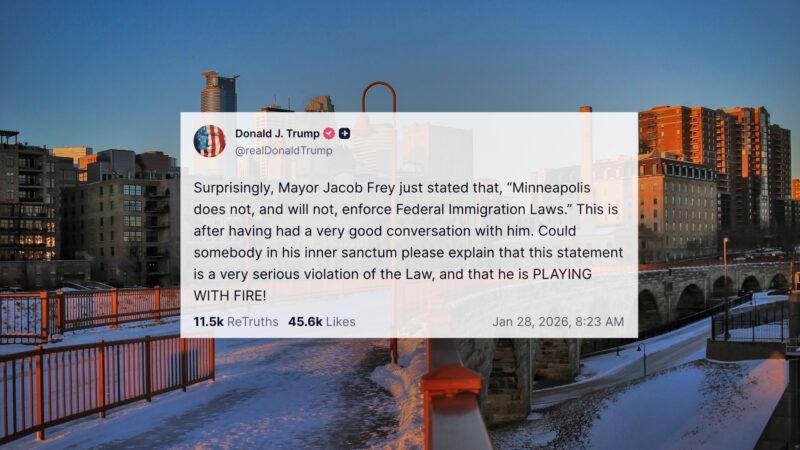
"Surprisingly, Mayor Jacob Frey just stated that, 'Minneapolis does not, and will not, enforce Federal Immigration Laws,'" President Donald Trump posted Wednesday morning on Truth Social. "Could somebody in his inner sanctum please explain that this statement is a very serious violation of the Law, and that he is PLAYING WITH FIRE!"
Though he added his own signature capitalization, Trump did accurately characterize Frey's position. "Minneapolis does not and will not enforce federal immigration laws," the mayor wrote on X. "We will remain focused on keeping our neighbors and streets safe." In response to Trump's threat, Frey added in a later post, "The job of our police is to keep people safe, not enforce fed immigration laws."
Obviously, Trump's threat that Frey is "playing with fire" is completely inappropriate—as are his administration's apparent attempts to criminally prosecute Frey and Minnesota Gov. Tim Walz. But Trump is also wrong on the law: Cities and states are not, in fact, obligated to participate in federal law enforcement operations, and there's good reason for that.
"Judicial decisions across the Trump and Biden administrations have consistently affirmed that immigration enforcement is a federal responsibility—but one that cannot be delegated by force," Bertina Kudrin, Megan Thomas, and Niharika Vattikonda wrote last year in Lawfare. "At the core of this issue is the anti-commandeering doctrine, a principle established by the Supreme Court that prohibits the federal government from compelling states to administer federal programs."
Two U.S. Supreme Court decisions, New York v. United States (1992) and Printz v. United States (1997), similarly established that states generally cannot be forced to carry out federal laws or regulations.
Many on Trump's side likely feel Frey and Walz should be forced to comply with all federal immigration officers' demands. It's always worth imagining a government's power in the hands of one's opponent.
Consider the Printz decision, wherein the Supreme Court struck down provisions of the Brady Handgun Violence Prevention Act requiring states to conduct background checks on anybody trying to purchase a handgun.
Many gun rights groups that historically supported Trump have criticized him in recent days, after he and members of his administration justified the killing of Alex Pretti by immigration officers simply because Pretti had a legally registered handgun in his possession.
One can imagine those same groups wouldn't like it if the federal government imposed mandatory background checks across the country, but under Trump's view of federal law, it would have that right.
"The Framers rejected the concept of a central government that would act upon and through the States, and instead designed a system in which the State and Federal Governments would exercise concurrent authority over the people," Justice Antonin Scalia wrote for the majority in the Printz decision. He quoted from Justice Anthony Kennedy in an earlier case, saying that under the American system as the Founders designed it, "our citizens would have two political capacities, one state and one federal, each protected from incursion by the other."
Walz and Frey have refused to cooperate with federal immigration officials operating in their respective jurisdictions. One can disagree with the decision, but the fact remains, they have the legal right to make it.
